



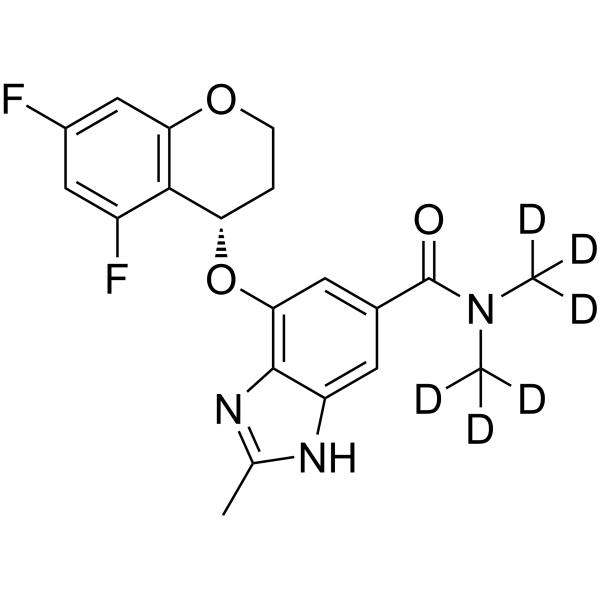
Tegoprazan-d6
Based on 1 publication(s) in Google Scholar
Tegoprazan (CJ-12420; RQ-00000004), a potassium-competitive acid blocker, is a reversible, oral active and highly selective inhibitor of gastric H+/K+-ATPase that could control gastric acid secretion and motility, with IC50 values ranging from 0.29-0.52 μM for porcine, canine, and human H+/K+-ATPases in vitro. Tegoprazan significantly improves colitis in mice and enhances the intestinal epithelial barrier function. Tegoprazan is promising for research of Inflammatory bowel, gastric acid-related, motilityimpaired diseases.
For research use only. We do not sell to patients.
- Formula: C20H13D6F2N3O3
- Molecular Weight:393.42
-
Storage:
Please store the product under the recommended conditions in the Certificate of Analysis.

To place orders, for customer services and technical support, please contact: MedChemExpress USA
Tel: 609-228-6898 E-mail: [email protected] [email protected]


-
 Biological Activity
-
Chemical Information
- Protocols
- Purity & Documentation
- References
-
 Help & FAQs


Publications Citing Use of MedChemExpress (MCE) Tegoprazan-d6
More

Biological Activity
Description
In Vitro
Tegoprazan (1.0 mM and 3.0 mM, 4 h) reduces DSS-induced colitis by maintaining high junction integrity of the epithelial mucosa in Caco-2 cells[1].
MedChemExpress (MCE) has not independently confirmed the accuracy of these methods. They are for reference only.
-
Cell Line:Caco-2 cells
-
Concentration:1.0 mM and 3.0 mM
-
Incubation Time:4 h
-
Result:Protected the intestinal epithelial tight junction barrier and inhibits the increase in intestinal permeability.
In Vivo
MedChemExpress (MCE) has not independently confirmed the accuracy of these methods. They are for reference only.
-
Animal Model:Pylorus-Ligated Rats[2]
-
Dosage:3 mg/kg and 10 mg/kg
-
Administration:p.o., a single dose
-
Result:Inhibited basal gastric acid secretion in a dose-dependent manner and was effective at a single dose in Pylorus-Ligated rats.
-
Animal Model:Naproxen-induced acute gastric ulcer rat model[2]
-
Dosage:0.1, 1 and 10 mg/kg
-
Administration:p.o., a single day or daily for 5 days
-
Result:Exerted an antiulcer effect in a dose-dependent manner and was effective at a single dose in naproxen-induced acute gastric ulcer rat model.
-
Animal Model:DNBS and Tegoprazan-induced rats[2]
-
Dosage:30 mg/kg
-
Administration:p.o., twice daily for 5 days
-
Result:Reduced mRNA expression levels of proinflammatory cytokines, especially interleukin-17 (IL17) in DNBS and Tegoprazan-induced rats.
Application
1. This compound can be used as a tracer
2. This compound can be used as an internal standard for quantitative analysis by NMR, GC-MS, or LC-MS.


Chemical Information
-
Unlabeled CAS 942195-55-3
-
Molecular Weight 393.42
-
Formula C20H13D6F2N3O3
-
SMILES
CC1=NC2=C(C=C(C=C2N1)C(N(C([2H])([2H])[2H])C([2H])([2H])[2H])=O)O[C@H]3CCOC4=C3C(F)=CC(F)=C4
-
Synonyms
CJ-12420-d6; RQ-00000004-d6
-
Shipping
Room temperature in continental US; may vary elsewhere.
-
Storage
Please store the product under the recommended conditions in the Certificate of Analysis.


Publications (1)
-
Journal Impact Factor
-
Most Recent


Purity & Documentation
References

Calculators
Concentration (start) × Volume (start) = Concentration (final) × Volume (final)


Tegoprazan-d6 Related Classifications
HY-17623S Related Classifications
 Powered by Bioz