



チオグリコール酸ナトリウム
Based on 1 publication(s) in Google Scholar
Thioglycolate sodium is used in inflammation research to elicit a neutrophil and macrophage response in vivo. Thioglycolate sodium can induce peritonitis in vivo.
商品は「研究用試薬」です。人や動物の医療用・臨床診断用・食品用の製品ではありません。
研究用途以外に使用した場合、当社は一切の責任を負いかねます。
- Assay : 99.7%
- CAS 番号: 367-51-1
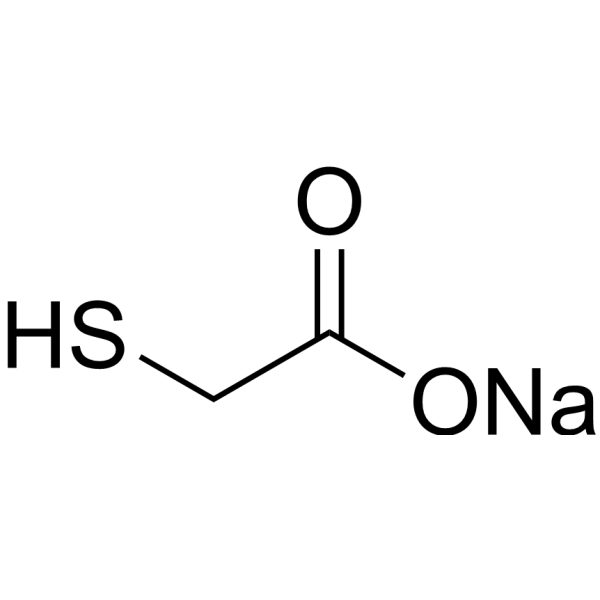
- 分子式: C2H3NaO2S
- 分子量:114.10
-
保管条件:
4°C, protect from light, stored under nitrogen
* In solvent : -80°C, 6 months; -20°C, 1 month (protect from light, stored under nitrogen)

To place orders, for customer services and technical support, please contact: MedChemExpress USA
Tel: 609-228-6898 E-mail: [email protected] [email protected]


-
 生物活性
生物活性
-
化学情報
-
溶剤 & 溶解度
- プロトコル
- 純度とドキュメンテーション
- 参考文献
-
 Help & FAQs




MedChemExpress(MCE)の使用を引用している文献 Thioglycolate sodium
More

生物活性
製品説明
Induced Disease Models
Please do not refer to only one article to determine the experimental conditions. It is recommended to determine the optimal experimental conditions (animal strain, age, dosage, frequency and cycle, detection time and indicators, etc.) through preliminary experiments before the formal experiment.
Induction of Peritonitis Models[1][2].
Administration: 3 mL of a sterile 3% (wt/vol) Thioglycolate sodium solution • injection
(2) Drug delivery groups: (a) No use of Carbon tetrachloride; (b) Starting at 4 weeks old, a total of 4 times; (c) Starting at 26 weeks old, a total of 4 times; (d) Starting at 4 weeks old, a total of 8 times; (e) Starting at 18 weeks old, a total of 8 times.
(3) All the mice were euthanized at 36 weeks of age. The liver lesions were examined visually and fixed in a 4% formaldehyde solution, then embedded in paraffin for histopathological examination.
MedChemExpress (MCE) has not independently confirmed the accuracy of these methods. They are for reference only.


化学情報
-
CAS 番号 367-51-1
-
性状 Solid
-
分子量 114.10
-
分子式 C2H3NaO2S
-
Color White to light brown
-
SMILES
O=C(O[Na])CS
-
別名
Thioglycolate sodium; Sodium thioglycolate
-
輸送条件
Room temperature in continental US; may vary elsewhere.
-
保管条件
4°C, protect from light, stored under nitrogen
* In solvent : -80°C, 6 months; -20°C, 1 month (protect from light, stored under nitrogen)


Publications (1)
-
Journal Impact Factor
-
Most Recent
-
J Immunother Cancer
CXCL16-driven CD4+ T cells orchestrate immunosurveillance against MHC-I-deficient hepatocellular tumors. [Abstract]2026 May 12;14(5):e012347. PMID: 42120180


溶剤 & 溶解度
体外:
H2O : ≥ 100 mg/mL (876.42 mM)
* "≥" means soluble, but saturation unknown.
Please refer to the solubility information to select the appropriate solvent. Once prepared, please aliquot and store the solution to prevent product inactivation from repeated freeze-thaw cycles.
Storage method and period of stock solution: -80°C, 6 months; -20°C, 1 month (protect from light, stored under nitrogen). When stored at -80°C, please use it within 6 months. When stored at -20°C, please use it within 1 month.
* Note: If you choose water as the stock solution, please dilute it to the working solution, then filter and sterilize it with a 0.22 μm filter before use.
Please refer to the solubility information to select the appropriate solvent. Once prepared, please aliquot and store the solution to prevent product inactivation from repeated freeze-thaw cycles.
Storage method and period of stock solution: -80°C, 6 months; -20°C, 1 month (protect from light, stored under nitrogen). When stored at -80°C, please use it within 6 months. When stored at -20°C, please use it within 1 month.
* Note: If you choose water as the stock solution, please dilute it to the working solution, then filter and sterilize it with a 0.22 μm filter before use.
濃度 (開始) × 体積 (開始) = 濃度 (終了) × 体積 (終了)


純度とドキュメンテーション
-
データシート (280 KB)
-
SDS (642 KB)
- English - EN (642 KB)
- Français - FR (642 KB)
- Deutsch - DE (642 KB)
- Norwegian - NO (642 KB)
- Español - ES (642 KB)
- Swedish - SV (642 KB)
- Italian - IT (642 KB)
- Korean - KR (642 KB)
- Portuguese - PT (642 KB)
-
取扱説明書 (2659 KB)
参考文献
[1]. Hermida MDR, et al. Selecting the right gate to identify relevant cells for your assay: a study of thioglycollate-elicited peritoneal exudate cells in mice. BMC Res Notes. 2017 Dec 6;10(1):695. [Content Brief]
[2]. Golubeva MG, et al. Tripeptide Pro-Gly-Pro prevents disturbances in osmotic resistance of rat erythrocytes under conditions of inflammation. Bull Exp Biol Med. 2012 Jul;153(3):295-7. [Content Brief]


Complete Stock Solution Preparation Table
Please refer to the solubility information to select the appropriate solvent. Once prepared, please aliquot and store the solution to prevent product inactivation from repeated freeze-thaw cycles.
Storage method and period of stock solution: -80°C, 6 months; -20°C, 1 month (protect from light, stored under nitrogen). When stored at -80°C, please use it within 6 months. When stored at -20°C, please use it within 1 month.
| Optional Solvent | Concentration Solvent Mass | 1 mg | 5 mg | 10 mg | 25 mg |
|---|---|---|---|---|---|
| H2O | 1 mM | 8.7642 mL | 43.8212 mL | 87.6424 mL | 219.1061 mL |
| 5 mM | 1.7528 mL | 8.7642 mL | 17.5285 mL | 43.8212 mL | |
| 10 mM | 0.8764 mL | 4.3821 mL | 8.7642 mL | 21.9106 mL | |
| 15 mM | 0.5843 mL | 2.9214 mL | 5.8428 mL | 14.6071 mL | |
| 20 mM | 0.4382 mL | 2.1911 mL | 4.3821 mL | 10.9553 mL | |
| 25 mM | 0.3506 mL | 1.7528 mL | 3.5057 mL | 8.7642 mL | |
| 30 mM | 0.2921 mL | 1.4607 mL | 2.9214 mL | 7.3035 mL | |
| 40 mM | 0.2191 mL | 1.0955 mL | 2.1911 mL | 5.4777 mL | |
| 50 mM | 0.1753 mL | 0.8764 mL | 1.7528 mL | 4.3821 mL | |
| 60 mM | 0.1461 mL | 0.7304 mL | 1.4607 mL | 3.6518 mL | |
| 80 mM | 0.1096 mL | 0.5478 mL | 1.0955 mL | 2.7388 mL | |
| 100 mM | 0.0876 mL | 0.4382 mL | 0.8764 mL | 2.1911 mL |
* Note: If you choose water as the stock solution, please dilute it to the working solution, then filter and sterilize it with a 0.22 μm filter before use.


Thioglycolate sodium 関連分類
HY-W115724 関連分類
 Powered by Bioz
Keywords