



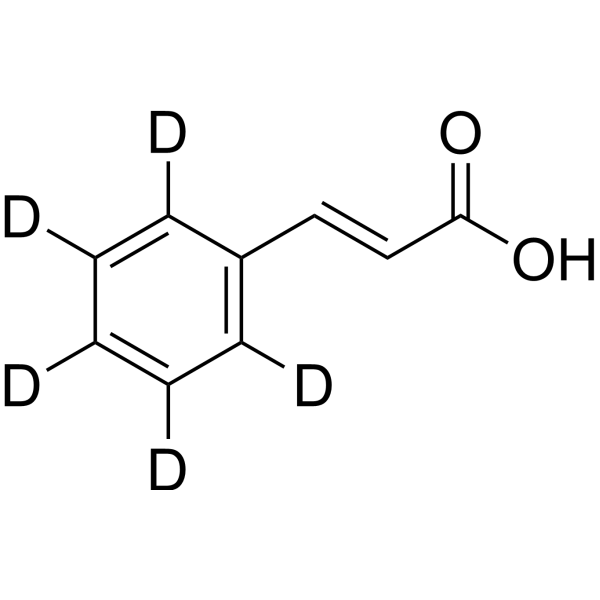
trans-Cinnamic acid-d5
trans-Cinnamic acid-d5 is the deuterium labeled trans-Cinnamic acid. trans-Cinnamic acid is a natural antimicrobial, with minimal inhibitory concentration (MIC) of 250 μg/mL against fish pathogen A. sobria, SY-AS1.
Para uso exclusivo en investigación. No vendemos a pacientes.
- No. CAS: 352431-48-2
- Fòrmula: C9H3D5O2
- Peso molecular:153.19
-
Almacenamiento:
Please store the product under the recommended conditions in the Certificate of Analysis.

To place orders, for customer services and technical support, please contact: MedChemExpress USA
Tel: 609-228-6898 E-mail: [email protected] [email protected]


-
 Actividad biológica
-
Chemical Information
- Protocolo
- Pureza y Documentación
- Referencias
-
 Help & FAQs


Ver todos los productos específicos de isoformas Endogenous Metabolite
More

Actividad biológica
Descripciòn
In Vitro
Stable heavy isotopes of hydrogen, carbon, and other elements have been incorporated into drug molecules, largely as tracers for quantitation during the drug development process. Deuteration has gained attention because of its potential to affect the pharmacokinetic and metabolic profiles of drugs[1].
MedChemExpress (MCE) has not independently confirmed the accuracy of these methods. They are for reference only.
Aplicación
1. This compound can be used as a tracer
2. This compound can be used as an internal standard for quantitative analysis by NMR, GC-MS, or LC-MS.


Chemical Information
-
No. CAS 352431-48-2
-
Unlabeled CAS 140-10-3
-
Peso molecular 153.19
-
Fòrmula C9H3D5O2
-
SMILES
OC(/C=C/C1=C([2H])C([2H])=C([2H])C([2H])=C1[2H])=O
-
Synonyms
trans-3-Phenylacrylic acid-d5
-
Envío
Room temperature in continental US; may vary elsewhere.
-
Almacenamiento
Please store the product under the recommended conditions in the Certificate of Analysis.


Pureza y Documentación
Referencias
[1]. Russak EM, et al. Impact of Deuterium Substitution on the Pharmacokinetics of Pharmaceuticals. Ann Pharmacother. 2019 Feb;53(2):211-216. [Content Brief]
[2]. Yilmaz S, et al. Antimicrobial activity of trans-cinnamic acid and commonly used antibiotics against important fish pathogens and nonpathogenic isolates. J Appl Microbiol. 2018 Sep 4. [Content Brief]

Calculators
Concentration (start) × Volume (start) = Concentration (final) × Volume (final)


trans-Cinnamic acid-d5 Related Classifications
HY-N0610S Related Classifications
 Powered by Bioz