



TP508
TP508 is a 23-amino acid nonproteolytic thrombin peptide that represents a portion of the receptor-binding domain of thrombin molecule. TP508 activates endothelial NO synthase (eNOS) and stimulates production of NO in human endothelial cells. TP508 activates endothelial cells and stem cells to revascularize and regenerate tissues.
For research use only. We do not sell to patients.
- CAS No.: 121341-81-9
- Formula: C97H146N28O36S
- Molecular Weight:2312.44
-
Storage:
Please store the product under the recommended conditions in the Certificate of Analysis.

To place orders, for customer services and technical support, please contact: MedChemExpress USA
Tel: 609-228-6898 E-mail: [email protected] [email protected]


-
 Biological Activity
-
Chemical Information
-
Solvent & Solubility
- Protocols
- Purity & Documentation
- References
-
 Help & FAQs




Biological Activity
Description
IC50 & Target
|
eNOS |
In Vitro
TP508 (50 μg/mL; 24 hours; HCAEC) treatment reverses radiation-induced endothelial dysfunction (ED) and loss of NO signaling by attenuating the downregulation of eNOS expression. TP508 treatment is able to stimulate NO production in the irradiated cells[1].
TP508 mitigates effects of nuclear radiation on human endothelial cells in culture restoring endothelial NO production, tube formation and accelerating repair of radiation-induced DNA double-strand breaks (DSB)[1].
TP508 acts as an antagonist for the effects of thrombin. TP508 peptide inhibits these thrombin-induced effects through a RGD and αvβ3-related mechanism[3].
MedChemExpress (MCE) has not independently confirmed the accuracy of these methods. They are for reference only.
-
Cell Line:Primary human coronary artery endothelial cells (HCAEC)
-
Concentration:50 μg/mL
-
Incubation Time:24 hours
-
Result:Prevented the radiation-induced downregulation of eNOS.
In Vivo
MedChemExpress (MCE) has not independently confirmed the accuracy of these methods. They are for reference only.
-
Animal Model:Male CD-1 mice (12-15-week old) with γ irradiation[1]
-
Dosage:10 mg/kg
-
Administration:Intravenous injection
-
Result:Mitigated radiation-induced endothelial cell damage, also significantly increased survival of CD-1 mice.
Clinical Trial
| NCT Number | Sponsor | Condition | Start Date |
Phase

|
|---|---|---|---|---|
| NCT01329991 | 2011-05 | PHASE1 |


Chemical Information
-
CAS No. 121341-81-9
-
Molecular Weight 2312.44
-
Formula C97H146N28O36S
-
Sequence
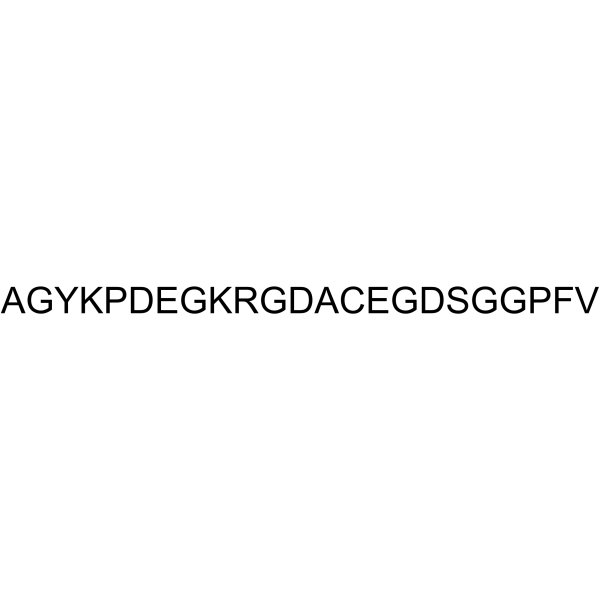
Ala-Gly-Tyr-Lys-Pro-Asp-Glu-Gly-Lys-Arg-Gly-Asp-Ala-Cys-Glu-Gly-Asp-Ser-Gly-Gly-Pro-Phe-Val
-
Sequence Shortening
AGYKPDEGKRGDACEGDSGGPFV
-
Shipping
Room temperature in continental US; may vary elsewhere.
-
Storage
Please store the product under the recommended conditions in the Certificate of Analysis.


Solvent & Solubility
In Vitro
H2O
Peptide Solubility and Storage Guidelines:
1. Calculate the length of the peptide.
2. Calculate the overall charge of the entire peptide according to the following table:
| Contents | Assign value | |
|---|---|---|
| Acidic amino acid | Asp (D), Glu (E), and the C-terminal -COOH. | -1 |
| Basic amino acid | Arg (R), Lys (K), His (H), and the N-terminal -NH2 | +1 |
| Neutral amino acid | Gly (G), Ala (A), Leu (L), Ile (I), Val (V), Cys (C), Met (M), Thr (T), Ser (S), Phe (F), Tyr (Y), Trp (W), Pro (P), Asn (N), Gln (Q) | 0 |
3. Recommended solution:
| Overall charge of peptide | Details |
|---|---|
| Negative (<0) |
1. Try to dissolve the peptide in water first. 2. If water fails, add NH4OH (<50 μL). 3. If the peptide still does not dissolve, add DMSO (50-100 μL) to solubilize the peptide. |
| Positive (>0) |
1. Try to dissolve the peptide in water first. 2. If water fails, try dissolving the peptide in a 10%-30% acetic acid solution. 3. If the peptide still does not dissolve, try dissolving the peptide in a small amount of DMSO. |
| Zero (=0) |
1. Try to dissolve the peptide in organic solvent (acetonitrile, methanol, etc.) first. 2. For very hydrophobic peptides, try dissolving the peptide in a small amount of DMSO, and then dilute the solution with water to the desired concentration. |


Purity & Documentation
References
[1]. Olszewska-Pazdrak B, et al. Nuclear Countermeasure Activity of TP508 Linked to Restoration of Endothelial Function and Acceleration of DNA Repair. Radiat Res. 2016 Aug;186(2):162-74. [Content Brief]
[2]. Olszewska-Pazdrak B, et al. Systemic administration of thrombin peptide TP508 enhances VEGF-stimulated angiogenesis and attenuates effects of chronic hypoxia. J Vasc Res. 2013;50(3):186-9 [Content Brief]
[3]. Tsopanoglou NE, et al. On the mode of action of thrombin-induced angiogenesis: thrombin peptide, TP508, mediates effects in endothelial cells via alphavbeta3 integrin. Thromb Haemost. 2004 Oct;92(4):846-57. [Content Brief]

Calculators
Concentration (start) × Volume (start) = Concentration (final) × Volume (final)


TP508 Related Classifications
HY-P0316 Related Classifications
 Powered by Bioz