



WCA-814
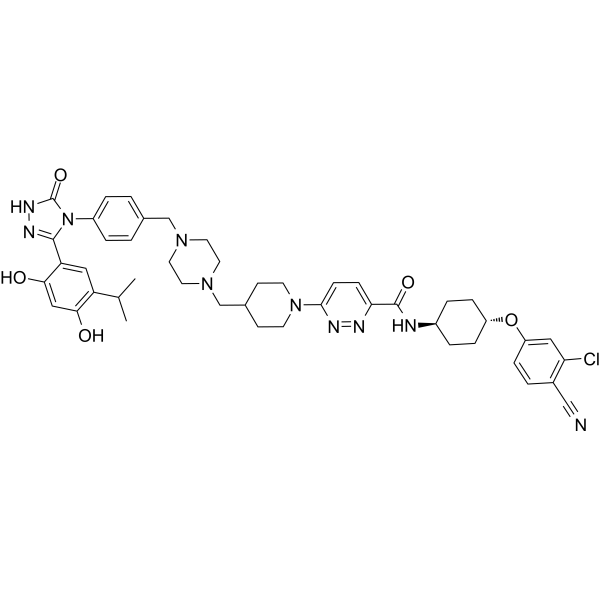
WCA-814 is an androgen receptor (AR) antagonist-Hsp90 inhibitor conjugate. WCA-814 induces the degradation of full-length and AR-V7. WCA-814 has cytotoxic effect in prostatic cancer cells (IC50: 171.2 nM, 26.5 nM for LNCaP, 22Rv1 cell).
Nos produits utilisent uniquement pour la recherche. Nous ne vendons pas aux patients.
- CAS No.: 2951858-45-8
- Formule: C46H53ClN10O5
- Masse moléculaire:861.43
-
Stockage:
Please store the product under the recommended conditions in the Certificate of Analysis.

To place orders, for customer services and technical support, please contact: MedChemExpress USA
Tel: 609-228-6898 E-mail: [email protected] [email protected]


-
 Activité biologique
-
Chemical Information
- Protocole
- Pureté et documentation
- Références
-
 Help & FAQs




Activité biologique
Description
Cellular Effect
|
Cell Line

|
Type | Value | Description | References |
|---|---|---|---|---|
| CWR22R | IC50 |
26.5 nM
Compound: 6; WCA-814
|
Cytotoxicity against human 22Rv1 cells assessed as inhibition of cell growth incubated for 5 days in presence of AR agonist, R1881 by WST-1 assay
Cytotoxicity against human 22Rv1 cells assessed as inhibition of cell growth incubated for 5 days in presence of AR agonist, R1881 by WST-1 assay
|
[PMID: 36960664] |
| LNCaP | IC50 |
171.2 nM
Compound: 6; WCA-814
|
Cytotoxicity against AR-positive human LNCaP cells assessed as inhibition of cell growth incubated for 5 days in presence of AR agonist, R1881 in charcoal stripped serum by WST-1 assay
Cytotoxicity against AR-positive human LNCaP cells assessed as inhibition of cell growth incubated for 5 days in presence of AR agonist, R1881 in charcoal stripped serum by WST-1 assay
|
[PMID: 36960664] |


Chemical Information
-
CAS No. 2951858-45-8
-
Masse moléculaire 861.43
-
Formule C46H53ClN10O5
-
SMILES
CC(C1=C(C=C(C(C2=NNC(N2C3=CC=C(C=C3)CN4CCN(CC4)CC5CCN(CC5)C6=CC=C(N=N6)C(N[C@H]7CC[C@@H](CC7)OC8=CC(Cl)=C(C=C8)C#N)=O)=O)=C1)O)O)C
-
Livraison
Room temperature in continental US; may vary elsewhere.
-
Stockage
Please store the product under the recommended conditions in the Certificate of Analysis.

Protocole
-
Research Protocol for Endocrine Diseases
Endocrine diseases often arise from disrupted hormone production, hormone signaling, or target-tissue responsiveness; for diabetes-focused endocrine disease models, insulin signaling regulates glucose uptake, hepatic glucose output, lipid metabolism, and β-cell compensation. Type 2 diabetes develops through interacting defects in insulin resistance, β-cell dysfunction, adipose inflammation, hepatic glucose overproduction, altered incretin signaling, and ectopic lipid metabolism. A major unresolved question is whether endocrine dysfunction is driven primarily by target-tissue insulin resistance, intrinsic β-cell failure, immune/inflammatory stress, or combined multi-organ failure that differs by disease stage.
-
Cell Viability Determination by MTT Colorimetric Assay
The following protocol uses the MTT colorimetric assay as a classic literature-established method for assessing cell viability/metabolic activity in cultured mammalian cells. MTT[3-(4,5-dimethylthiazol-2-yl)-2,5-diphenyltetrazolium bromide] is reduced by metabolically active cells to a colored formazan product; the amount of formazan is quantified spectrophotometrically and provides an indirect measure of metabolically active viable cells. Importantly, MTT reduction reflects cellular oxidoreductase/metabolic activity rather than an absolute direct count of living cells, so changes in cellular metabolism can alter the signal independently of cell number.


Pureté et documentation
Références

Calculators
Concentration (start) × Volume (start) = Concentration (final) × Volume (final)


WCA-814 Related Classifications
HY-149914 Related Classifications
 Powered by Bioz