



1-Cyclohexanol

Based on 1 Customer Validation
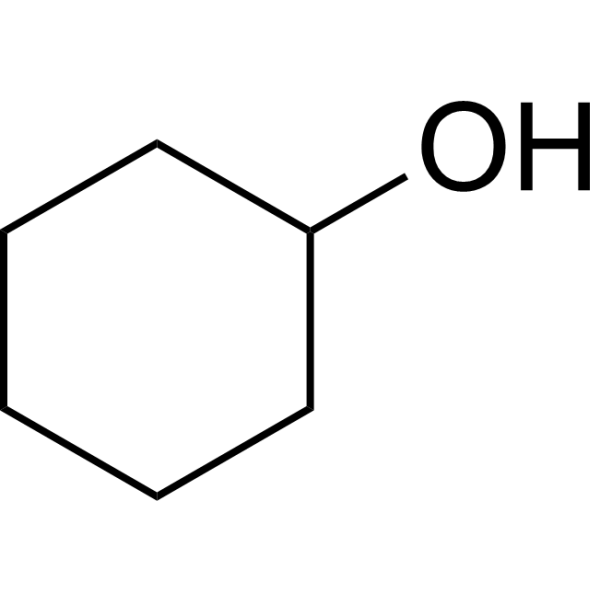
1-Cyclohexanol (Hydroxycyclohexane; NSC 5471) is an orally active Cramer Class I flavor ingredient that can be used in fragrances. 1-Cyclohexanol has a wide margin of safety and is environmentally friendly.
For research use only. We do not sell to patients.
- Purity : 99.94%
- CAS No.: 108-93-0
- Formula: C6H12O
- Molecular Weight:100.16
-
Storage:Pure form -20°C, 3 years , 4°C, 2 years ; In solvent -80°C, 6 months , -20°C, 1 month

To place orders, for customer services and technical support, please contact: MedChemExpress USA
Tel: 609-228-6898 E-mail: [email protected] [email protected]


-
 Biological Activity
-
Chemical Information
-
Solvent & Solubility
- Purity & Documentation
- References
-
 Help & FAQs


-

HY-W133953
1-Methoxy-2-propyl acetateBiomarker -
HY-Y1275
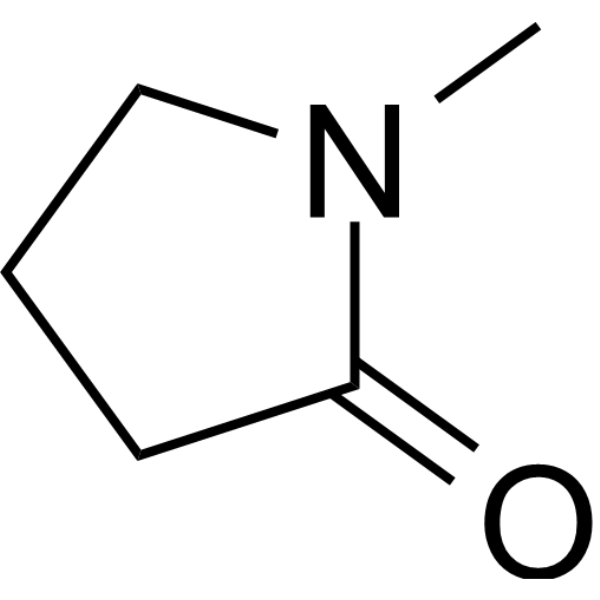
N-MethylpyrrolidoneFive-membered Cyclic Amide -
HY-Y0320
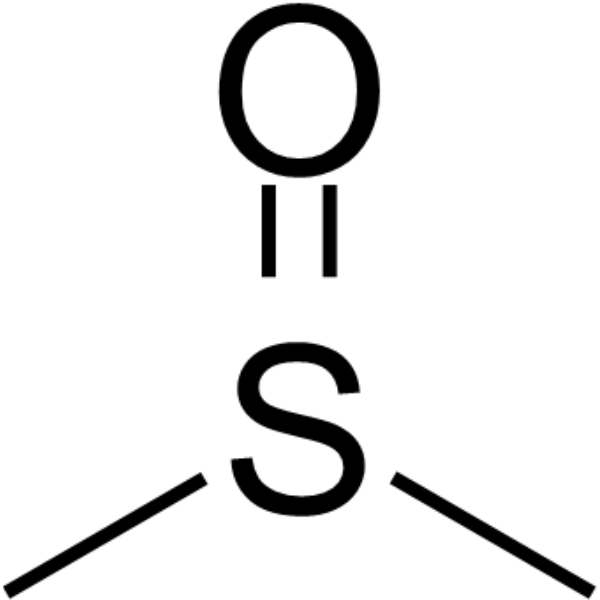
Dimethyl sulfoxide, meets analytical specification of Ch.P.Aprotic Solvent -
HY-Y0320C
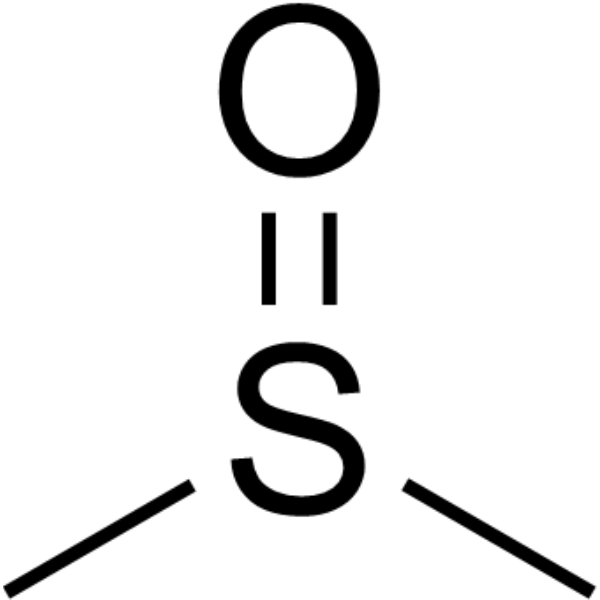
Dimethyl sulfoxideAprotic Solvent -

HY-Y0320D
Dimethyl sulfoxide, cryoprotectant vitrification agentBiochemical Assay Reagent -
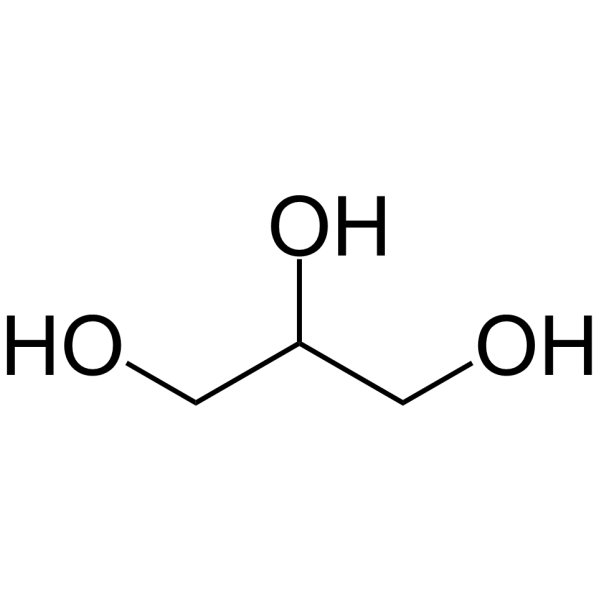
HY-B1659
GlycerolEndogenous Metabolite -
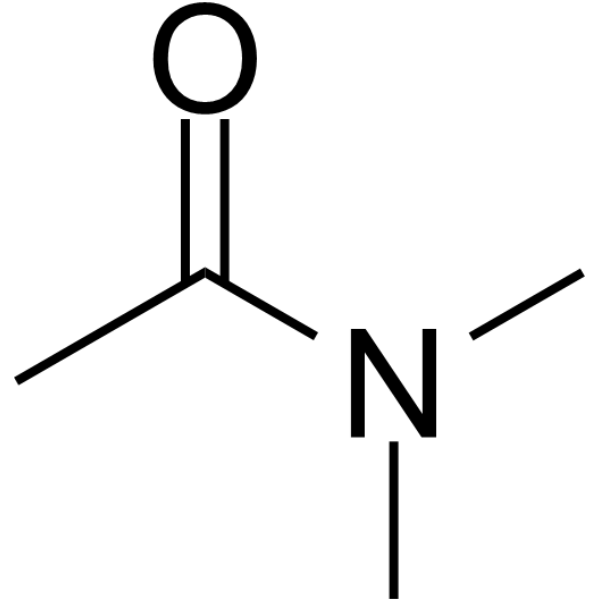
HY-W042416
N,N-DimethylacetamideAnti-inflammatory agent


Biological Activity
Description
In Vitro
Cyclohexanol (1000.0 μg/mL; 4 h) is not mutagenic to mouse lymphoma L5178Y cells in vitro, with or without metabolic activation[1].
Cyclohexanol (15000 μg/plate) does not exhibit mutagenic activity in Salmonella typhimurium strains TA98, TA1535, TA1537, and TA1538, with or without metabolic activation[1].
MedChemExpress (MCE) has not independently confirmed the accuracy of these methods. They are for reference only.
In Vivo
Cyclohexanol (159-478 mg/kg/day; inhalation; 6 h/day, 5 days/week; 13-16 weeks) has a no observed adverse effect level (NOAEL) for repeated dose inhalation toxicity in Sprague Dawley rats of 159 mg/kg/day, with treatment-related mortality and clinical signs occurring at 478 mg/kg/day[1].
Cyclohexanol (25 mg/kg/day; p.o.; daily; 40 days) induces reversible male infertility in rabbits by inhibiting spermatogenesis at the spermatocyte and spermatid levels[1].
Cyclohexanol does not induce skin sensitization in guinea pigs in a maximization test[1].
MedChemExpress (MCE) has not independently confirmed the accuracy of these methods. They are for reference only.
-
Animal Model:NMRI (male and female)[1]
-
Dosage:500 mg/kg; 1000 mg/kg; 1500 mg/kg
-
Administration:p.o.; single dose
-
Result:Showed no statistically significant increase in the incidence of micronucleated polychromatic erythrocytes at any tested dose or time point.
-
Animal Model:Sprague Dawley (male and female)[1]
-
Dosage:159 mg/kg/day (equivalent to 150 ppm); 478 mg/kg/day (equivalent to 450 ppm, reduced to 400 ppm after 10 weeks)
-
Administration:inhalation; 6 h/day, 5 days/week; 13-16 weeks
-
Result:Showed no treatment-related effects at 159 mg/kg/day across all evaluated endpoints.
Caused treatment-related mortality in male rats on study days 37, 38, and 60, and euthanasia of 1 female rat in extremis on day 17 at 478 mg/kg/day.
Induced immediate post-exposure decreased activity and prostration in both sexes at 478 mg/kg/day.
-
Animal Model:Sprague Dawley (female)[1]
-
Dosage:300 mg/kg/day; 600 mg/kg/day
-
Administration:p.o.; daily; gestation days 6-15
-
Result:Showed no treatment-related or toxicologically relevant effects in fetuses at 300 mg/kg/day or 600 mg/kg/day.
Induced treatment-related clinical signs of hypoactivity and/or salivation in 21 out of 24 dams at 600 mg/kg/day, with no such signs at 300 mg/kg/day.
-
Animal Model:unspecified (male)[1]
-
Dosage:25 mg/kg/day
-
Administration:p.o.; daily; 40 days
-
Result:Induced degenerative changes in testes (loss of type A spermatogonia, spermatocytes, spermatids, and spermatozoa; morphological changes to spermatids; shrunken Leydig cells) and epididymides (reduced luminal epithelium, scanty stereocilia, spermatozoa-free lumens).
Caused statistically significant reductions in testicular/epididymal RNA, protein, sialic acid, and glycogen, increases in testicular cholesterol, reduced acid phosphatase activity, decreased adrenal ascorbic acid, reduced serum protein, and elevated serum cholesterol, phospholipids, triglycerides, bilirubin, pyruvate transaminase, and alkaline phosphatase.
Reversed all histological and biochemical changes to subnormal levels after a 70-day recovery period.


Chemical Information
-
CAS No. 108-93-0
-
Appearance Liquid (Density: 0.948 g/cm3)
-
Molecular Weight 100.16
-
Formula C6H12O
-
Color Colorless to light yellow
-
SMILES
OC1CCCCC1
-
Synonyms
Hydroxycyclohexane; NSC 54711; Naxol; Cyclohexanol
-
Shipping
Room temperature in continental US; may vary elsewhere.
-
Storage
Pure form -20°C 3 years 4°C 2 years In solvent -80°C 6 months -20°C 1 month


Solvent & Solubility
In Vitro:
DMSO : 200 mg/mL (1996.81 mM; Need ultrasonic; Hygroscopic DMSO has a significant impact on the solubility of product, please use newly opened DMSO)
Please refer to the solubility information to select the appropriate solvent. Once prepared, please aliquot and store the solution to prevent product inactivation from repeated freeze-thaw cycles.
Storage method and period of stock solution: -80°C, 6 months; -20°C, 1 month. When stored at -80°C, please use it within 6 months. When stored at -20°C, please use it within 1 month.
Please refer to the solubility information to select the appropriate solvent. Once prepared, please aliquot and store the solution to prevent product inactivation from repeated freeze-thaw cycles.
Storage method and period of stock solution: -80°C, 6 months; -20°C, 1 month. When stored at -80°C, please use it within 6 months. When stored at -20°C, please use it within 1 month.
Concentration (start) × Volume (start) = Concentration (final) × Volume (final)
In Vivo:
Select the appropriate dissolution method based on your experimental animal and administration route.
- For the following dissolution methods, please ensure to first prepare a clear stock solution using an In Vitro approach and then sequentially add co-solvents:
- To ensure reliable experimental results, the clarified stock solution can be appropriately stored based on storage conditions. As for the working solution for In Vivo experiments, it is recommended to prepare freshly and use it on the same day.
- The percentages shown for the solvents indicate their volumetric ratio in the final prepared solution. If precipitation or phase separation occurs during preparation, heat and/or sonication can be used to aid dissolution.
Add each solvent one by one: 10% DMSO 40% PEG300 5% Tween-80 45% Saline
Solubility: ≥ 5 mg/mL (49.92 mM); Clear solution
This protocol yields a clear solution of ≥ 5 mg/mL (saturation unknown).
Taking 1 mL working solution as an example, add 100 μL DMSO stock solution (50.0 mg/mL) to 400 μL PEG300, and mix evenly; then add 50 μL Tween-80 and mix evenly; then add 450 μL Saline to adjust the volume to 1 mL.
Preparation of Saline: Dissolve 0.9 g sodium chloride in ddH₂O and dilute to 100 mL to obtain a clear Saline solution.
Add each solvent one by one: 10% DMSO 90% (20% SBE-β-CD in Saline)
Solubility: ≥ 5 mg/mL (49.92 mM); Clear solution
This protocol yields a clear solution of ≥ 5 mg/mL (saturation unknown).
Taking 1 mL working solution as an example, add 100 μL DMSO stock solution (50.0 mg/mL) to 900 μL 20% SBE-β-CD in Saline, and mix evenly.
Preparation of 20% SBE-β-CD in Saline (4°C, storage for one week): 2 g SBE-β-CD powder is dissolved in 10 mL Saline, completely dissolve until clear.
In Vivo Dissolution Calculator
Please enter the basic information of animal experiments:
-
-
-
-
Recommended: Prepare an additional quantity of animals to account for potential losses during experiments.
Please enter your animal formula composition:
-
%DMSO +
Recommended: Keep the proportion of DMSO in working solution below 2% if your animal is weak.
-
%+
-
+%Tween-80 + +
-
%Saline +
The co-solvents required include: DMSO, . All of co-solvents are available by MedChemExpress (MCE). , Tween 80. All of co-solvents are available by MedChemExpress (MCE).
Working solution concentration: 0.22 mg/mL
Method for preparing stock solution: mg drug dissolved in μL DMSO. Stock solution concentration: mg/mL.
1. Take μL DMSO stock solution;
2. Add μL .
μL , mix evenly;
3. Then add μL Tween 80, mix evenly;
4. Then add μL
Please ensure that the stock solution in the first step is dissolved to a clear state, and add co-solvents in sequence. You can use ultrasonic heating (ultrasonic cleaner, recommended frequency 20-40 kHz), vortexing, etc. to assist dissolution.


Purity & Documentation
-
Data Sheet (276 KB)
-
SDS (538 KB)
- English - EN (538 KB)
- Français - FR (538 KB)
- Deutsch - DE (538 KB)
- Norwegian - NO (538 KB)
- Español - ES (538 KB)
- Swedish - SV (538 KB)
- Italian - IT (538 KB)
- Korean - KR (538 KB)
- Portuguese - PT (538 KB)
-
Handling Instructions (2659 KB)
References


Complete Stock Solution Preparation Table
Please refer to the solubility information to select the appropriate solvent. Once prepared, please aliquot and store the solution to prevent product inactivation from repeated freeze-thaw cycles.
Storage method and period of stock solution: -80°C, 6 months; -20°C, 1 month. When stored at -80°C, please use it within 6 months. When stored at -20°C, please use it within 1 month.
| Optional Solvent | Concentration Solvent Mass | 1 mg | 5 mg | 10 mg | 25 mg |
|---|---|---|---|---|---|
| DMSO | 1 mM | 9.9840 mL | 49.9201 mL | 99.8403 mL | 249.6006 mL |
| 5 mM | 1.9968 mL | 9.9840 mL | 19.9681 mL | 49.9201 mL | |
| 10 mM | 0.9984 mL | 4.9920 mL | 9.9840 mL | 24.9601 mL | |
| 15 mM | 0.6656 mL | 3.3280 mL | 6.6560 mL | 16.6400 mL | |
| 20 mM | 0.4992 mL | 2.4960 mL | 4.9920 mL | 12.4800 mL | |
| 25 mM | 0.3994 mL | 1.9968 mL | 3.9936 mL | 9.9840 mL | |
| 30 mM | 0.3328 mL | 1.6640 mL | 3.3280 mL | 8.3200 mL | |
| 40 mM | 0.2496 mL | 1.2480 mL | 2.4960 mL | 6.2400 mL | |
| 50 mM | 0.1997 mL | 0.9984 mL | 1.9968 mL | 4.9920 mL | |
| 60 mM | 0.1664 mL | 0.8320 mL | 1.6640 mL | 4.1600 mL | |
| 80 mM | 0.1248 mL | 0.6240 mL | 1.2480 mL | 3.1200 mL | |
| 100 mM | 0.0998 mL | 0.4992 mL | 0.9984 mL | 2.4960 mL |


1-Cyclohexanol Related Classifications
HY-Y1217 Related Classifications
 Powered by Bioz
Keywords