



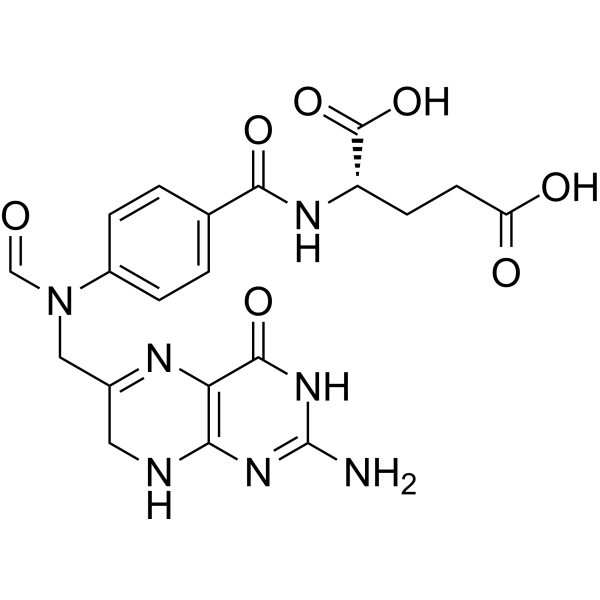
10-Formyl-7,8-dihydrofolic acid

Based on 1 Customer Validation
10-Formyl-7,8-dihydrofolic acid is a biologically active folic acid and growth promoter. 10-Formyl-7,8-dihydrofolic acid serves as a substrate for aminoimidazolecarboxamide ribonucleotide transformylase and dihydrofolate reductase (DHFR) to support catalytic reactions (with detection wavelengths of 552 nm and 340 nm, respectively). 10-Formyl-7,8-dihydrofolic acid not only promotes the growth of leukemia cells, but also effectively reverses the growth inhibition induced by antifolate drugs under folate-deficient conditions. 10-Formyl-7,8-dihydrofolic acid can be used in the research of leukemia.
For research use only. We do not sell to patients.
- Purity : 97.70%
- CAS No.: 28459-40-7
- Formula: C20H21N7O7
- Molecular Weight:471.42
-
Storage:
-20°C, stored under nitrogen
* In solvent : -80°C, 6 months; -20°C, 1 month (stored under nitrogen)

To place orders, for customer services and technical support, please contact: MedChemExpress USA
Tel: 609-228-6898 E-mail: [email protected] [email protected]


-
 Biological Activity
-
Chemical Information
- Purity & Documentation
- References
-
 Help & FAQs




Biological Activity
Description
In Vitro
10-Formyl-7,8-dihydrofolic acid (1-5000 nM; 90-162 h, with methotrexate co-treatment) reverses methotrexate-induced growth suppression in human acute lymphoblastic leukemia CCRF-CEM cells in a dose-dependent manner, with a mean fractional change in cell growth of 0.7, and supports increased cell viability at higher concentrations[1].
10-Formyl-7,8-dihydrofolic acid (5 × 10⁻⁴ mol/L; up to 300 min) is a substrate for dihydrofolate reductase from human acute lymphoblastic leukemia CCRF-CEM cells, supporting enzyme activity as measured by decreasing absorbance at 340 nm over time[1].
10-Formyl-7,8-dihydrofolic acid (5 × 10⁻⁴ mol/L; up to 24 h) is a substrate for aminoimidazole carboxamide ribotide transformylase from human acute lymphoblastic leukemia CCRF-CEM cells, supporting enzyme activity as measured by decreasing absorbance at 552 nm over time[1].
MedChemExpress (MCE) has not independently confirmed the accuracy of these methods. They are for reference only. .
-
Cell Line:human acute lymphoblastic leukemia CCRF-CEM cells
-
Concentration:1 nM; 10 nM; 100 nM; 1000 nM; 5000 nM (with 5 nM/25 nM/100 nM Methotrexate)
-
Incubation Time:90 h; 96 h; 97 h; 142 h; 162 h
-
Result:Increased fractional change in cell number above control by 0.3 (96 h, 5 nmol/L methotrexate), 0.2 (142 h, 25 nmol/L methotrexate), 0.4 (162 h, 100 nmol/L methotrexate) with 32% viability at 1 nM.
Increased fractional change in cell number above control by 0.2 (96 h, 5 nmol/L methotrexate), 0.3 (142 h, 25 nmol/L methotrexate), 0.4 (162 h, 100 nmol/L methotrexate) with 32% viability at 10 nM.
Increased fractional change in cell number above control by 0.2 (96 h, 5 nmol/L methotrexate), 0.2 (97 h, 25 nmol/L methotrexate), 0.4 (142 h, 25 nmol/L methotrexate), 0.7 (90 h, 100 nmol/L methotrexate), 0.2 (162 h, 100 nmol/L methotrexate) with 43% viability at 100 nM.
Increased fractional change in cell number above control by 0.3 (96 h, 5 nmol/L methotrexate), 0.6 (142 h, 25 nmol/L methotrexate), 2.8 (162 h, 100 nmol/L methotrexate) with 82% viability at 1000 nM.
Increased fractional change in cell number above control by 0.3 (97 h, 25 nmol/L methotrexate), 1.2 (142 h, 25 nmol/L methotrexate), 3.6 (90 h, 100 nmol/L methotrexate), 8.2 (162 h, 100 nmol/L methotrexate) with 93% viability at 5000 nM.
Achieved a mean fractional change in cell growth of 0.7.


Chemical Information
-
CAS No. 28459-40-7
-
Appearance Solid
-
Molecular Weight 471.42
-
Formula C20H21N7O7
-
Color Off-white to light brown
-
SMILES
O=C(O)CC[C@@H](C(O)=O)NC(C1=CC=C(N(CC2=NC3=C(N=C(N)NC3=O)NC2)C=O)C=C1)=O
-
Structure Classification
-
Initial Source
-
Shipping
Room temperature in continental US; may vary elsewhere.
-
Storage
-20°C, stored under nitrogen
* In solvent : -80°C, 6 months; -20°C, 1 month (stored under nitrogen)


Purity & Documentation
-
Data Sheet (275 KB)
-
SDS (419 KB)
- English - EN (419 KB)
- Français - FR (419 KB)
- Deutsch - DE (419 KB)
- Norwegian - NO (419 KB)
- Español - ES (419 KB)
- Swedish - SV (419 KB)
- Italian - IT (419 KB)
- Korean - KR (419 KB)
- Portuguese - PT (419 KB)
-
Handling Instructions (2659 KB)
References

Calculators
Concentration (start) × Volume (start) = Concentration (final) × Volume (final)


10-Formyl-7,8-dihydrofolic acid Related Classifications
HY-137129 Related Classifications
 Powered by Bioz