



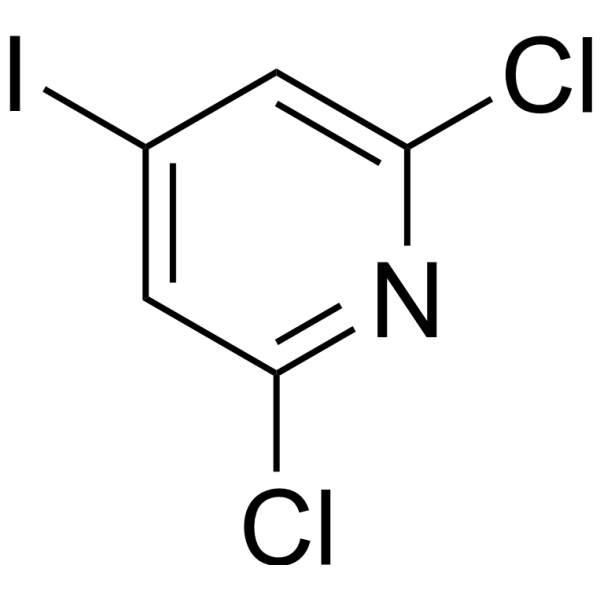
2,6-Dichloro-4-iodopyridine

Based on 1 Customer Validation
2,6-Dichloro-4-iodopyridine is a biochemical reagent. 2,6-Dichloro-4-iodopyridine is commonly used as a highly reactive synthetic building block and versatile intermediate in organic synthesis, medicinal chemistry, and proteomics research.
For research use only. We do not sell to patients.
- Purity : 99.10%
- CAS No.: 98027-84-0
- Formula: C5H2Cl2IN
- Molecular Weight:273.89
-
Storage:
4°C, protect from light
* The compound is unstable in solutions, freshly prepared is recommended.

To place orders, for customer services and technical support, please contact: MedChemExpress USA
Tel: 609-228-6898 E-mail: [email protected] [email protected]


-
 Biological Activity
-
Chemical Information
-
Solvent & Solubility
- Protocols
- Purity & Documentation
- References
-
 Help & FAQs





Biological Activity
Description
In Vitro
2,6-Dichloro-4-iodopyridine can be used as an intermediate for the synthesis of DLK/LZK inhibitors GNE-3511 (HY-12947) and DN-1289 (HY-152142)[2].
2,6-Dichloro-4-iodopyridine can be used as an intermediate for the synthesis of ATM inhibitors[4].
MedChemExpress (MCE) has not independently confirmed the accuracy of these methods. They are for reference only. Further protocols information, click here.


Chemical Information
-
CAS No. 98027-84-0
-
Appearance Solid
-
Molecular Weight 273.89
-
Formula C5H2Cl2IN
-
Color Off-white to light yellow
-
SMILES
ClC1=CC(I)=CC(Cl)=N1
-
Shipping
Room temperature in continental US; may vary elsewhere.
-
Storage
4°C, protect from light
* The compound is unstable in solutions, freshly prepared is recommended.


Solvent & Solubility
In Vitro:
DMSO : 33.33 mg/mL (121.69 mM; ultrasonic and warming and heat to 60°C; Hygroscopic DMSO has a significant impact on the solubility of product, please use newly opened DMSO)
Please refer to the solubility information to select the appropriate solvent. The compound is unstable in solutions, freshly prepared is recommended.
Please refer to the solubility information to select the appropriate solvent. The compound is unstable in solutions, freshly prepared is recommended.
Concentration (start) × Volume (start) = Concentration (final) × Volume (final)
In Vivo:
Select the appropriate dissolution method based on your experimental animal and administration route.
- For the following dissolution methods, please ensure to first prepare a clear stock solution using an In Vitro approach and then sequentially add co-solvents:
- To ensure reliable experimental results, the clarified stock solution can be appropriately stored based on storage conditions. As for the working solution for In Vivo experiments, it is recommended to prepare freshly and use it on the same day.
- The percentages shown for the solvents indicate their volumetric ratio in the final prepared solution. If precipitation or phase separation occurs during preparation, heat and/or sonication can be used to aid dissolution.
In Vivo Dissolution Calculator
Please enter the basic information of animal experiments:
-
-
-
-
Recommended: Prepare an additional quantity of animals to account for potential losses during experiments.
Please enter your animal formula composition:
-
%DMSO +
Recommended: Keep the proportion of DMSO in working solution below 2% if your animal is weak.
-
%+
-
+%Tween-80 + +
-
%Saline +
The co-solvents required include: DMSO, . All of co-solvents are available by MedChemExpress (MCE). , Tween 80. All of co-solvents are available by MedChemExpress (MCE).
Working solution concentration: 0.22 mg/mL
Method for preparing stock solution: mg drug dissolved in μL DMSO. Stock solution concentration: mg/mL. * The compound is unstable in solutions, freshly prepared is recommended.
1. Take μL DMSO stock solution;
2. Add μL .
μL , mix evenly;
3. Then add μL Tween 80, mix evenly;
4. Then add μL
Please ensure that the stock solution in the first step is dissolved to a clear state, and add co-solvents in sequence. You can use ultrasonic heating (ultrasonic cleaner, recommended frequency 20-40 kHz), vortexing, etc. to assist dissolution.

Protocols
-
Research Protocol for Omics Data Analysis Pipelines
Omics data analysis pipelines convert raw high-throughput measurements from genomics, transcriptomics, epigenomics, proteomics, metabolomics, or single-cell assays into quality-controlled, statistically tested, biologically interpretable results. A reproducible omics pipeline requires predefined experimental metadata, raw-data quality control, modality-specific preprocessing, normalization, statistical modeling, multiple-testing correction, biological annotation, and independent validation. RNA-seq pipelines commonly include read QC, alignment or pseudoalignment, quantification, normalization, and differential-expression testing, while single-cell pipelines additionally require cell-level QC, normalization, dimensionality reduction, clustering, cell annotation, and sample-aware differential testing. Multi-omics integration can connect molecular layers such as transcriptome, proteome, metabolome, and epigenome, but unresolved problems include batch effects, missing values, unequal featu


Purity & Documentation
-
Data Sheet (274 KB)
-
SDS (615 KB)
- English - EN (615 KB)
- Français - FR (615 KB)
- Deutsch - DE (615 KB)
- Norwegian - NO (615 KB)
- Español - ES (615 KB)
- Swedish - SV (615 KB)
- Italian - IT (615 KB)
- Korean - KR (615 KB)
- Portuguese - PT (615 KB)
-
Handling Instructions (2659 KB)
References


Complete Stock Solution Preparation Table
Please refer to the solubility information to select the appropriate solvent. The compound is unstable in solutions, freshly prepared is recommended.
| Optional Solvent | Concentration Solvent Mass | 1 mg | 5 mg | 10 mg | 25 mg |
|---|---|---|---|---|---|
| DMSO | 1 mM | 3.6511 mL | 18.2555 mL | 36.5110 mL | 91.2775 mL |
| 5 mM | 0.7302 mL | 3.6511 mL | 7.3022 mL | 18.2555 mL | |
| 10 mM | 0.3651 mL | 1.8256 mL | 3.6511 mL | 9.1278 mL | |
| 15 mM | 0.2434 mL | 1.2170 mL | 2.4341 mL | 6.0852 mL | |
| 20 mM | 0.1826 mL | 0.9128 mL | 1.8256 mL | 4.5639 mL | |
| 25 mM | 0.1460 mL | 0.7302 mL | 1.4604 mL | 3.6511 mL | |
| 30 mM | 0.1217 mL | 0.6085 mL | 1.2170 mL | 3.0426 mL | |
| 40 mM | 0.0913 mL | 0.4564 mL | 0.9128 mL | 2.2819 mL | |
| 50 mM | 0.0730 mL | 0.3651 mL | 0.7302 mL | 1.8256 mL | |
| 60 mM | 0.0609 mL | 0.3043 mL | 0.6085 mL | 1.5213 mL | |
| 80 mM | 0.0456 mL | 0.2282 mL | 0.4564 mL | 1.1410 mL | |
| 100 mM | 0.0365 mL | 0.1826 mL | 0.3651 mL | 0.9128 mL |


2,6-Dichloro-4-iodopyridine Related Classifications
HY-41945 Related Classifications
 Powered by Bioz
Keywords
- 2,6-Dichloro-4-iodopyridine
- 98027-84-0
- Biochemical Assay Reagents
- high bone mass phenotype
- prenatal fluoride-induced persistent hyper-osteogenesis
- BMPR2 activation
- BMPR2
- prenatal NaF-induced excessive bone formation
- JNK1
- RIOK2
- osteogenic marker expression
- male offspring
- OMD upregulation
- Inhibitor
- inhibitor
- inhibit