



2-Deoxy-L-ribose

Based on 1 Customer Validation
2-Deoxy-L-ribose is a stereoisomer of 2-Deoxy-d-ribose that inhibits 2-Deoxy-d-ribose anti-apoptotic effects. 2-Deoxy-L-ribose suppresses metastasis of tumor cells overexpressing thymidine phosphorylase.
Para uso exclusivo en investigación. No vendemos a pacientes.
- No. CAS: 18546-37-7
- Fòrmula: C5H10O4
- Peso molecular:134.13
-
Almacenamiento:Powder -20°C, 3 years , 4°C, 2 years ; In solvent -80°C, 6 months , -20°C, 1 month


To place orders, for customer services and technical support, please contact: MedChemExpress USA
Tel: 609-228-6898 E-mail: [email protected] [email protected]


-
 Actividad biológica
-
Chemical Information
- Protocolo
- Pureza y Documentación
- Referencias
-
 Help & FAQs


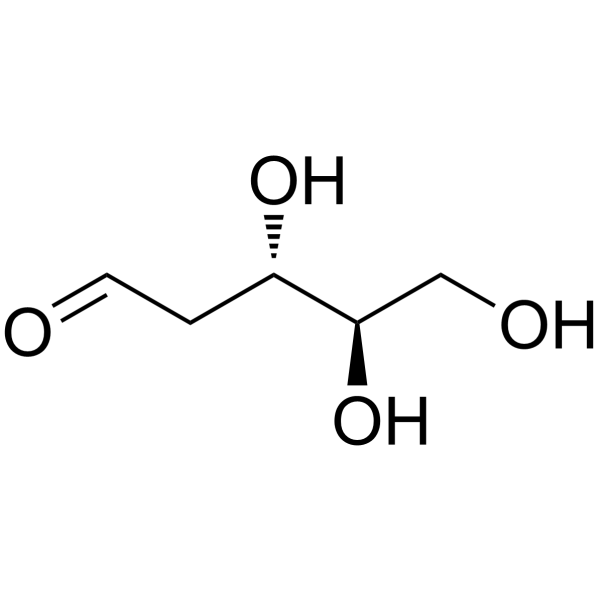
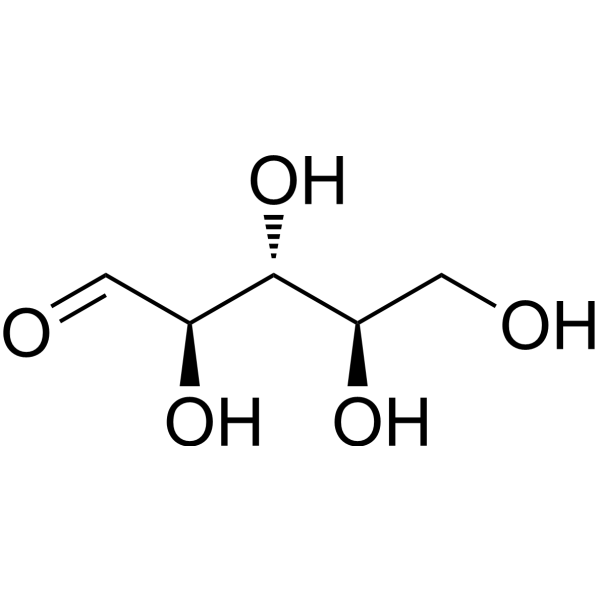


Actividad biológica
Descripciòn
In Vitro
2-Deoxy-L-ribose (10-100 μM; 24 h) significantly reduces the number of invading KB/TP cells under hypoxia[1].
2-Deoxy-L-ribose (10-100 μM; 48 h) decreases VEGF and IL-8 mRNA levels in KB/TP cells under hypoxia[1].
MedChemExpress (MCE) has not independently confirmed the accuracy of these methods. They are for reference only. Further protocols information, click here.
-
Cell Line:KB/TP cells (thymidine phosphorylase (TP)-overexpressing human epidermoid carcinoma)
-
Concentration:10 μM or 100 μM
-
Incubation Time:24 hours
-
Result:Inhibited TP-overexpressing tumor cell invasion in vitro.
-
Cell Line:KB/TP cells (thymidine phosphorylase (TP)-overexpressing human epidermoid carcinoma)
-
Concentration:10 μM or 100 μM
-
Incubation Time:48 hours
-
Result:
In Vivo
2-Deoxy-L-ribose (20 mg/kg; p.o.; daily; 52 days) showes superior efficacy to Tegafur (HY-17400) (100 mg/kg) in reducing abdominal metastatic nodules[1].
.
MedChemExpress (MCE) has not independently confirmed the accuracy of these methods. They are for reference only.
-
Animal Model:BALB/c nude mice intrasplenically injected with KB/TP cells[1]
-
Dosage:20 mg/kg/day or 100 mg/kg/day
-
Administration:Oral (p.o.), daily for 28 days
-
Result:Effectively inhibited TP-mediated liver metastasis and angiogenesis.
-
Animal Model:BALB/c nude mice with subcutaneous KB/TP cell injection[1]
-
Dosage:20 mg/kg/day
-
Administration:Oral (p.o.), daily until day 52
-
Result:Decreased the number of metastatic nodules in organs.


Chemical Information
-
No. CAS 18546-37-7
-
Appearance Solid
-
Peso molecular 134.13
-
Fòrmula C5H10O4
-
Color White to light yellow
-
SMILES
O=CC[C@H]([C@H](CO)O)O
-
Envío
Room temperature in continental US; may vary elsewhere.
-
Almacenamiento
Powder -20°C 3 years 4°C 2 years In solvent -80°C 6 months -20°C 1 month

Protocolo
-
Apoptosis
Apoptosis, also called programmed cell death, is generally characterized by distinct morphological characteristics.
-
Apoptosis Solutions
Apoptosis is a regulated, generally non-lytic cell-death pathway that removes unwanted, damaged, infected, or abnormal cells through coordinated morphological changes, caspase activation, DNA fragmentation, and membrane remodeling. The intrinsic apoptosis pathway is controlled mainly by mitochondrial outer membrane permeabilization, BCL-2 family proteins, cytochrome c release, apoptosome formation, caspase-9 activation, and downstream executioner caspase-3/7 activation. The extrinsic apoptosis pathway is initiated by death receptors such as Fas, TNFR, and TRAIL receptors, which recruit adaptor proteins and activate caspase-8 before engaging executioner caspases or mitochondrial amplification through BID cleavage. Apoptosis is linked to many phenotypes, including cancer cell killing, tissue homeostasis, immune regulation, neurodegeneration, infection response, and treatment-induced cytotoxicity; unresolved questions include how apoptosis interacts with necroptosis, pyroptosis, ferroptos
-
Orthotopic Cell-Line Xenograft
Orthotopic cell-line xenograft models involve implantation of human cancer cell lines into the anatomically corresponding organ of immunodeficient mice to reproduce tumor growth within a native microenvironment, enabling more clinically relevant tumor behavior compared with subcutaneous models. These models are widely used because orthotopic placement better recapitulates tumor progression, including invasion and metastatic spread, which are often underrepresented in heterotopic implantation systems. Compared with conventional xenografts, orthotopic implantation is described as more technically complex but provides improved simulation of tumor-microenvironment interactions and metastatic behavior, making it particularly valuable for translational oncology research. Surgical orthotopic implantation approaches have been emphasized as enabling faithful reproduction of clinical cancer features, including metastasis and disease progression patterns that align with the tumor’s organ of origi


Pureza y Documentación
-
Ficha de datos (270 KB)
-
SDS (252 KB)
- Français - FR (252 KB)
- Deutsch - DE (252 KB)
- Norwegian - NO (252 KB)
- Español - ES (252 KB)
- Swedish - SV (252 KB)
- Italian - IT (252 KB)
- Korean - KR (252 KB)
- Portuguese - PT (252 KB)
-
Instrucciones de manejo (2659 KB)
Referencias

Calculators
Concentration (start) × Volume (start) = Concentration (final) × Volume (final)


2-Deoxy-L-ribose Related Classifications
HY-W012670 Related Classifications
 Powered by Bioz