



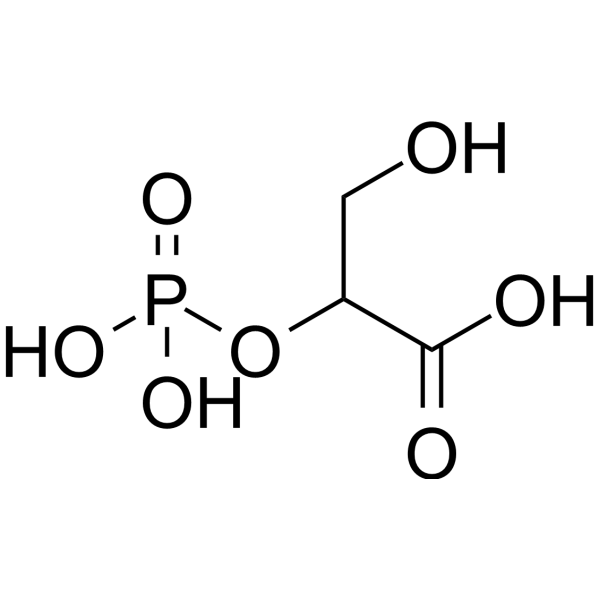
2-Phosphoglyceric acid
2-Phosphoglyceric acid (DL-2-phosphoglyceric acid) is a glycolytic substrate that is catalyzed by enolase to form phosphoenolpyruvate ester (PEP). 2-Phosphoglyceric acid inhibits the ferroptosis pathway by down-regulating ACSL4 and up-regulating GPX4, and has significant neuroprotective effects. 2-Phosphoglyceric acid reflects the overall metabolic state and flux of the cell.
For research use only. We do not sell to patients.
- CAS No.: 2553-59-5
- Formula: C3H7O7P
- Molecular Weight:186.06
-
Storage:
Please store the product under the recommended conditions in the Certificate of Analysis.

To place orders, for customer services and technical support, please contact: MedChemExpress USA
Tel: 609-228-6898 E-mail: [email protected] [email protected]


-
 Biological Activity
-
Chemical Information
- Protocols
- Purity & Documentation
- References
-
 Help & FAQs


All Endogenous Metabolite Isoforms
More

Biological Activity
Description
IC50 & Target
|
ACSL4 |
Human Endogenous Metabolite |
In Vitro
2-Phosphoglyceric acid is significantly increased during the stationary phase of glycolysis in Lactococcus lactis, serving as a metabolic marker for the transition of cells from a state of rapid growth and active glycolysis to growth arrest or slow growth[1].
2-Phosphoglyceric acid (50-200 μM) is significantly downregulated in an oxygen-glucose deprivation/reperfusion (OGD/R)-induced injury model of mouse hippocampal neuronal cells (HT-22), and exogenous supplementation of this metabolite can effectively alleviate OGD/R-induced neuronal death[2].
2-Phosphoglyceric acid (100-200 μM) reduces intracellular Fe²⁺ accumulation and reactive oxygen species (ROS) levels in HT-22 cells, improves mitochondrial function, downregulates the expression of acyl-CoA synthetase long-chain family member 4 (ACSL4), and upregulates the expression of glutathione peroxidase 4 (GPX4) protein[2].
MedChemExpress (MCE) has not independently confirmed the accuracy of these methods. They are for reference only. Further protocols information, click here.
In Vivo
MedChemExpress (MCE) has not independently confirmed the accuracy of these methods. They are for reference only.
-
Animal Model:Hypoxic-ischemic brain damage (HIBD) model established in neonatal rats[2]
-
Dosage:100 and 200 μM
-
Administration:Intraventricular injection (i.c.v), single dose
-
Result:Significantly reduced the volume of cerebral infarction.
Significantly increased the number of surviving neurons in the cortex and hippocampus, and reduced neuronal damage.


Chemical Information
-
CAS No. 2553-59-5
-
Molecular Weight 186.06
-
Formula C3H7O7P
-
SMILES
O=C(O)C(OP(O)(O)=O)CO
-
Synonyms
DL-2-phosphoglyceric acid
-
Structure Classification
-
Initial Source
-
Shipping
Room temperature in continental US; may vary elsewhere.
-
Storage
Please store the product under the recommended conditions in the Certificate of Analysis.

Protocols
-
Ferroptosis Solutions
Ferroptosis is an iron-dependent, non-apoptotic form of regulated cell death characterized by lethal lipid peroxidation and sensitivity to suppression by iron chelators or lipophilic radical-trapping antioxidants. The core pathway links cystine uptake through system Xc−, glutathione availability, GPX4-dependent detoxification of phospholipid hydroperoxides, iron-dependent oxidative reactions, and polyunsaturated-phospholipid metabolism into a cell-death program that is biochemically and morphologically distinct from apoptosis, necrosis, and autophagy. The ferroptosis pathway is experimentally linked to phenotype through chemical and genetic perturbation. Erastin induces ferroptosis by inhibiting cystine uptake through system Xc− and weakening antioxidant defenses, while GPX4 inhibition or depletion causes lipid peroxide accumulation and ferroptotic cancer-cell death. ACSL4 and oxidizable arachidonoyl- or adrenoyl-containing phosphatidylethanolamines shape ferroptosis sensitivity by con


Purity & Documentation
-
Data Sheet (273 KB)
-
SDS (252 KB)
- Français - FR (252 KB)
- Deutsch - DE (252 KB)
- Norwegian - NO (252 KB)
- Español - ES (252 KB)
- Swedish - SV (252 KB)
- Italian - IT (252 KB)
- Korean - KR (252 KB)
- Portuguese - PT (252 KB)
-
Handling Instructions (2659 KB)
References
[1]. Ramos A, et al. Relationship between glycolysis and exopolysaccharide biosynthesis in Lactococcus lactis. Appl Environ Microbiol. 2001 Jan;67(1):33-41. [Content Brief]
[2]. Chen H, et al. Metabolomics analysis revealed the neuroprotective role of 2-phosphoglyceric acid in hypoxic-ischemic brain damage through GPX4/ACSL4 axis regulation. Eur J Pharmacol. 2024 May 15;971:176539. [Content Brief]
[3]. Huang CK, et al. ENO1 and Cancer. Mol Ther Oncolytics. 2022 Jan 3;24:288-298. [Content Brief]

Calculators
Concentration (start) × Volume (start) = Concentration (final) × Volume (final)


2-Phosphoglyceric acid Related Classifications
HY-113167 Related Classifications
 Powered by Bioz