



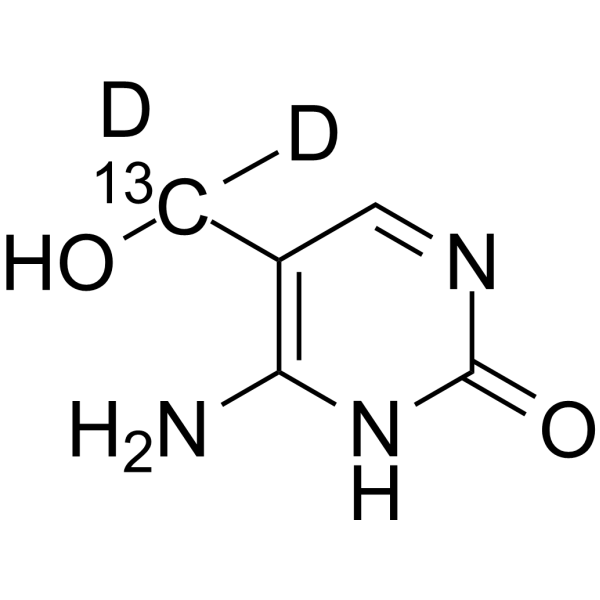
5-Hydroxymethylcytosine-13C,d2
5-Hydroxymethylcytosine-13C,d2 is the 13C and deuterium labeled 5-Hydroxymethylcytosine (HY-W018324). 5-Hydroxymethylcytosine (5hmC) is an oxidized forms of 5-methylcytosine (5mC) in mammalian DNA. 5-Hydroxymethylcytosine is produced from 5mC in an enzymatic pathway involving three 5mC oxidases, Ten-eleven translocation (TET)1, TET2, and TET3. The conversion of 5mC into 5hmC can be the first step in a pathway leading towards DNA demethylation. 5-Hydroxymethylcytosine is associated with gene transcription and frequently used as a mark to investigate dynamic DNA methylation conversion during mammalian development. 5-Hydroxymethylcytosine can be used for the study of non-small cell lung cancer (NSCLC), neurodegenerative diseases (Alzheimer’s, Parkinson’s) and hematological malignancies (acute myeloid leukemia, myelodysplastic syndromes).
For research use only. We do not sell to patients.
- Formula: C413CH5D2N3O2
- Molecular Weight:144.13
-
Storage:
Please store the product under the recommended conditions in the Certificate of Analysis.

To place orders, for customer services and technical support, please contact: MedChemExpress USA
Tel: 609-228-6898 E-mail: [email protected] [email protected]


-
 Biological Activity
-
Chemical Information
- Protocols
- Purity & Documentation
- References
-
 Help & FAQs




Biological Activity
Description
In Vitro
Stable heavy isotopes of hydrogen, carbon, and other elements have been incorporated into drug molecules, largely as tracers for quantitation during the drug development process. Deuteration has gained attention because of its potential to affect the pharmacokinetic and metabolic profiles of drugs. 5-Hydroxymethylcytosine (5hmC) is a stable epigenetic modification derived from the oxidation of 5-methylcytosine (5mC) by ten-eleven translocation (TET) enzymes (TET1, TET2, TET3). 5-Hydroxymethylcytosine functions as both an intermediate in active DNA demethylation and an independent regulator of gene expression-enriching in CpG islands, active/bivalent promoters, and transcriptional enhancers to promote euchromatin formation and modulate transcription factor binding. 5-Hydroxymethylcytosine plays pivotal roles in biological processes: maintaining embryonic stem cell (ESC) pluripotency, driving neurodevelopment, and restraining tumor progression[1][2].
MedChemExpress (MCE) has not independently confirmed the accuracy of these methods. They are for reference only. Further protocols information, click here.
Application
1. This compound can be used as a tracer
2. This compound can be used as an internal standard for quantitative analysis by NMR, GC-MS, or LC-MS.


Chemical Information
-
Molecular Weight 144.13
-
Formula C413CH5D2N3O2
-
SMILES
O=C1N=CC([13C]([2H])([2H])O)=C(N)N1
-
Synonyms
5hmC-13C,d2
-
Shipping
Room temperature in continental US; may vary elsewhere.
-
Storage
Please store the product under the recommended conditions in the Certificate of Analysis.

Protocols
-
Research Protocol for Epigenomic Data Analysis
Epigenomic data analysis identifies genome-wide regulatory features that influence gene expression, chromatin state, and phenotype without changing the underlying DNA sequence. In this strategy, the core regulatory layer includes chromatin accessibility, transcription-factor or histone-mark occupancy, DNA methylation, and chromatin-state patterns; these features are measured by sequencing-based assays and interpreted as regulatory elements, promoters, enhancers, repressive domains, methylated cytosines, or candidate phenotype-associated chromatin programs. The literature links epigenomic features to phenotype by showing that functional genomic elements can be mapped across human cell types and tissues, and that integrated epigenomic maps reveal cell-type-specific regulatory programs. ENCODE integrated transcription, chromatin accessibility, transcription-factor occupancy, and histone modification data to annotate functional elements in the human genome, while the Roadmap Epigenomics Co


Purity & Documentation
References
[1]. Russak EM, et al. Impact of Deuterium Substitution on the Pharmacokinetics of Pharmaceuticals. Ann Pharmacother. 2019 Feb;53(2):211-220. [Content Brief]
[2]. Zheng K, et al. 5-Hydroxymethylcytosine: Far Beyond the Intermediate of DNA Demethylation. Int J Mol Sci. 2024 Nov 2;25(21):11780. [Content Brief]
[3]. Pfeifer GP, et al. 5-hydroxymethylcytosine and its potential roles in development and cancer. Epigenetics Chromatin. 2013 May 1;6(1):10. [Content Brief]
[4]. Cui XL, et al. A human tissue map of 5-hydroxymethylcytosines exhibits tissue specificity through gene and enhancer modulation. Nat Commun. 2020 Dec 2;11(1):6161. [Content Brief]

Calculators
Concentration (start) × Volume (start) = Concentration (final) × Volume (final)


5-Hydroxymethylcytosine-13C,d2 Related Classifications
HY-W018324S Related Classifications
 Powered by Bioz