



CDK2

Based on 1 Customer Validation
CDK2 is a member of the eukaryotic S/T protein kinase family and its function is to catalyze the phosphoryl transfer of ATP γ-phosphate to serine or threonine hydroxyl (denoted as S0/T0) in a protein substrate.
Nur für Forschungszwecke. Wir verkaufen nicht an Patienten.
- Reinheit : 98.61%
- CAS. Nr.: 255064-79-0
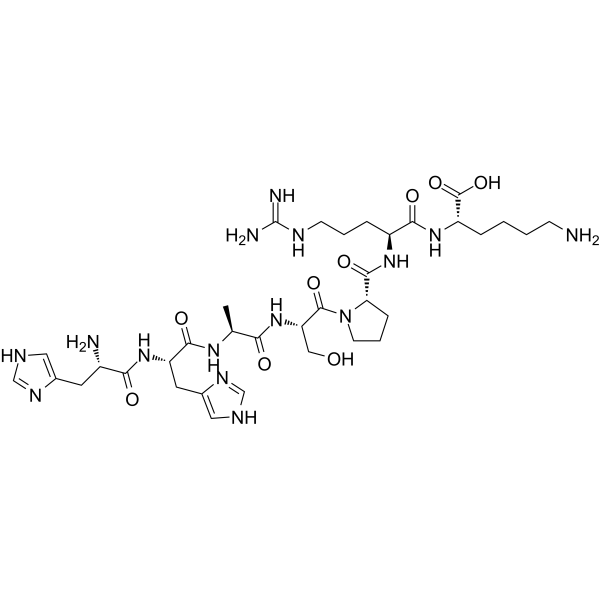
- Formel: C35H57N15O9
- Molecular Weight:831.92
-
Speicherung:
Sealed storage, away from moisture.
Powder -80°C, 2 years , -20°C, 1 year* In solvent : -80°C, 6 months; -20°C, 1 month (sealed storage, away from moisture)

To place orders, for customer services and technical support, please contact: MedChemExpress USA
Tel: 609-228-6898 E-mail: [email protected] [email protected]


-
 Biologische Aktivität
-
Chemical Information
-
Lösungsmittel & Löslichkeit
- Reinheit & Dokumentation
- Verweise
-
 Help & FAQs




Biologische Aktivität
Beschreibung
In Vitro
CDK2 (Cyclin-dependent kinase 2) is a member of the eukaryotic S/T protein kinase family and its function is to catalyze the phosphoryl transfer of ATP γ-phosphate to serine or threonine hydroxyl (denoted as S0/T0) in a protein substrate. The fully active CDK2 is in complex with HHASPRK (an optimal peptide substrate), namely interactions of CDK2 with peptide substrate and the dynamics of the G-loop. CDK2 participates in eukaryotic cell cycle regulation at the G1/S boundary. CDK2 deregulation has been proved to occur in tumor cells, evoking a strong interest in artificial and native inhibitors. CDK2 activity is tightly regulated by a complex mechanism, including a positive regulatory subunit binding, and phosphorylations at positive and/or negative regulatory sites[1].
MedChemExpress (MCE) has not independently confirmed the accuracy of these methods. They are for reference only. .


Chemical Information
-
CAS. Nr. 255064-79-0
-
Appearance Solid
-
Molecular Weight 831.92
-
Formel C35H57N15O9
-
Color White to off-white
-
Sequence
His-His-Ala-Ser-Pro-Arg-Lys
-
Sequence Shortening
HHASPRK
-
Versand
Room temperature in continental US; may vary elsewhere.
-
Speicherung
Sealed storage, away from moisture
Powder -80°C 2 years -20°C 1 year * In solvent : -80°C, 6 months; -20°C, 1 month (sealed storage, away from moisture)


Lösungsmittel & Löslichkeit
In Vitro
H2O
Peptide Solubility and Storage Guidelines:
1. Calculate the length of the peptide.
2. Calculate the overall charge of the entire peptide according to the following table:
| Contents | Assign value | |
|---|---|---|
| Acidic amino acid | Asp (D), Glu (E), and the C-terminal -COOH. | -1 |
| Basic amino acid | Arg (R), Lys (K), His (H), and the N-terminal -NH2 | +1 |
| Neutral amino acid | Gly (G), Ala (A), Leu (L), Ile (I), Val (V), Cys (C), Met (M), Thr (T), Ser (S), Phe (F), Tyr (Y), Trp (W), Pro (P), Asn (N), Gln (Q) | 0 |
3. Recommended solution:
| Overall charge of peptide | Details |
|---|---|
| Negative (<0) |
1. Try to dissolve the peptide in water first. 2. If water fails, add NH4OH (<50 μL). 3. If the peptide still does not dissolve, add DMSO (50-100 μL) to solubilize the peptide. |
| Positive (>0) |
1. Try to dissolve the peptide in water first. 2. If water fails, try dissolving the peptide in a 10%-30% acetic acid solution. 3. If the peptide still does not dissolve, try dissolving the peptide in a small amount of DMSO. |
| Zero (=0) |
1. Try to dissolve the peptide in organic solvent (acetonitrile, methanol, etc.) first. 2. For very hydrophobic peptides, try dissolving the peptide in a small amount of DMSO, and then dilute the solution with water to the desired concentration. |


Reinheit & Dokumentation
-
Data Sheet (258 KB)
-
SDS (252 KB)
- English - EN (252 KB)
- Français - FR (252 KB)
- Deutsch - DE (252 KB)
- Norwegian - NO (252 KB)
- Español - ES (252 KB)
- Swedish - SV (252 KB)
- Italian - IT (252 KB)
- Korean - KR (252 KB)
- Portuguese - PT (252 KB)
-
Handling Instructions (2659 KB)
Verweise

Calculators
Konzentration (Stammlösung) × Volumen (Stammlösung) = Konzentration (Ziellösung) × Volumen (Ziellösung)


CDK2 Related Classifications
HY-P0235 Related Classifications
 Powered by Bioz