



Cetoleic acid

Based on 1 Customer Validation
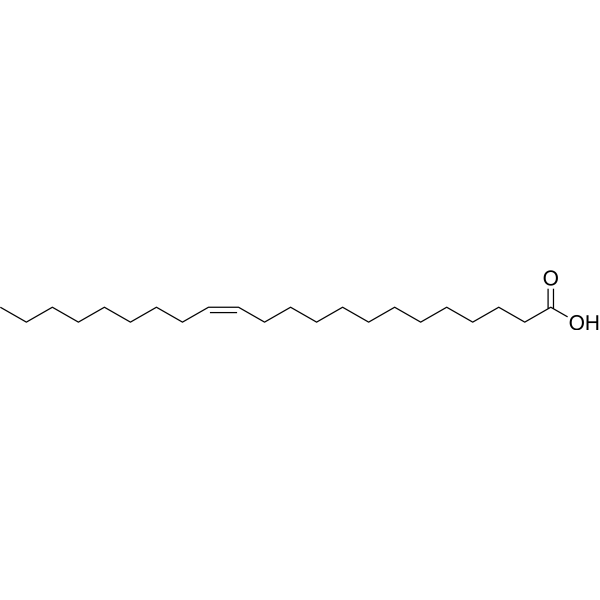
Cetoleic acid is a long-chain monounsaturated fatty acid found in deep-sea fish. Cetoleic acid can promote the synthesis of ALA in human HepG2 cells and EPA in vitro in salmon liver cells, affecting cholesterol levels in rodents. Cetoleic acid has potential applications in cardiovascular disease research.
For research use only. We do not sell to patients.
- Purity : 99.99%
- CAS No.: 1002-96-6
- Formula: C22H42O2
- Molecular Weight:338.57
-
Storage:Powder -20°C, 3 years , 4°C, 2 years ; In solvent -80°C, 6 months , -20°C, 1 month


To place orders, for customer services and technical support, please contact: MedChemExpress USA
Tel: 609-228-6898 E-mail: [email protected] [email protected]


-
 Biological Activity
-
Chemical Information
-
Solvent & Solubility
- Protocols
- Purity & Documentation
- References
-
 Help & FAQs



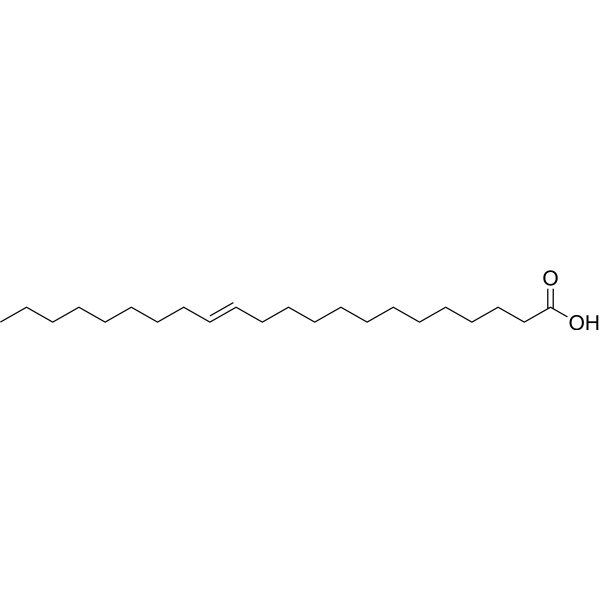

All Endogenous Metabolite Isoforms
More

Biological Activity
Description
Clinical Trial
| NCT Number | Sponsor | Condition | Start Date |
Phase

|
|---|---|---|---|---|
| NCT01329991 | Plexxikon| | 2011-05 | PHASE1 |


Chemical Information
-
CAS No. 1002-96-6
-
Appearance Solid
-
Molecular Weight 338.57
-
Formula C22H42O2
-
Color White to off-white
-
SMILES
CCCCCCCCCC/C=C\CCCCCCCCCC(O)=O
-
Shipping
Room temperature in continental US; may vary elsewhere.
-
Storage
Powder -20°C 3 years 4°C 2 years In solvent -80°C 6 months -20°C 1 month


Solvent & Solubility
In Vitro:
Ethanol : 25 mg/mL (73.84 mM; Need ultrasonic)
Please refer to the solubility information to select the appropriate solvent. Once prepared, please aliquot and store the solution to prevent product inactivation from repeated freeze-thaw cycles.
Storage method and period of stock solution: -80°C, 6 months; -20°C, 1 month. When stored at -80°C, please use it within 6 months. When stored at -20°C, please use it within 1 month.
Please refer to the solubility information to select the appropriate solvent. Once prepared, please aliquot and store the solution to prevent product inactivation from repeated freeze-thaw cycles.
Storage method and period of stock solution: -80°C, 6 months; -20°C, 1 month. When stored at -80°C, please use it within 6 months. When stored at -20°C, please use it within 1 month.
Concentration (start) × Volume (start) = Concentration (final) × Volume (final)


Purity & Documentation
-
Data Sheet (264 KB)
-
SDS (393 KB)
- English - EN (393 KB)
- Français - FR (393 KB)
- Deutsch - DE (393 KB)
- Norwegian - NO (393 KB)
- Español - ES (393 KB)
- Swedish - SV (393 KB)
- Italian - IT (393 KB)
- Korean - KR (393 KB)
- Portuguese - PT (393 KB)
-
Handling Instructions (2659 KB)
References
[1]. Tone-Kari Knutsdatter Østbye, et al. The long-chain monounsaturated cetoleic acid improves the efficiency of the n-3 fatty acid metabolic pathway in Atlantic salmon and human HepG2 cells. Br J Nutr. 2019 Oct 14;122(7):755-768. [Content Brief]
[2]. Margrete Mjaatveit, et al. Effects of diets containing fish oils or fish oil concentrates with high cetoleic acid content on the circulating cholesterol concentration in rodents. A systematic review and meta-analysis. Br J Nutr. 2024 Feb 28;131(4):606-621. [Content Brief]


Complete Stock Solution Preparation Table
Please refer to the solubility information to select the appropriate solvent. Once prepared, please aliquot and store the solution to prevent product inactivation from repeated freeze-thaw cycles.
Storage method and period of stock solution: -80°C, 6 months; -20°C, 1 month. When stored at -80°C, please use it within 6 months. When stored at -20°C, please use it within 1 month.
| Optional Solvent | Concentration Solvent Mass | 1 mg | 5 mg | 10 mg | 25 mg |
|---|---|---|---|---|---|
| Ethanol | 1 mM | 2.9536 mL | 14.7680 mL | 29.5360 mL | 73.8400 mL |
| 5 mM | 0.5907 mL | 2.9536 mL | 5.9072 mL | 14.7680 mL | |
| 10 mM | 0.2954 mL | 1.4768 mL | 2.9536 mL | 7.3840 mL | |
| 15 mM | 0.1969 mL | 0.9845 mL | 1.9691 mL | 4.9227 mL | |
| 20 mM | 0.1477 mL | 0.7384 mL | 1.4768 mL | 3.6920 mL | |
| 25 mM | 0.1181 mL | 0.5907 mL | 1.1814 mL | 2.9536 mL | |
| 30 mM | 0.0985 mL | 0.4923 mL | 0.9845 mL | 2.4613 mL | |
| 40 mM | 0.0738 mL | 0.3692 mL | 0.7384 mL | 1.8460 mL | |
| 50 mM | 0.0591 mL | 0.2954 mL | 0.5907 mL | 1.4768 mL | |
| 60 mM | 0.0492 mL | 0.2461 mL | 0.4923 mL | 1.2307 mL |


Cetoleic acid Related Classifications
HY-113000 Related Classifications
 Powered by Bioz