



Brassicaceae Extract
-
- Raphanus sativus Linn. (11)
- Lepidium meyenii Walp. (10)
- Cruciferous vegetables (10)
- Arabidopsis thaliana (L.) Heynh. (9)
- Arabidopsis thaliana (7)
- Brassica oleracea L. (7)
- Camelina sativa (L.) Crantz (7)
- Isatis tinctoria L. (5)
- Brassica juncea (Linnaeus) Czernajew (4)
- Brassica napus L. (4)
- Brassica campestris L. (3)
- Brassica napus var. napobrassica (L.) Rchb. (3)
- Brassica rapa L. (3)
- Brassica rapa var. oleifera de Candolle (3)
- Coronopus didymus (3)
- Aurinia sinuata (L.) Griseb. (2)
- Brassica oleracea var. italica Plenck (2)
- Degenia velebitica (Degen) Hayek (2)
- Eruca vesicaria subsp. sativa (Mill.) Thell. (2)
- Erysimum cheiranthoides Linn. (2)
- Eutrema wasabi (Siebold) Maximowicz (2)
- Lepidium apetalumWilld. (2)
- Mutarda nigra (L.) Bernh. (2)
- Rorippa indica (L.) Hiern (2)
- Sinapis alba L. (2)
- Armoracia rusticana G. Gaertn., B. Mey. & Scherb. (1)
- Barbarea stricta Andrz. ex Besser (1)
- Brassica napus var. napobrassica (Linnaeus) Reichenbach (1)
- Brassica oleracea var. gongylodes L. (1)
- Capsella bursa-pastoris (L.) Medik. (1)
- Cardamine hirsuta L. (1)
- Conringia orientalis (L.) C.Presl (1)
- Crambe cordifolia Steven (1)
- Draba nemorosa L. (1)
- Erucaria microcarpa Boiss. (1)
- Iberis amara L. (1)
- Lepidium sativum L. (1)
- Lunaria annua L. (1)
- Nasturtium officinale R.Br. ex W.T.Aiton (1)
- Raphanus raphanistrum L. (1)
- Sisymbrium officinale (L.) Scop. (1)
-
Brassicaceae Extract (127)

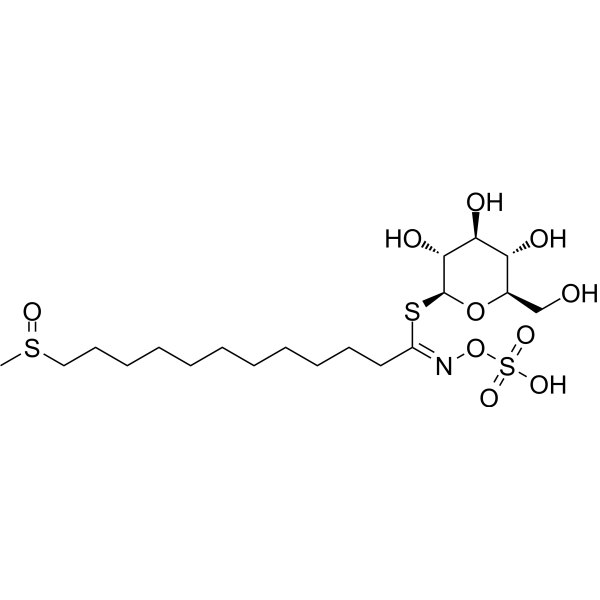
- Formula: C19H37NO10S3
- Molecular Weight: 535.69
11-(Methylsulfinyl)undecyl-glucosinolate is an aliphatic glucosinolate.

- Formula: C5H6O4
- Molecular Weight: 130.10
Mesaconic acid (Standard) is the analytical standard of Mesaconic acid. This product is intended for research and analytical applications. Mesaconic acid (Citronic acid; Methylfumaric acid) is an orally active anti-inflammatory and antioxidant agent. Mesaconic acid reduces the level of NF-κB in colon tissues, downregulates the expression of Keap1 and Bax, upregulates the expression of Nrf2 and Bcl2, and decreases the expression of Caspase-1. Mesaconic acid reduces the levels of NLRP3, ASC and Casp-1 in colon, liver and kidney tissues. Mesaconic acid reduces pro-inflammatory cytokine levels, increases the level of the anti-inflammatory cytokine IL-10, elevates NAD+ levels, regulates oxidative stress markers and antioxidant enzyme levels, and upregulates intestinal barrier proteins in colon, liver and kidney tissues. Mesaconic acid increases the abundance of beneficial gut bacteria and reduces the abundance of harmful gut bacteria in rapidly aging mice, and exhibits anti-aging properties. Mesaconic acid acts as a flame retardant and serves as a competitive inhibitor of fumarate reduction. Mesaconic acid can be used in the research of aging-related inflammation.
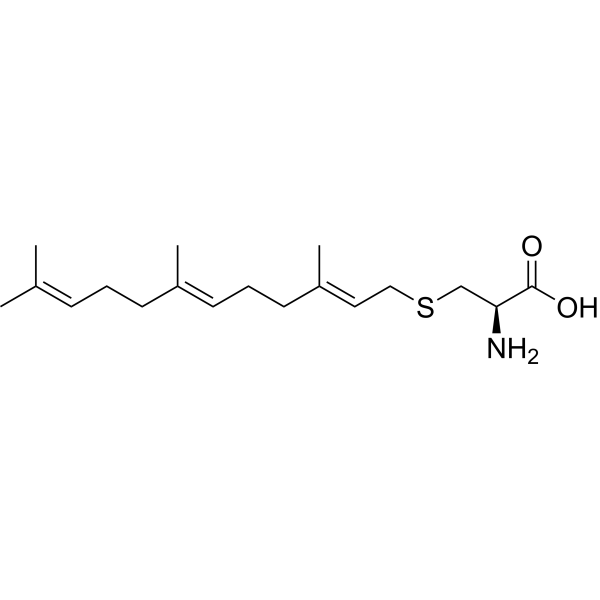
- Formula: C18H31NO2S
- Molecular Weight: 325.51
Farnesylcysteine (FC) is a competitive inhibitor of ICMT. The fcly mutant has quantitatively low farnesylcysteine (FC) lyase activity and an enhanced response to ABA. Farnesylcysteine induces an ABA hypersensitive phenotype in Arabidopsis thaliana.


- Formula: C13H24KNO9S3
- Molecular Weight: 473.62
Glucoberteroin potassium is an aliphatic glucosinolate. Glucoberteroin potassium can be isolated from Degenia velebitica, inhibits protein glycosylation and carbonylation, reduces the production of carbonylated proteins, and helps prevent skin aging.

- Formula: C11H18KNO10S2
- Molecular Weight: 427.49
Progoitrin potassium is an orally active glucosinolate. As the precursor of goitrin (HY-N0224A), an antithyroid compound, progoitrin releases goitrin via hydrolysis by myrosinase or gastrointestinal glucosidase. Progoitrin converts to goitrin in vivo and exerts antithyroid activity by inhibiting the accumulation of radioactive iodine in the thyroid gland. Progoitrin potassium can be used in the research of Graves' disease (thyrotoxicosis).

- Formula: C28H32O14
- Molecular Weight: 592.55
1,2-Disinapoylglucose is a phenylpropanoid sinapate ester that exists in the developing seeds of Brassica napus and Brassica oleracea L. var. costata DC, as well as in Arabidopsis thaliana seedlings. 1,2-Disinapoylglucose can be used in studies related to Verticillium longisporum infection.

- Formula: C17H23NO11S2
- Molecular Weight: 481.49
Glucomalcomin (3-Benzoyloxypropyl glucosinolate) is an aliphatic, side-chain benzoylated hydroxyalkyl derivative of 3-hydroxypropyl glucosinolate. Glucomalcomin is one of the most abundant glucosinolates induced to accumulate by high temperature during seed development of Arabidopsis thaliana, and its content is closely correlated with the expression of the AOP3 gene.

- Formula: C16H31NO10S3
- Molecular Weight: 493.61
Glucohirsutin is an 8-carbon aliphatic glucosinolate that can be isolated from *Arabidopsis thaliana* seeds. The abundance of Glucohirsutin is increased in a specific *Arabidopsis thaliana* mutant line (3614) with seed-specific glucosinolate alterations.

- Formula: C15H20KNO10S2
- Molecular Weight: 477.55
Glucobarbarin is a glucosinolate that can be isolated from cruciferous species such as Barbarea stricta. Under the enzymatic action of myrosinase, glucobarbarin is converted to barbarin via an unstable isothiocyanate intermediate, and further converted to resedine.

- Formula: C18H35NO10S3
- Molecular Weight: 521.67
Glucocamelinin (GSL 10) is a sulfinyl glucosinolate identified from seeds of Camelina sativa and an upregulator of quinone reductase (NQO1). Glucocamelinin upregulates the activity of phase II detoxifying enzymes, exhibits selective cytotoxic activity against lung cancer cells, and possesses in vitro antioxidant activity. Glucocamelinin can be used in studies related to non-small cell lung cancer.




