



Autophagy
Autophagy is a conserved cellular degradation and recycling process in the lysosome. In mammalian cells, there are three primary types of autophagy: microautophagy, macroautophagy, and chaperone-mediated autophagy (CMA). Microphagy captures cargoes by means of invaginations or protrusions of the lysosomal membrane directly, CMA uses chaperones to identify cargo proteins and then unfolds and transfers them into the lysosomal, while macroautophagy sequesters cargo by autophagosomes-de novo synthesized of double-membrane vesicles-and subsequently transport it to the lysosome.
Macroautophagy is the best studied and it occurs at a low level constitutively and can also be further induced under stress conditions, such as nutrient or energy starvation with a salient feature of autophagy protein degradation. Stress-induced macrophagy plays an important role in protein catabolism with another key protein degradation pathway, the ubiquitin–proteasome system (UPS).
As the study progressed, autophagy gains its importance under basal, nutrient-rich conditions, and is now recognized as a critical housekeeping pathway in catabolism of diverse cellular constituents, such as protein aggregates (aggrephagy), lipid droplets (lipophagy), iron complex (Ferritinophagy) and carbohydrate. Except for macromolecules, autophagy can also target several organelles and structures, such as mitochondria (mitophagy), peroxisome (pexophagy), endoplasmic reticulum (reticulophagy or ER-phagy), ribosome (ribophagy), spermatozoon-inherited organelles following fertilization (allophagy), secretory granules within pancreatic cells (zymophagy) and intracellular pathogens (xenophagy).
Autophagy and its dysfunction are associated with a variety of human pathologies, including ageing, cancer, neurodegenerative disease, heart disease and metabolic diseases, such as diabetes. Plenty of drugs and natural products are involved in autophagy modulation through multiple signaling pathways. Small molecules that can regulate autophagy seem to have great potential to intervene such diseases in animal models or clinical courses.
All Product Categories
-
Autophagy Inhibitors
(485)
View all products
-
Autophagy Agonists
(6)
View all products
-
Autophagy Activators
(124)
View all products
-
Autophagy Modulators
(59)
View all products
-
Autophagy Chemicals
(2)
View all products
-
Autophagy Inducers
(2200)
View all products
-
Autophagy Controls
(5)
View all products
-
Autophagy Ligand
(1)
View all products
-
Autophagy Related Products (3416)
Related Products (3416)

-
Antibodies (31)
-
Autophagy Signaling Pathway
-
Esmolol hydrochloride (Standard)
 0 ImagesEsmolol hydrochloride (Standard) is the analytical standard of Esmolol hydrochloride (HY-B1392).This product is intended for research and analytical applications. Esmolol hydrochloride is an ultra-short-acting cardioselective β1-adrenergic blocker. Esmolol hydrochloride exerts its antiarrhythmic effect by activating Neurokinin 1 ReceptorEsmolol hydrochloride attenuates post resuscitation myocardial dysfunction. Esmolol hydrochloride improves diabetic wound healing by inhibiting aldose reductase and the production of advanced glycation end products and promoting fibroblast migration. Esmolol hydrochloride can be used to study cardiac diseases such as arrhythmias and diabetic foot ulcers.
-
Lamotrigine-d3
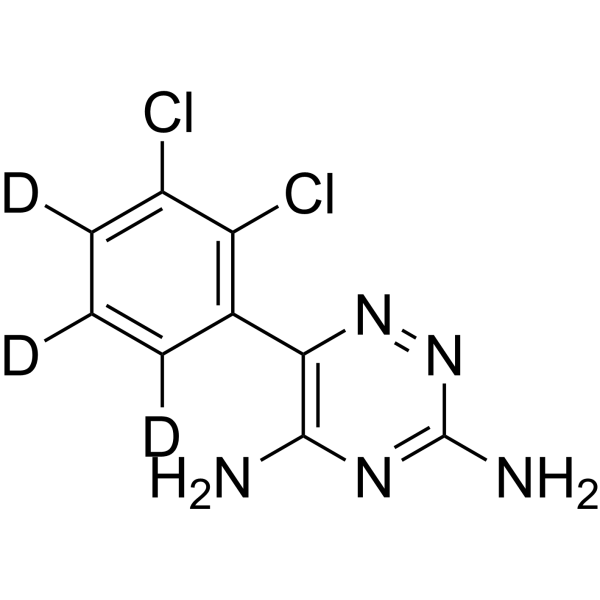 0 ImagesCat. No.: HY-B0495S5CAS No.: 1132746-94-1Synonyms: LTG-d3; BW430C-d3Lamotrigine-d3 is the deuterium labeled Lamotrigine. Lamotrigine (BW430C) is a potent and orally active anticonvulsant or antiepileptic agent. Lamotrigine selectively blocks voltage-gated Na+ channels, stabilizing presynaptic neuronal membranes and inhibiting glutamate release. Lamotrigine can be used for the research of epilepsy, focal seizure, et al.
-
Atorvastatin sodium (Standard)
 0 ImagesCat. No.: HY-108257RCAS No.: 134523-01-6Atorvastatin sodium (Standard) is the analytical standard of Atorvastatin (sodium) (HY-108257). This product is intended for research and analytical applications. Atorvastatin sodium is an orally active HMG-CoA reductase inhibitor, has the ability to effectively decrease blood lipids. Atorvastatin sodium inhibits human SV-SMC proliferation and invasion with IC50s of 0.39 μM and 2.39 μM, respectively.
-
Cediranib (Standard)
 0 ImagesSynonyms: AZD2171 (Standard)Cediranib (Standard) is the analytical standard of Cediranib. This product is intended for research and analytical applications. Cediranib (AZD2171) is a highly potent, orally available VEGFR tyrosine kinase inhibitor with IC50s of <1, <3, 5, 5, 36, 2 nM for Flt1, KDR, Flt4, PDGFRα, PDGFRβ, c-Kit, respectively.
-
Ethalfluralin
 0 ImagesCat. No.: HY-W714214CAS No.: 55283-68-6Ethalfluralin is a dinitroaniline herbicide and microtubule inhibitor. Ethalfluralin blocks nuclear division and cytokinesis of parasites by inhibiting intranuclear spindle formation. Ethalfluralin activates the phosphorylation levels of NF-κB and P38 MAPK, inhibits the PI3K/AKT signaling pathway, impairs mitochondrial function, and induces apoptosis, endoplasmic reticulum stress, autophagy, and ROS production. Ethalfluralin is applicable to research related to toxoplasmosis.
-
Fluoxetine (Standard)
 0 ImagesCat. No.: HY-B0102RCAS No.: 54910-89-3Synonyms: LY-110140 free base (Standard)Fluoxetine (Standard) is the analytical standard of Fluoxetine (HY-B0102). This product is intended for research and analytical applications. Fluoxetine (LY-110140 free base) is a selective serotonin reuptake inhibitor (SSRI) class used for antidepressant research.
-
Metofenazate diethanesulfonate
 0 ImagesCat. No.: HY-100263BCAS No.: 1674-48-2Synonyms: Methophenazine diethanesulfonateMetofenazate diethanesulfonate is a selective calmodulin inhibitor.
-
Silybin A (Standard)
 0 ImagesCat. No.: HY-13748RCAS No.: 22888-70-6Synonyms: Silibinin A (Standard)Silybin A (Standard) is the analytical standard of Silybin A. This product is intended for research and analytical applications. Silybin A (Silibinin A), an effective anti-cancer and chemopreventive agent, has been shown to exert multiple effects on cancer cells, including inhibition of both cell proliferation and migration.
-
Ipsalazide
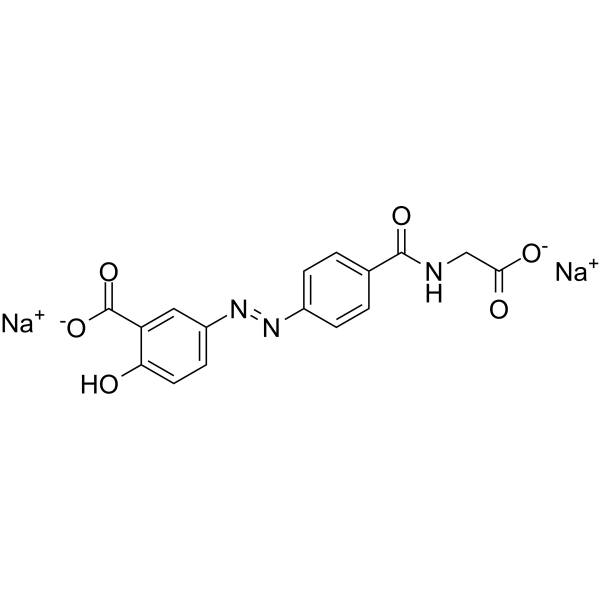 0 ImagesCat. No.: HY-101744CAS No.: 82101-17-5Ipsalazide is a novel sulfasalazine analog designed to release 5-aminosalicylic acid and a nontoxic carrier molecule in the gastrointestinal tract.
-
Bergapten (Standard)
 0 ImagesBergapten (Standard) is the analytical standard of Bergapten. This product is intended for research and analytical applications. Bergapten is a natural anti-inflammatory and anti-tumor agent. Bergapten is inhibitory towards mouse and human CYP isoforms.
-
F-SLOH
 0 ImagesCat. No.: HY-183660CAS No.: 1620896-55-0F-SLOH is a brain-penerant and orally active TFEB activator and amyloid-β inhibitor with an IC50 of 3.4 μM against amyloid-β. F-SLOH promotes nuclear translocation of TFEB, driving autophagy and lysosomal biogenesis. F-SLOH reduces amyloid-β oligomers and Tau aggregates via autophagy lysosomal degradation pathway. F-SLOH can be used for the research of Alzheimer’s disease.
-
Tolvaptan (Standard)
 0 ImagesSynonyms: OPC-41061 (Standard)Tolvaptan (Standard) is the analytical standard of Tolvaptan. This product is intended for research and analytical applications. Tolvaptan is a selective, competitive and orally active vasopressin receptor 2 (V2R) antagonist with an IC50 of 1.28 μM for the inhibition of arginine vasopressin (AVP)-induced platelet aggregation. Tolvaptan induces cell apoposis and affects cell cycle. Tolvaptan can be used for the research of hyponatremia.
-
Daurisoline (Standard)
 0 ImagesCat. No.: HY-N0221RCAS No.: 70553-76-3Synonyms: (R,R)-Daurisoline (Standard)Daurisoline (Standard) is the analytical standard of Daurisoline. This product is intended for research and analytical applications. Daurisoline is a bis-benzylisoquinoline alkaloid that can be isolated from Menispermum dauricum and Rhizoma Menispermi. Daurisoline exerts a blocking effect on hERG and has antiarrhythmic effects. Daurisoline is a potent autophagy blocker that can be used for the research of cancer.

-
Redafamdastat (Standard)
 0 ImagesCat. No.: HY-14376RCAS No.: 1020315-31-4Synonyms: PF-04457845 (Standard)Redafamdastat (Standard) is the analytical standard of Redafamdastat. This product is intended for research and analytical applications. Redafamdastat (PF-04457845) is a highly efficacious and selective FAAH inhibitor with IC50 values is 7.2±0.63 nM and 7.4±0.62 nM for hFAAH and rFAAH, respectively.
-
SB 202190 hydrochloride (Standard)
 0 ImagesSB 202190 (hydrochloride) (Standard) is the analytical standard of SB 202190 (hydrochloride). This product is intended for research and analytical applications. SB 202190 hydrochloride is a selective p38 MAP kinase inhibitor with IC50s of 50 nM and 100 nM for p38α and p38β2, respectively. SB 202190 hydrochloride binds to the ATP pocket of the active recombinant human p38 kinase with a Kd of 38 nM. SB 202190 hydrochloride has anti-cancer activity. SB202190 hydrochloride induces autophagy.
-
BI-D1870 (Standard)
 0 ImagesBI-D1870 (Standard) is the analytical standard of BI-D1870 (HY-10510). This product is intended for research and analytical applications. BI-D1870 is an ATP-competitive, cell permeable and brain penetrated inhibitor of RSK isoforms, with IC50s of 31 nM/24 nM/18 nM/15 nM for RSK1/RSK2/RSK3/RSK4, respectively.
-
Glucosamine-13C6
 0 ImagesCat. No.: HY-B1125SSynonyms: D-Glucosamine-13C6; Chitosamine-13C6Glucosamine-13C6 (D-Glucosamine-13C6) is 13C labeled Glucosamine. Glucosamine (D-Glucosamine) is an amino sugar and a prominent precursor in the biochemical synthesis of glycosylated proteins and lipids, is used as a dietary supplement. Glucosamine also is a natural constituent of glycosaminoglycans in the cartilage matrix and synovial fluid, which when administered exogenously, exerts pharmacological effects on osteoarthritic cartilage and chondrocytes.
-
Z-VAD (Standard)
 0 ImagesCat. No.: HY-164388RCAS No.: 162852-62-2Z-VAD (Standard) is the analytical standard of Z-VAD (HY-164388). This product is intended for research and analytical applications. Z-VAD is an irreversible, broad-spectrum pan-caspase inhibitor that can inhibit a variety of caspases including caspase-3, -6, -7, -8, -9, etc. (with a weaker inhibitory effect on caspase-2). Z-VAD can block apoptosis signaling pathways, induce autophagy and necrosis in tumor cells, and has anti-angiogenic activity. Z-VAD can enhance the sensitivity of breast cancer and lung cancer cells to radiotherapy in vitro and in vivo, and prolong the growth delay of tumor xenograft models. Z-VAD is well tolerated and is mainly used in research related to cancer radiosensitization and cell death pathway regulation.
-
DAPT (Standard)
 0 ImagesCat. No.: HY-13027RCAS No.: 208255-80-5Synonyms: GSI-IX (Standard)DAPT (Standard) is the analytical standard of DAPT (HY-13027). This product is intended for research and analytical applications. DAPT (GSI-IX) is a potent and orally active γ-secretase inhibitor with IC50s of 115 nM and 200 nM for total amyloid-β (Aβ) and Aβ42, respectively. DAPT inhibits the activation of Notch 1 signaling and induces cell differentiation. DAPT also induces autophagy and apoptosis. DAPT has neuroprotection activity and has the potential for autoimmune and lymphoproliferative diseases, degenerative disease and cancers treatment.




