



Bacterial
Anything that destroys bacteria or suppresses their growth or their ability to reproduce. Heat, chemicals such as chlorine, and antibiotic drugs all have antibacterial properties. Many antibacterial products for cleaning and handwashing are sold today. Such products do not reduce the risk for symptoms of viral infectious diseases in otherwise healthy persons. This does not preclude the potential contribution of antibacterial products to reducing symptoms of bacterial diseases in the home.
All Product Categories
-
Bacterial Inhibitors
(7521)
View all products
-
Bacterial Agonists
(3)
View all products
-
Bacterial Antagonists
(9)
View all products
-
Bacterial Activators
(24)
View all products
-
Bacterial Modulators
(27)
View all products
-
Bacterial Chemicals
(2)
View all products
-
Bacterial Inducers
(7)
View all products
-
Bacterial Controls
(14)
View all products
-
Bacterial Substrates
(2)
View all products
-
Bacterial Ligand
(1)
View all products
-
Bacterial Related Products (8852)
Related Products (8852)

-
Antibodies (14)
-
Related Compound Screening Libraries (1)
-
Polymyxin M
 0 ImagesPolymyxin M is a cyclic peptide antibiotic found in Bacillus polymyxa var. Ross.
-
Indomethacin-13C6
 0 ImagesCat. No.: HY-14397S3Synonyms: Indometacin-13C6Indomethacin-13C6 (Indometacin-13C6) is 13C labeled Indomethacin. Indomethacin (Indometacin) is a potent, orally active COX1/2 inhibitor with IC50 values of 18 nM and 26 nM for COX-1 and COX-2, respectively. Indomethacin has anticancer activity and anti-infective activity. Indomethacin can be used for cancer, inflammation and viral infection research.
-
2-Methoxybenzaldehyde (Standard)
 0 Images2-Methoxybenzaldehyde (Standard) is the analytical standard of 2-Methoxybenzaldehyde. This product is intended for research and analytical applications. 2-Methoxybenzaldehyde (o-Anisaldehyde) is a bacterial/fungal inhibitor with a BA50 value of 0.19 for Salmonella. 2-Methoxybenzaldehyde can be used for the study of bacterial and fungal infectious diseases.
-
(+)-Tuberine
 0 ImagesCat. No.: HY-187580CAS No.: 97400-75-4(+)-Tuberine is an alkaloid found in Haplophyllum tuberculatum, with antibacterial and antifungal activities. (+)-Tuberine can be used in studies on antimicrobial natural products and microbial growth inhibition.
-
BRD-9327
 0 ImagesCat. No.: HY-172348CAS No.: 443894-71-1BRD-9327 is an inhibitor of EfpA. BRD-9327 binds in the outer vestibule without complete blockade of the substrate path to the outside, suggesting its possible inhibition of the movement necessary for alternate access of the transporter. BRD-9327 can be used for anti-tuberculosis study.
-
Maridomycin VI
 0 ImagesCat. No.: HY-N14203CAS No.: 35775-66-7Maridomycin VI is a macrolide antibiotic. Maridomycin VI has the activity against Gram-positive bacteria and mycoplasma. Maridomycin VI has the effect of protecting Gram-positive bacterial infection mice.
-
Dihydroniphimycin
 0 ImagesCat. No.: HY-N14554CAS No.: 157536-03-3Dihydroniphimycin has anti-fungal, yeast and Gram-positive bacteria action.
-
Mycolic acid IIa
 0 ImagesCat. No.: HY-N15644CAS No.: 23599-54-4Mycolic acid IIa is a structural lipid component of mycobacterial cell wall. Mycolic acid IIa can be isolated from Mycobacterium bovis BCG. Mycolic acid IIa significantly modulates membrane permeability and stability, promising for mycobacterium tuberculosis infection research.
-
Poly diallyldimethylammonium chloride
 0 ImagesCat. No.: HY-W110755CAS No.: 26062-79-3Poly diallyldimethylammonium chloride is a cationic polymer with quaternary ammonium side groups, which exhibits excellent flocculation performance and thermal stability. Poly diallyldimethylammonium chloride also possesses microbicidal activity. Poly diallyldimethylammonium chloride can be used in studies on bacterial and fungal infections, as well as in research related to water treatment, textile printing and dyeing, papermaking chemical industry and other fields, with a wide range of applications.
-
SC 44914
 0 ImagesCat. No.: HY-123354CAS No.: 115812-74-3SC 44914 is a quinoxaline compound with antibacterial effects. SC-44914 has activity against Campylobacter jejuni, C. coli, and Clostridium difficile.
-
Mirosamicin
 0 ImagesCat. No.: HY-125104CAS No.: 73684-69-2Mirosamicin is an antibiotic with high antibacterial activity that targets a wide range of gram-positive bacteria and certain Gram-negative bacteria as well as mycoplasma. Mirosamicin can be used for research in the field of food safety monitoring.
-
Cefoselis hydrochloride
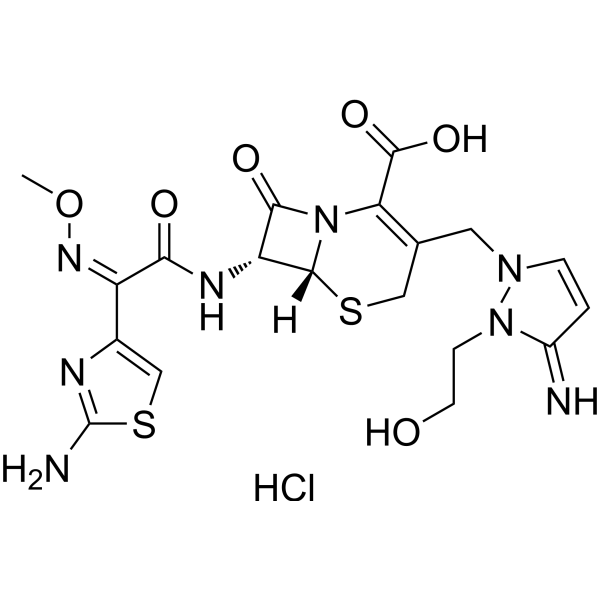 0 ImagesCat. No.: HY-B0186ACAS No.: 911212-25-4Cefoselis hydrochloride, the fourth gen-eration of cephalosporin, is a β-lactam antibiotic. Cefoselis hydrochloride exhibits good activity against a wide range of Gram-positive and Gram-negative organisms. Cefoselis hydrochloride penetrates the blood-brain barrier.
-
Dihydrotetrodecamycin
 0 ImagesCat. No.: HY-N12322CAS No.: 166403-10-7Dihydrotetrodecamycin is an antibiotic that can be isolated from the fermentation broth of Streptomyces nashvillensis MJ885-mF8. Dihydrotetrodecamycin has MIC values of 50 mg/mL against both Pasteurella piscicida sp. 639 and P. piscicida sp. 6356.
-
Antibacterial agent 297
 0 ImagesCat. No.: HY-178781Antibacterial agent 297 (Compound A40), an antibacterial agent, is a Lsrk inhibitor (IC50: 0.40 μM; KD: 3.79 μM). Antibacterial agent 297 inhibits biofilm formation and bacterial motility and changes biofilm morphology through AI-2 QS inhibition rather than direct antibacterial effects. Antibacterial agent 297 has favorable oral PK properties.

-
T3SS-1-IN-1
 0 ImagesCat. No.: HY-173598CAS No.: 930993-54-7T3SS-1-IN-1 (Compound C26) is a T3SS-1 inhibitor. T3SS-1-IN-1 inhibits the secretion of SipA and the activity of HilD (IC50 values are 29.2 and 16.9 μM, respectively). T3SS-1-IN-1 can be used for the study of anti-virulence of Salmonella.
-
L-573655
 0 ImagesCat. No.: HY-114737CAS No.: 112507-21-8L-573655 is a reversible inhibitor of UDP-3-O-[R-3-hydroxymyristoyl]-GlcNAc deacetylase with an IC50 value of 8.5 μM. L-573655 possesses antibacterial activity against a wild-type strain of E. coli. with MIC values of 200-400 μg/mL.
-
Gatifloxacin mesylate
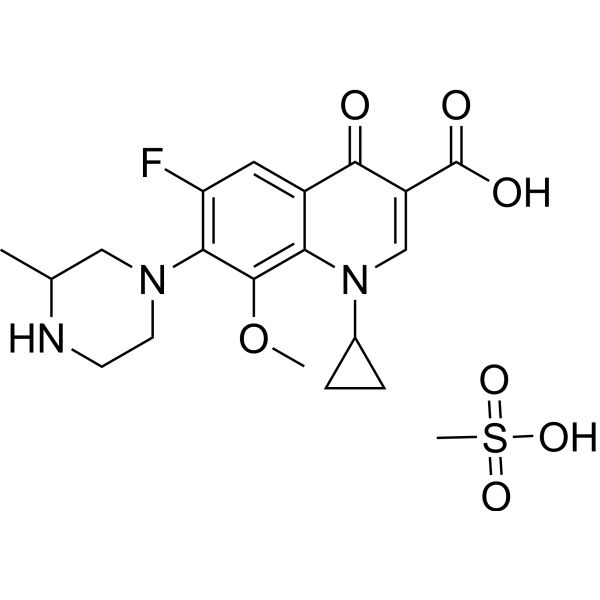 0 ImagesCat. No.: HY-10581BCAS No.: 316819-28-0Synonyms: AM-1155 mesylate; BMS-206584 mesylate; PD135432 mesylateGatifloxacin mesylate (AM-1155; BMS-206584; PD135432) is a potent fluoroquinolone antibiotic with broad-spectrum antibacterial activity. Gatifloxacin mesylate inhibits bacterial type II topoisomerases (IC50=13.8 μg/ml for S. aureus topoisomerase IV) and E. coli DNA gyrase (IC50 = 0.109 μg/ml). Gatifloxacin mesylate can be used to treat bacterial conjunctivitis in vivo.
-
RK-286D
 0 ImagesCat. No.: HY-116060CAS No.: 140429-37-4RK-286D is an antibiotic and a PKC inhibitor with antimicrobial activity. RK-286D shows inhibitory activities against bleb formation induced by PDBu (HY-18985) and in vitro PKC activity.
-
IDP-73152
 0 ImagesCat. No.: HY-187554CAS No.: 1091682-50-6IDP-73152 is an orally active bacterial Peptide deformylase inhibitor and Antibiotic. IDP-73152 exhibits activity against Gram-positive bacteria. IDP-73152 can be used in the research of infections caused by Streptococcus pneumoniae, Enterococcus faecium and Staphylococcus aureus.




