



HSV
Herpes simplex virus
HSV (Herpes simplex virus) can be spread when an infected person is producing and shedding the virus. Herpes simplex can be spread through contact with saliva, such as sharing drinks. Symptoms of herpes simplex virus infection include watery blisters in the skin or mucous membranes of the mouth, lips or genitals. Lesions heal with ascab characteristic of herpetic disease. As neurotropic and neuroinvasive viruses, HSV-1 and -2 persist in the body by becoming latent and hiding from the immune system in the cell bodies of neurons. After the initial or primary infection, some infected people experience sporadic episodes of viral reactivation or outbreaks.
HSV Isoform Specific Products
All Product Categories
-
HSV Related Products (362)
Related Products (362)

-
HSV Isoform Comparison
-
PKHB1
 0 ImagesSynonyms: txCD47PKHB1 (txCD47) is a CD47 agonist and Thrombospondin-1 peptide mimetic. PKHB1 activates CD47 and triggers Caspase-independent, calcium-dependent cell death via mitochondrial alterations, ROS production, endoplasmic reticulum morphological changes, and dissipation of mitochondrial membrane potential. PKHB1 induces the exposure of Calreticulin, HSP70, and HSP90, thereby driving immunogenic cell death. PKHB1 promotes intratumoral CD8+ T cell infiltration and inhibits breast tumorigenesis. PKHB1 reduces HSV-1 levels and alleviates the severity of herpes simplex keratitis. PKHB1 can be used in research related to breast cancer, herpes simplex keratitis, and T-cell acute lymphoblastic leukemia.
-
FCE-20696 hydrochloride
 0 ImagesCat. No.: HY-100158CAS No.: 83359-86-8FCE-20696 hydrochloride is an orally active immunomodulator. FCE-20696 hydrochloride also shows anti-inflammation and anti-infection effects. FCE-20696 hydrochloride can be used for the researches of infection, inflammation and immunology, such as adjuvant arthritis.
-
G2-Peptide
 0 ImagesCat. No.: HY-P3795CAS No.: 361443-81-4G2-Peptide is a 3-O-sulfated heparan sulfate (3-OS HS) binder and antiviral agent. G2-Peptide blocks herpesvirus attachment, entry, cell-to-cell spread and syncytium formation, and reduces viral protein translocation. G2-Peptide exhibits antiviral activity against both HSV-1 and HSV-2. G2-Peptide inhibits neural activity and impairs synapse assembly. G2-Peptide can be used in the research of genital herpes, ocular herpes infection and keratitis.

-
Antiviral agent 64
 0 ImagesCat. No.: HY-N15215CAS No.: 1004319-60-1Antiviral agent 64 (Compound 12) is a diarylheptanoid that can be isolated from Alpinia officinarum. Antiviral agent 64 exhibits cytotoxicity in human neuroblastoma cell IMR-32 with an IC50 of 0.23 μM. Antiviral agent 64 exhibits antiviral efficacy, that inhibits RSV, poliovirus, measles virus, HSV-1, and influenza virus H1N1, with EC50 of 13.3, 3.7, 6.3, 5.7, and <10 μg/mL, respectively.
-
BVDU 5′-Triphosphate
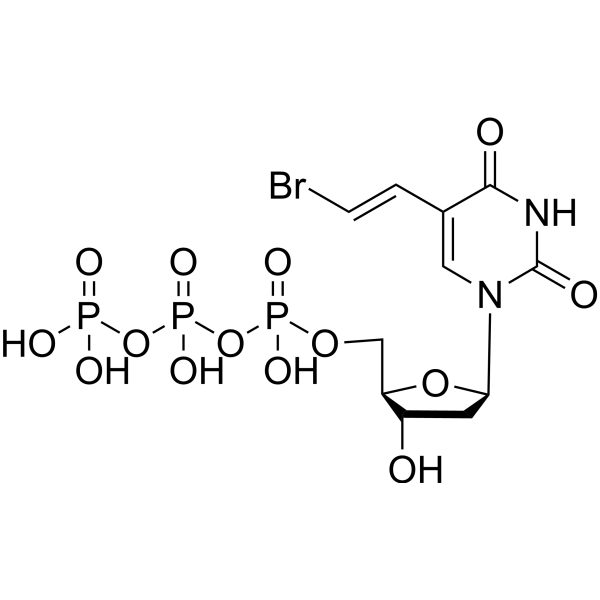 0 ImagesCat. No.: HY-W747737CAS No.: 77222-61-8Synonyms: (E)-5-(2-Bromovinyl)-dUTP; BVdUTPBVDU 5′-Triphosphate is an antivirus agent with 5′-Triphosphate label, targeting viral DNA polymerase. BVDU 5′-Triphosphate shows excellent selectivity against varicella-zoster virus (VZV) and herpes simplex virus type 1 (HSV-1), due to a specific phosphorylation by the virus-encoded thymidine kinase.
-
HSV-1-IN-2
 0 ImagesCat. No.: HY-176163HSV-1-IN-2 (compound 5i) is a potent Herpes simplex virus type 1 (HSV-1) inhibitor with an EC50 of 1.95 μM. HSV-1-IN-2 inhibits apoptosis and improves herpes encephalitis model mouse survival.

-
GF-17
 0 ImagesCat. No.: HY-P11160GF-17 is a polypeptide containing 17 amino acids. is the precursor peptide of GF19. GF-17 exhibits significant antiviral activity. GF-17 can be used for research on viral infections such as HSV-1 virus.
-
Cycloviracin B2
 0 ImagesCat. No.: HY-N14564CAS No.: 142382-46-5Cycloviracin B2 is an antibiotic with antiviral activity. Cycloviracin B2 has a strong inhibitory activity against herpes simplex virus type 1 (HSV-1).
-
Imiquimod-d9
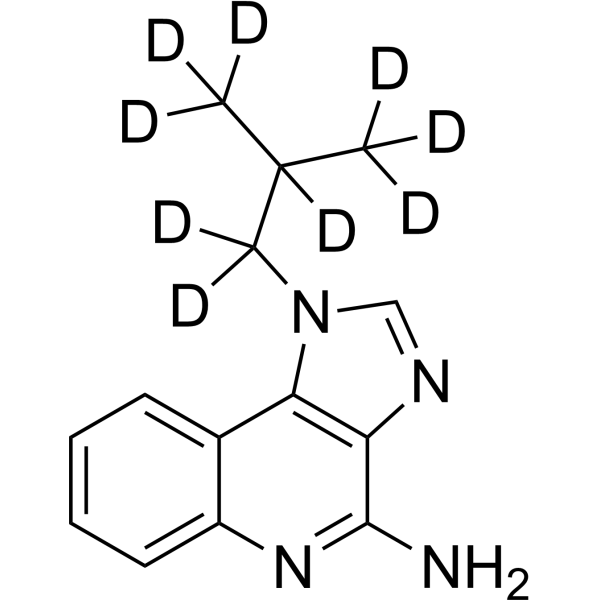 0 ImagesCat. No.: HY-B0180S1CAS No.: 2712126-48-0Synonyms: R 837-d9Imiquimod-d9 is deuterium labeled Imiquimod. Imiquimod (R 837), an immune response modifier, is a selective toll like receptor 7 (TLR7) agonist. Imiquimod exhibits antiviral and antitumor effects in vivo. Imiquimod can be used for the research of external genital, perianal warts, cancer and COVID-19.
-
Antiviral agent 58
 0 ImagesCat. No.: HY-162701CAS No.: 939655-35-3Antiviral agent 58 (Compound J1) is an orally active antiviral agent with broad-spectrum antiviral activity against enveloped viruses, including influenza A virus (IAV), respiratory syncytial virus (RSV), severe acute respiratory syndrome coronavirus 2 (SARS-CoV-2), human coronavirus OC43 (HCoV-OC43), herpes simplex virus type 1 (HSV-1), and HSV-2.

-
Sodium propionate-13C2
 0 ImagesCat. No.: HY-B1773AS2CAS No.: 83587-75-1Sodium propionate-13C-2 is the 13C-labeled Propionate sodium (HY-B1773A). Sodium propionate is an orally active short-chain fatty acid. Sodium propionate can be produced by intestinal bacteria from the metabolism of dietary fiber. Sodium propionate increases PPAR-γ, inhibits NF-κB activation, and reduces COX-2 expression and NO production. Sodium propionate also induces Apoptosis and Autophagy. Sodium propionate reduces HSV-1-induced keratitis. Sodium propionate has anticancer effects against glioblastoma. Sodium propionate exhibits neuroprotective, antioxidant, and anti-inflammatory activities. Sodium propionate can be used in the research of spinal cord injury and Alzheimer's disease.
-
Imiquimod-d6
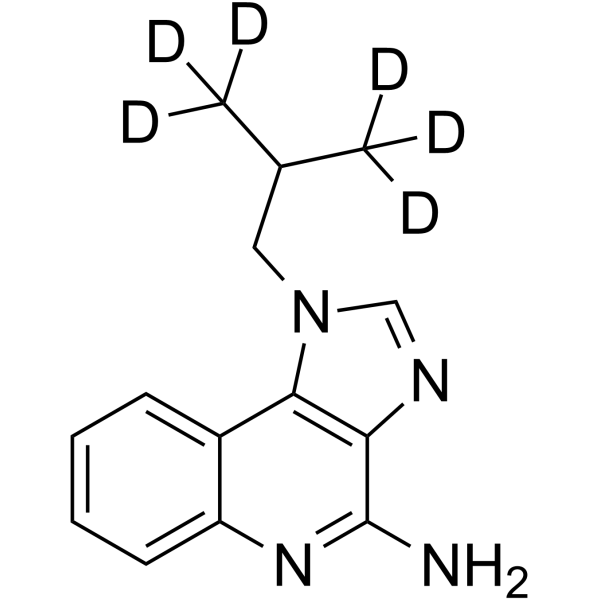 0 ImagesCat. No.: HY-B0180SSynonyms: R 837-d6Imiquimod-d6 is the deuterium labeled Imiquimod. Imiquimod (R 837), an immune response modifier, is a selective toll like receptor 7 (TLR7) agonist. Imiquimod exhibits antiviral and antitumor effects in vivo. Imiquimod can be used for the research of external genital, perianal warts, cancer and COVID-19.
-
Isoxanthohumol (Standard)
 0 ImagesIsoxanthohumol (Standard) is the analytical standard of Isoxanthohumol (HY-N2584A). This product is intended for research and analytical applications. Isoxanthohumol is an orally active flavonoid compound. Isoxanthohumol has biological activities such as anti-tumor, anti-inflammatory, antioxidant, antiviral, antifungal, and inhibition of adipogenesis. Isoxanthohumol can induce apoptosis, autophagy, and migration of tumor cells. Isoxanthohumol is active against viruses such as HSV, BVDV, CMV, and Rhino. Isoxanthohumol can be used for the research of tumors, metabolic, and inflammatory diseases.
-
Oxytetracycline dihydrate (Standard)
 0 ImagesCat. No.: HY-B0275BRCAS No.: 6153-64-6Oxytetracycline (dihydrate) (Standard) is the analytical standard of Oxytetracycline (dihydrate). This product is intended for research and analytical applications. Oxytetracycline dihydrate is an antibiotic belonging to the tetracycline class. Oxytetracycline dihydrate potent inhibits Gram-negative and Gram-positive bacteria. Oxytetracycline dihydrate is a protein synthesis inhibitor and prevents the binding from aminoacil-tRNA to the complex m-ribosomal RNA. Oxytetracycline dihydrate also possesses anti-HSV-1 activity.
-
Pritelivir mesylate (Standard)
 0 ImagesCat. No.: HY-15303ARCAS No.: 1428333-96-3Synonyms: AIC316 mesylate (Standard); BAY 57-1293 mesylate (Standard)Pritelivir (mesylate) (Standard) is the analytical standard of Pritelivir (mesylate). This product is intended for research and analytical applications. Pritelivir mesylate (BAY 57-1293 mesylate), an inhibitor of the viral helicase-primase complex, exhibits antiviral activity in vitro and in animal models of herpes simplex virus (HSV) infection. Pritelivir mesylate is active against herpes simplex virus types 1 and 2 (HSV-1 and HSV-2) with the IC50 of 0.02 μM against HSV1-2.
-
Mogroside III A2
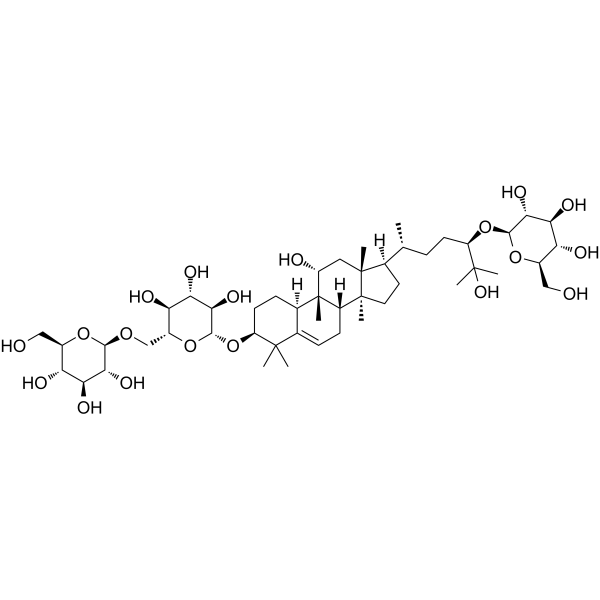 0 ImagesCat. No.: HY-N8041CAS No.: 88901-43-3Mogroside III A2 is a cucurbitane glycoside. Mogroside III A2 can inhibit Epstein-Barr virus early antigen (EBV-EA) activation. Mogroside III A2 shows weak inhibitory effects on activation of NOR 1.



