



LXRβ
Liver X receptor β (LXRβ) is a nuclear receptor activated by oxysterols that regulates cholesterol, lipid, and glucose homeostasis[1][2][3]. Mechanistically, LXRβ modulates transcription of key lipogenic genes such as SREBP1c and FASN, independently of LXRα, thereby controlling cellular lipogenesis in mammalian tissues including adipocytes and mammary epithelial cells[4][2]. In the immune system, LXRβ is essential for T cell fitness and the suppression of CD4+ T cell senescence, which contributes to the maintenance of immune homeostasis and limits inflammatory bowel disease progression[5][6]. In the central nervous system, LXRβ influences synaptic plasticity, neuroinflammation, and excitatory/inhibitory neurotransmission, demonstrating isoform-specific roles in hippocampal- and amygdala-dependent cognitive and anxiety-related behaviors[7][8]. Compared with LXRα, LXRβ has less impact on macrophage-mediated cholesterol efflux, cardiac ischemia/reperfusion injury, and intestinal sterol transport, highlighting functional specialization between isoforms[9][10][11][12]. Pharmacologically, LXRβ-selective agonists and antagonists have been developed to exploit these specific functions, enabling modulation of lipogenesis, glucose metabolism, and immune responses without eliciting LXRα-driven hepatic lipogenesis[13][14][3]. Therefore, LXRβ serves as a distinct therapeutic target for metabolic, immune, and neurological research applications, with experimental utility in both cell-based and in vivo models[13][15][2][6].
References:
- [1]. Chen M, et al. Identfication of Potent LXRβ-Selective Agonists without LXRα Activation by In Silico Approaches. Molecules. 2018 Jun 4;23(6):1349. [Content Brief]
- [2]. Maqdasy S, et al. Once and for all, LXRα and LXRβ are gatekeepers of the endocrine system. Mol Aspects Med. 2016 Jun;49:31-46. [Content Brief]
- [3]. Shi HB, et al. Nuclear receptor subfamily 1 group H member 2 (LXRB) is the predominant liver X receptor subtype regulating transcription of 2 major lipogenic genes in goat primary mammary epithelial cells. J Dairy Sci. 2017 Aug;100(8):6743-6752. [Content Brief]
- [4]. Hong C, et al. LXRα is uniquely required for maximal reverse cholesterol transport and atheroprotection in ApoE-deficient mice. J Lipid Res. 2012 Jun;53(6):1126-33. [Content Brief]
- [5]. Patel D, et al. LXRβ controls glioblastoma cell growth, lipid balance, and immune modulation independently of ABCA1. Sci Rep. 2019 Oct 29;9(1):15458. [Content Brief]
- [6]. Qiu C, et al. Activation of the Hippocampal LXRβ Improves Sleep-Deprived Cognitive Impairment by Inhibiting Neuroinflammation. Mol Neurobiol. 2021 Oct;58(10):5272-5288. [Content Brief]
- [7]. Hu X, et al. LXRβ activation increases intestinal cholesterol absorption, leading to an atherogenic lipoprotein profile. J Intern Med. 2012 Nov;272(5):452-64. [Content Brief]
- [8]. Michaels AJ, et al. Nuclear receptor LXRβ controls fitness and functionality of activated T cells. J Exp Med. 2021 Apr 5;218(4):e20201311. [Content Brief]
- [9]. Gerin I, et al. LXRbeta is required for adipocyte growth, glucose homeostasis, and beta cell function. J Biol Chem. 2005 Jun 17;280(24):23024-31. [Content Brief]
- [10]. Zhang Y, et al. Loss of LXRβ Drives CD4+ T Cell Senescence and Exacerbates the Progression of Colitis. Biomedicines. 2026 Jan 11;14(1):152. [Content Brief]
- [11]. Pu J, et al. Activation of LXR伪 but Not LXR尾 Protects the Heart from Ischemia/Reperfusion Injury[J]. 2012.
- [12]. Yu W, et al. Activation of LXRβ Signaling in the Amygdala Confers Anxiolytic Effects Through Rebalancing Excitatory and Inhibitory Neurotransmission upon Acute Stress. Neurotherapeutics. 2020 Jul;17(3):1253-1270. [Content Brief]
- [13]. Ishibashi M, et al. Knock-down of the oxysterol receptor LXRα impairs cholesterol efflux in human primary macrophages: lack of compensation by LXRβ activation. Biochem Pharmacol. 2013 Jul 1;86(1):122-9. [Content Brief]
- [14]. Fan S, et al. LXRα/β Antagonism Protects against Lipid Accumulation in the Liver but Increases Plasma Cholesterol in Rhesus Macaques. Chem Res Toxicol. 2021 Mar 15;34(3):833-838. [Content Brief]
- [15]. Patel R, et al. LXRβ is required for glucocorticoid-induced hyperglycemia and hepatosteatosis in mice. J Clin Invest. 2011 Jan;121(1):431-41. [Content Brief]
All Product Categories
-
LXRβ Related Products (6)
Related Products (6)

-
LXRβ ligand 1
 0 ImagesLXRβ ligand 1 is a LXR β ligand-binding domain agonist, with an EC50 of 57 μM and a Ki of 28 μM against human LXR β. LXRβ ligand 1 forms hydrogen bonds with His435, stabilizes the His-Trp activation switch, and locks the ligand-binding domain in an agonist conformation; its tert-butyl moiety occupies a hydrophobic subpocket, while its phenyl moiety forms a π-π stacking interaction with Phe329. LXRβ ligand 1 serves as a structural unit for the development of LXRβ modulators.
-
TLC-2716
 0 ImagesCat. No.: HY-182014CAS No.: 2408041-54-1TLC-2716 is an orally available, gut- and liver-restricted inhibitor against LXRα and LXRβ, with EC50 values of 7 nM and 15 nM, respectively. TLC-2716 represses LXRα/β transcriptional activity, downregulates genes involved in lipogenesis, lipid absorption and lipoprotein metabolism, and preserves peripheral reverse cholesterol transport. TLC-2716 reduces lipid accumulation, suppresses inflammation and fibrotic gene expression, enhances triglyceride-rich lipoprotein clearance, and improves glucose homeostasis and insulin sensitivity. TLC-2716 lowers serum and hepatic triglycerides, plasma cholesterol and other atherogenic lipid profiles in experimental models and humanized liver mice. TLC-2716 can be used for the research of dyslipidemia and related cardiometabolic disorders.
-
AU403
 0 ImagesCat. No.: HY-184474AU403 is a potent, brain-penetrant, isoform-selective LXRβ/PPARδ dual agonist (EC50 ≈ 45 nM for LXRβ and EC50 ≈ 40 nM for PPARδ). AU403 is designed to bypass LXRα-driven hepatotoxicity. AU403 significantly improves cognitive functions and reduces amyloid-β plaque burden in 3xTg-AD mice. AU403 is a promising dual-acting agonist for the research of Alzheimer’s disease.
-
LXRβ agonist-2
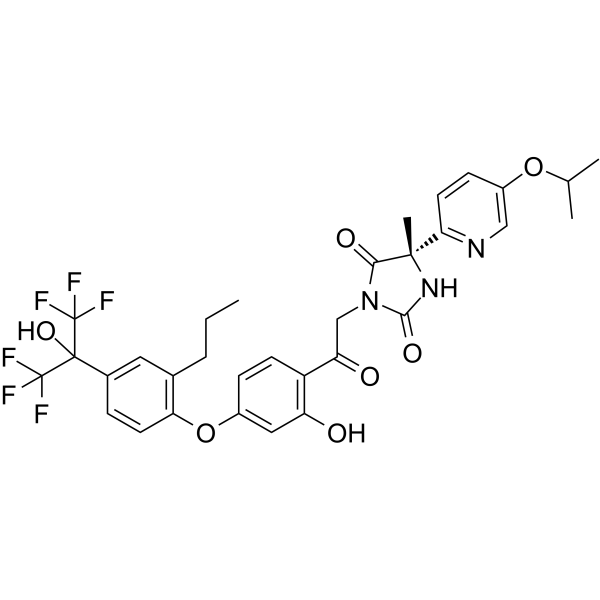 0 ImagesCat. No.: HY-100469CAS No.: 1949801-52-8LXRβ agonist-2 is an orally active and selective LXRβ agonist. LXRβ agonist-2 increases high-density lipoprotein cholesterol levels without elevating plasma triglyceride levels. LXRβ agonist-2 decreases lipid accumulation area in the aortic arch. LXRβ agonist-2 can be used for the research of atherosclerosis.
-
LXRα agonist 1
 0 ImagesCat. No.: HY-173393CAS No.: 1790089-97-2LXRα agonist 1 is a selective LXRα agonist, with EC50 values of 42 nM and 266 nM against purified LXRα and LXRβ, respectively. LXRα agonist 1 acts as a lipotoxicity inducer, triggering the production of toxic saturated fatty acids in tumor cells, and induces lipotoxicity-mediated cancer cell death when combined with the Raf inhibitor Sorafenib (HY-10201). LXRα agonist 1 can be used in the research of hepatocellular carcinoma.
-
27-Norcholestenoic acid
 0 ImagesCat. No.: HY-160126CAS No.: 2154373-60-927-Norcholestenoic acid is an inverse agonist of LXRβ and LXRα that decreases basal luciferase activity and inhibits agonist-induced transactivation. 27-Norcholestenoic acid induces conformational changes in the AF-2 domain that favor corepressor over coactivator recruitment, thereby destabilizing the active receptor conformation. 27-Norcholestenoic acid downregulates FASN and SREBP-1a/c gene expression.



