



Biochemical Assay Reagents
Biochemical agents refers to the life science research related to biological material or organic compounds. Due to a wide range of life sciences, rapid development, and therefore a wide variety of such agents, complex in nature. There are electrophoresis reagents, chromatography reagents, centrifuged reagents, immunological reagent, labeled reagent, staining agents, penetration agents and carcinogens variable, insecticides, culture, buffering agents, electron microscopy reagents, protein and nucleic acid precipitating agent, condensing agent ultrafiltration membrane, clinical diagnostic reagents, dyes, antioxidants, preservatives, detergents and surfactants, standard biochemical reagents, biochemical reagents quality control materials, separation material, etc..
All Product Categories
-
Biochemical Assay Reagents Inhibitors
(10)
View all products
-
Biochemical Assay Reagents Modulator
(1)
View all products
-
Biochemical Assay Reagents Chemicals
(7)
View all products
-
Biochemical Assay Reagents Inducer
(1)
View all products
-
Biochemical Assay Reagents Controls
(59)
View all products
-
Biochemical Assay Reagents Substrates
(4)
View all products
-
Biochemical Assay Reagents Ligands
(2)
View all products
-
Biochemical Assay Reagents Related Products (16057)
Related Products (16057)

-
Antibodies (44)
-
Cholesterol-PEG5000-amine
 0 ImagesCat. No.: HY-W440692Cholesterol-PEG5000-amine is a cholesterol PEG derivative that can form micelles through molecular self-assembly and has a longer half-life in vivo. Cholesterol-PEG5000-amine can be used in drug delivery research.
-
(18Z,21Z,24Z,27Z,30Z,33Z)-Hexatriacontahexaenoyl-CoA
 0 ImagesCat. No.: HY-CE00079Synonyms: (18Z,21Z,24Z,27Z,30Z,33Z)-Hexatriacontahexaenoyl-coenzyme A(18Z,21Z,24Z,27Z,30Z,33Z)-Hexatriacontahexaenoyl-CoA ((18Z,21Z,24Z,27Z,30Z,33Z)-Hexatriacontahexaenoyl-coenzyme A) is an unsaturated fatty acyl-CoA.
-
4R-Fluoro-N6-ethanimidoyl-L-lysine-CoA
 0 ImagesCat. No.: HY-CE01465Synonyms: 4R-Fluoro-N6-ethanimidoyl-L-lysine-coenzyme A4R-Fluoro-N6-ethanimidoyl-L-lysine-CoA (4R-Fluoro-N6-ethanimidoyl-L-lysine-coenzyme A) is a coenzyme A derivative.

-
C33:0-CoA
 0 ImagesCat. No.: HY-CE01247Synonyms: C33:0-Coenzyme AC33:0-CoA (C33:0-Coenzyme A) is a coenzyme A derivative.
-
3-Azido-3-deoxy-1,2:5,6-di-O-isopropylidene-α-D-glucofuranose
 0 ImagesCat. No.: HY-W698504CAS No.: 13964-23-33-Azido-3-deoxy-1,2:5,6-di-O-isopropylidene-α-D-glucofuranose is a class of biochemical reagents used in glycobiology research. Glycobiology studies the structure, synthesis, biology, and evolution of sugars. It involves carbohydrate chemistry, enzymology of glycan formation and degradation, protein-glycan recognition, and the role of glycans in biological systems. This field is closely related to basic research, biomedicine, and biotechnology.

-
N-Tetracosanoyl-D-sphingosine 1-benzoate
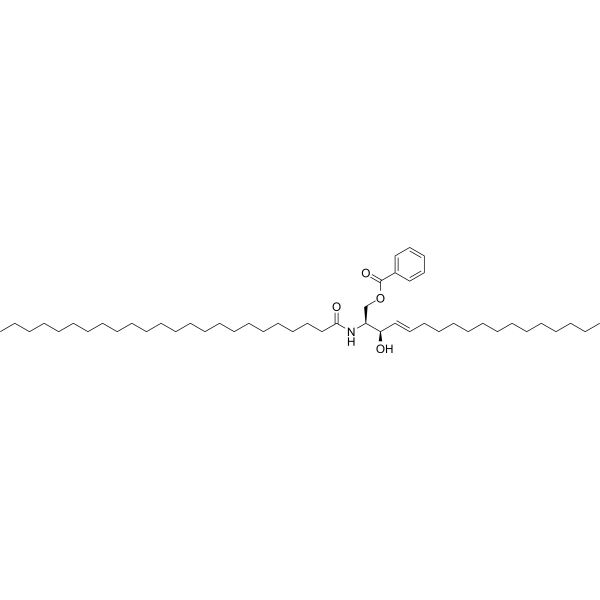 0 ImagesCat. No.: HY-W127354CAS No.: 123446-98-0N-Tetracosanoyl-D-sphingosine 1-benzoate is a biochemical reagent that can be used as a biological material or organic compound for life science related research.
-
S-Hydroxycysteine-CoA
 0 ImagesCat. No.: HY-CE01836Synonyms: S-Hydroxycysteine-coenzyme AS-Hydroxycysteine-CoA (S-Hydroxycysteine-coenzyme A) is a coenzyme A derivative.


-
NH2-PEG600-COOH
 0 ImagesCat. No.: HY-168940ECAS No.: 139729-28-5NH2-PEG600-COOH is a compound composed of an NH2 group, PEG units (MW = 600) and a carboxyl group (-COOH). NH2-PEG-COOH is widely used for surface modification and functionalization of polymer carriers or nanoparticles.
-
4(Z),7(Z),10(Z),13(Z)-Hexadecatetraenoic acid methyl ester
 0 ImagesCat. No.: HY-W346639CAS No.: 873108-81-74(Z),7(Z),10(Z),13(Z)-Hexadecatetraenoic acid methyl ester is a methyl ester form of polyunsaturated fatty acid. 4(Z),7(Z),10(Z),13(Z)-Hexadecatetraenoic acid methyl ester can be used in cancer-related research.
-
1,1,3-Tribromo-3-chloroacetone
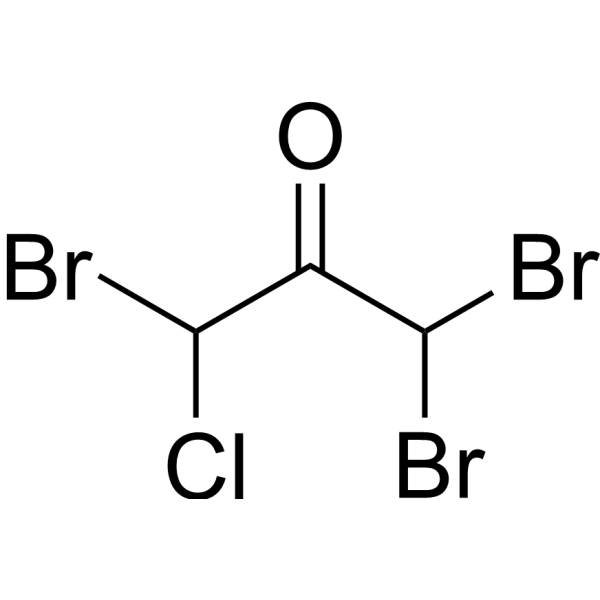 0 ImagesCat. No.: HY-133628CAS No.: 55716-01-31,1,3-Tribromo-3-chloroacetone is a halogenated ozone-chlorine and ozone chloramine disinfection byproducts (DBPs) at elevated bromide levels when chlorine or chloramine is used as a secondary disinfectant.
-
ZnAF-2
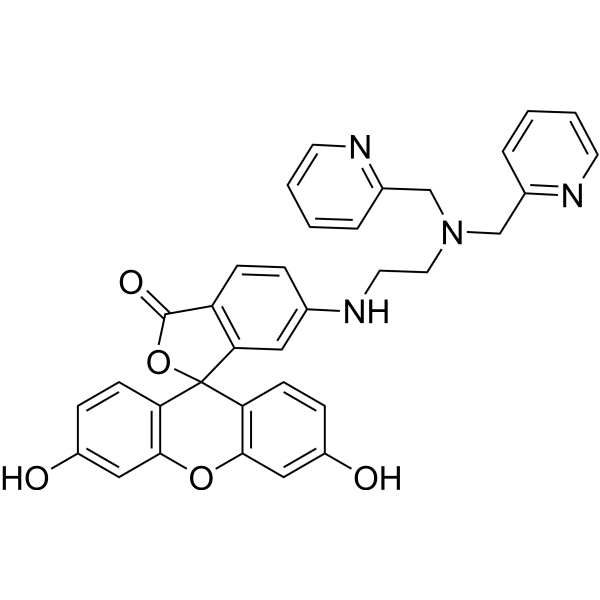 0 ImagesCat. No.: HY-D0157CAS No.: 321859-11-4ZnAF-2, 6-iso- is a cell-impermeable compound that acts as a high-affinity Zn2 -specific fluorescent probe (Kd = 2.7 nM). It exhibits low basal fluorescence with an approximately 51-fold increase in fluorescence intensity upon stoichiometric (1:1) binding to Zn2 . Little affinity for Ca2 , Mg2 , Na or K .

-
PLLA10000-PEG3000-NH2
 0 ImagesCat. No.: HY-167440PLLA10000-PEG3000-NH2 is a block copolymer based on polylactic acid derivatives that can self-assemble in water. PLLA10000-PEG3000-NH2 can be used in drug delivery research.
-
DSPE-PEG5000-Silane
 0 ImagesCat. No.: HY-W1123942CDSPE-PEG5000-Silane is a multifunctional biomaterial that combines phospholipid DSPE, PEG and silane for drug delivery.
-
(12Z,15Z,18Z,21Z)-Tetracosatetraenoyl-CoA
 0 ImagesCat. No.: HY-CE00023Synonyms: C24:4(Omega-3)-CoA(12Z,15Z,18Z,21Z)-Tetracosatetraenoyl-CoA (C24:4(Omega-3)-CoA) is an unsaturated fatty acyl-CoA.
-
PMO-G
 0 ImagesCat. No.: HY-W893751CAS No.: 2708274-72-8PMO-G is a spherical-shape polymeric micelles. PMO-G has skin permeation. PMO-G can result in up to a 50-fold higher level of dystrophin in abdominal muscles of mdx mice. PMO-G can be studied in research on Duchenne muscular dystrophy.




