



Acridine Orange hydrochloride (solution)

Based on 1 Customer Validation
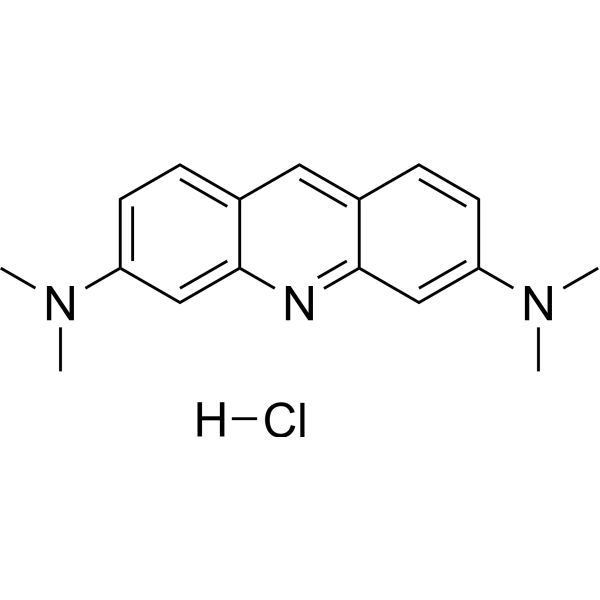
Acridine Orange hydrochloride (solution) is a cell-penetrable nucleic acid-selective fluorescent dye. Acridine Orange hydrochloride produces orange fluorescence when it binds to ssDNA or RNA, and green fluorescence when it binds to dsDNA (Ex: 488 nM; Em: green fluorescence at 530 nm, orange fluorescence at 640 nm) .
Solvent and Concentration: Sterile water: 10 mg/mL
The 1 mL volume is defined as the base specification. All larger sizes correspond to incremental volumes of this base.
For research use only. We do not sell to patients.
- CAS No.: 65-61-2
- Formula: C17H20ClN3
- Molecular Weight:301.82
-
Storage:
Please store the product under the recommended conditions in the Certificate of Analysis.


To place orders, for customer services and technical support, please contact: MedChemExpress USA
Tel: 609-228-6898 E-mail: [email protected] [email protected]


-
 Biological Activity
-
Chemical Information
- Purity & Documentation
- References
-
 Help & FAQs


-
HY-101879
Acridine Orange hydrochlorideNucleic Acid dye -
HY-D0815
Propidium IodideFluorochrome -

HY-DY1006
Propidium Iodide (solution)Fluorochrome -
HY-D0083
DiIFluorescent Dye -
HY-D0814
DAPI dihydrochlorideFluorescent DNA Stain -

HY-101879R
Acridine Orange hydrochloride (Standard)Reference Standard -
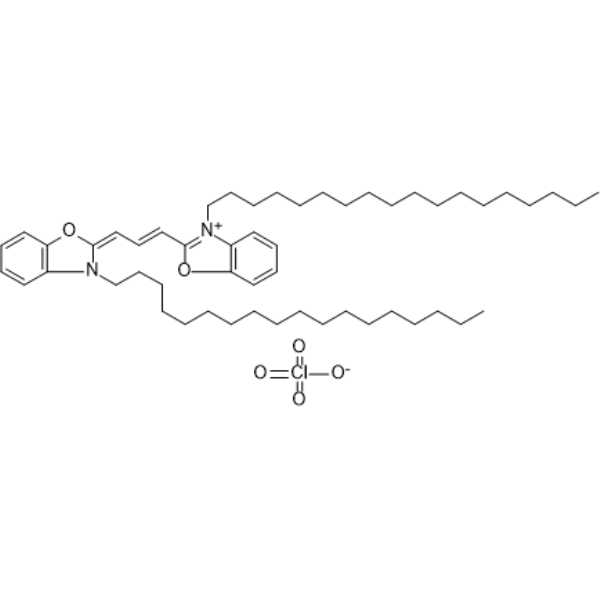
HY-D0969
DiOFluorescent Probe -
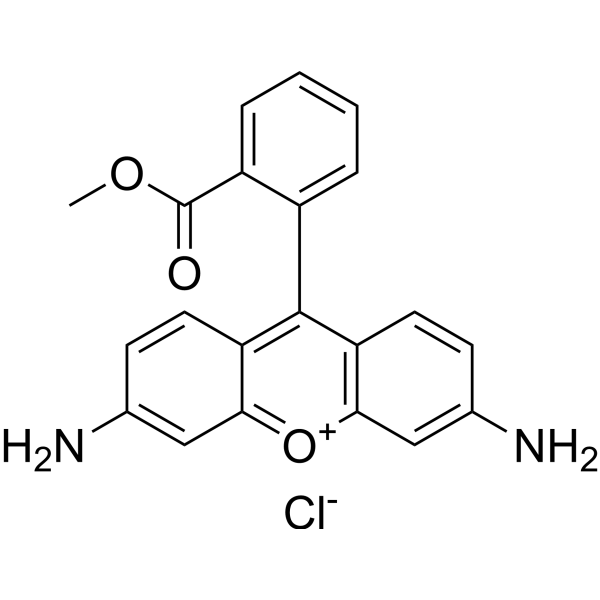
HY-D0816
Rhodamine 123Fluorescent Dye -
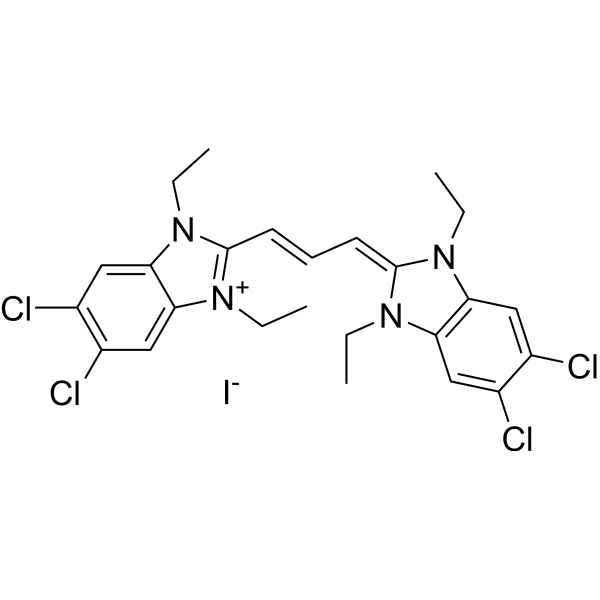
HY-15534
JC-1Mitochondrial Membrane Potential Probe -
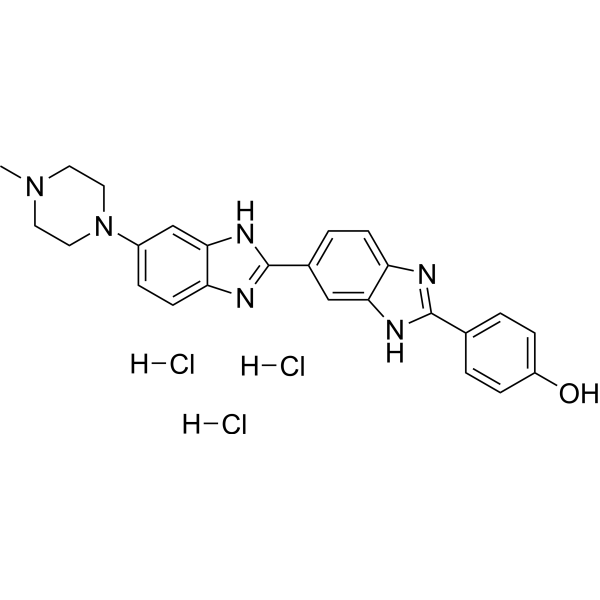
HY-15558A
Hoechst 33258 trihydrochlorideDNA Staining -

HY-DY1081
DAPI dihydrochloride (solution)Fluorescent DNA Stain -

HY-DY1012
DiI (solution)Fluorescent Dye


Biological Activity
Description
Solvent and Concentration: Sterile water: 10 mg/mL
The 1 mL volume is defined as the base specification. All larger sizes correspond to incremental volumes of this base.
Cellular Effect
|
Cell Line

|
Type | Value | Description | References |
|---|---|---|---|---|
| R3230AC | IC50 |
2.29 μM
Compound: AO.HCl
|
Phototoxicity in rat R3230AC cells irradiated with halogen lamp pretreated 24 hrs before irradiation by MTT assay
Phototoxicity in rat R3230AC cells irradiated with halogen lamp pretreated 24 hrs before irradiation by MTT assay
|
[PMID: 19692249] |
In Vitro
Guide (Following is our recommended protocol. This protocol only provides a guideline, and should be modified according to your specific needs)[4].
1. Stain cells with Acridine Orange hydrochloride (1 μM; 20 min; 37°C).
2. Wash cells with PBS.
3. Cells are observed by a confocal laser scanning microscopy (FV3000, Olympus).
MedChemExpress (MCE) has not independently confirmed the accuracy of these methods. They are for reference only. .
In Vivo
MedChemExpress (MCE) has not independently confirmed the accuracy of these methods. They are for reference only.


Chemical Information
-
CAS No. 65-61-2
-
Appearance Liquid
-
Molecular Weight 301.82
-
Formula C17H20ClN3
-
Color Orange to red
-
SMILES
CN(C)C1=CC=C2C(N=C3C=C(N(C)C)C=CC3=C2)=C1.[H]Cl
-
Shipping
Room temperature in continental US; may vary elsewhere.
-
Storage
Please store the product under the recommended conditions in the Certificate of Analysis.


Purity & Documentation
-
Data Sheet (268 KB)
-
SDS (252 KB)
- English - EN (252 KB)
- Français - FR (252 KB)
- Deutsch - DE (252 KB)
- Norwegian - NO (252 KB)
- Español - ES (252 KB)
- Swedish - SV (252 KB)
- Italian - IT (252 KB)
- Korean - KR (252 KB)
- Portuguese - PT (252 KB)
-
Handling Instructions (2659 KB)
References
[1]. Byvaltsev VA, et al. Acridine Orange: A Review of Novel Applications for Surgical Cancer Imaging and Therapy. Front Oncol. 2019 Sep 24;9:925. [Content Brief]
[2]. Wang Q, et al. Substrate stiffness regulates the differentiation profile and functions of osteoclasts via cytoskeletal arrangement. Cell Prolif. 2022 Jan;55(1):e13172. [Content Brief]
[3]. McMaster GK, et al. Analysis of single- and double-stranded nucleic acids on polyacrylamide and agarosegels by using glyoxal and acridine orange. Proc Natl Acad Sci U S A. 1977 Nov;74(11):4835-8. [Content Brief]
[4]. Traganos F, et al. Simultaneous staining of ribonucleic and deoxyribonucleic acids in unfixed cells using acridine orange in a flow cytofluorometric system. J Histochem Cytochem. 1977 Jan;25(1):46-56. [Content Brief]

Calculators
Concentration (start) × Volume (start) = Concentration (final) × Volume (final)


Acridine Orange hydrochloride (solution) Related Classifications
HY-DY1038 Related Classifications
 Powered by Bioz