



Alkyne Cholesterol
Based on 2 publication(s) in Google Scholar
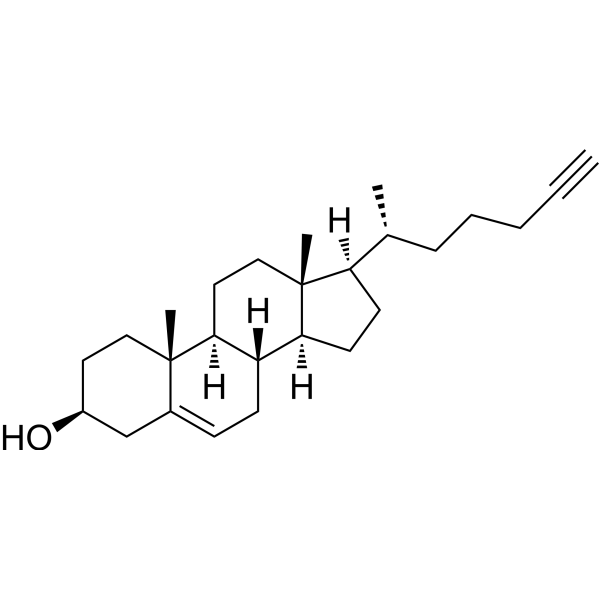
Alkyne Cholesterol, a modified lipid, is a click chemistry reagent containing an alkyne group. The terminal alkyne group can be used in a highly specific linking reaction with azide-containing reagents in the presence of a copper (Cu)-containing catalyst. Alkyne Cholesterol can be used for tracking cellular cholesterol metabolism and localization.
Nos produits utilisent uniquement pour la recherche. Nous ne vendons pas aux patients.
- Pureté : 99.96%
- CAS No.: 1631985-09-5
- Formule: C26H40O
- Masse moléculaire:368.60
-
Stockage:
-20°C, protect from light, stored under nitrogen
* In solvent : -80°C, 6 months; -20°C, 1 month (protect from light, stored under nitrogen)

To place orders, for customer services and technical support, please contact: MedChemExpress USA
Tel: 609-228-6898 E-mail: [email protected] [email protected]


-
 Activité biologique
-
Chemical Information
-
Solvant et solubilité
- Protocole
- Pureté et documentation
- Références
-
 Help & FAQs


Publications Citing Use of MedChemExpress (MCE) Alkyne Cholesterol
More

Activité biologique
Description
In Vitro
Click chemistry is used to describe the selective, modular, wide range and high-yield chemical reactions that allow rapid synthesis of new compounds through heteroatom linking (C-X-C). Bertozzi developed click chemistry in a new dimension —Bioorthogonal chemistry. It is defined as a rapid and selective reaction that does not interfere with biological processes under physiological conditions. Common reaction structures of click chemistry, such as Azide, Alkyne, DBCO, BCN, TCO and Tetrazine.
MedChemExpress (MCE) has not independently confirmed the accuracy of these methods. They are for reference only. Further protocols information, click here.


Chemical Information
-
CAS No. 1631985-09-5
-
Appearance Solid
-
Masse moléculaire 368.60
-
Formule C26H40O
-
Color White to off-white
-
SMILES
C[C@@]12[C@](CC[C@]2([H])[C@H](C)CCCC#C)([H])[C@@]3([H])[C@@](CC1)([H])[C@@]4(C(C[C@H](CC4)O)=CC3)C
-
Livraison
Room temperature in continental US; may vary elsewhere.
-
Stockage
-20°C, protect from light, stored under nitrogen
* In solvent : -80°C, 6 months; -20°C, 1 month (protect from light, stored under nitrogen)


Publications (2)
-
Journal Impact Factor
-
Most Recent
-
J Hazard Mater
Prenatal amoxicillin exposure induces depressive-like behavior in offspring via gut microbiota and myristic acid-mediated modulation of the STING pathway. [Abstract]2025 Mar 5:485:136750. PMID: 39672059 -


Solvant et solubilité
In Vitro:
Ethanol : 12.5 mg/mL (33.91 mM; Need ultrasonic)
Please refer to the solubility information to select the appropriate solvent. Once prepared, please aliquot and store the solution to prevent product inactivation from repeated freeze-thaw cycles.
Storage method and period of stock solution: -80°C, 6 months; -20°C, 1 month (protect from light, stored under nitrogen). When stored at -80°C, please use it within 6 months. When stored at -20°C, please use it within 1 month.
Please refer to the solubility information to select the appropriate solvent. Once prepared, please aliquot and store the solution to prevent product inactivation from repeated freeze-thaw cycles.
Storage method and period of stock solution: -80°C, 6 months; -20°C, 1 month (protect from light, stored under nitrogen). When stored at -80°C, please use it within 6 months. When stored at -20°C, please use it within 1 month.
Concentration (start) × Volume (start) = Concentration (final) × Volume (final)
In Vivo:
Select the appropriate dissolution method based on your experimental animal and administration route.
- For the following dissolution methods, please ensure to first prepare a clear stock solution using an In Vitro approach and then sequentially add co-solvents:
- To ensure reliable experimental results, the clarified stock solution can be appropriately stored based on storage conditions. As for the working solution for In Vivo experiments, it is recommended to prepare freshly and use it on the same day.
- The percentages shown for the solvents indicate their volumetric ratio in the final prepared solution. If precipitation or phase separation occurs during preparation, heat and/or sonication can be used to aid dissolution.
Add each solvent one by one: 10% EtOH 90% Corn Oil
Solubility: ≥ 1.25 mg/mL (3.39 mM); Clear solution
This protocol yields a clear solution of ≥ 1.25 mg/mL (saturation unknown). If the continuous dosing period exceeds half a month, please choose this protocol carefully.
Taking 1 mL working solution as an example, add 100 μL EtOH stock solution (12.5 mg/mL) to 900 μL Corn oil, and mix evenly.
In Vivo Dissolution Calculator
Please enter the basic information of animal experiments:
-
-
-
-
Recommended: Prepare an additional quantity of animals to account for potential losses during experiments.
Working solution concentration: 0.22 mg/mL

Protocole
-
EdU Incorporation Assay (Click Chemistry-Based DNA Synthesis Measurement)
The EdU incorporation assay measures DNA synthesis by adding the thymidine analog 5-ethynyl-2′-deoxyuridine to cells or tissues, where it is incorporated into newly synthesized DNA during S phase. Incorporated EdU is detected by copper-catalyzed azide-alkyne cycloaddition, in which a fluorescent azide covalently reacts with the ethynyl group on EdU, allowing S-phase cells to be detected by fluorescence microscopy, flow cytometry, or high-content imaging. EdU detection does not require DNA denaturation or anti-BrdU antibody access, which preserves sample structure and improves compatibility with immunostaining and multiparameter cytometry compared with BrdU-based detection. EdU can be cytotoxic in a cell-type- and exposure-dependent manner, so pulse duration, concentration, and continuous-labeling designs should be validated for each cell type.


Pureté et documentation
-
Fiche technique (281 KB)
-
SDS (252 KB)
- English - EN (252 KB)
- Français - FR (252 KB)
- Deutsch - DE (252 KB)
- Norwegian - NO (252 KB)
- Español - ES (252 KB)
- Swedish - SV (252 KB)
- Italian - IT (252 KB)
- Korean - KR (252 KB)
- Portuguese - PT (252 KB)
-
Instruction de manipulation (2659 KB)
Références
[1]. Katherine Windsor, et al. Probing lipid-protein adduction with alkynyl surrogates: application to Smith-Lemli-Opitz syndrome. J Lipid Res. 2013 Oct;54(10):2842-50. [Content Brief]
[2]. Katherine Windsor, et al. Assay of protein and peptide adducts of cholesterol ozonolysis products by hydrophobic and click enrichment methods. Chem Res Toxicol. 2014 Oct 20;27(10):1757-68. [Content Brief]
[3]. Alkyne Cholesterol.


Complete Stock Solution Preparation Table
Please refer to the solubility information to select the appropriate solvent. Once prepared, please aliquot and store the solution to prevent product inactivation from repeated freeze-thaw cycles.
Storage method and period of stock solution: -80°C, 6 months; -20°C, 1 month (protect from light, stored under nitrogen). When stored at -80°C, please use it within 6 months. When stored at -20°C, please use it within 1 month.
| Optional Solvent | Concentration Solvent Mass | 1 mg | 5 mg | 10 mg | 25 mg |
|---|---|---|---|---|---|
| Ethanol | 1 mM | 2.7130 mL | 13.5648 mL | 27.1297 mL | 67.8242 mL |
| 5 mM | 0.5426 mL | 2.7130 mL | 5.4259 mL | 13.5648 mL | |
| 10 mM | 0.2713 mL | 1.3565 mL | 2.7130 mL | 6.7824 mL | |
| 15 mM | 0.1809 mL | 0.9043 mL | 1.8086 mL | 4.5216 mL | |
| 20 mM | 0.1356 mL | 0.6782 mL | 1.3565 mL | 3.3912 mL | |
| 25 mM | 0.1085 mL | 0.5426 mL | 1.0852 mL | 2.7130 mL | |
| 30 mM | 0.0904 mL | 0.4522 mL | 0.9043 mL | 2.2608 mL |


Alkyne Cholesterol Related Classifications
HY-151705 Related Classifications
 Powered by Bioz