



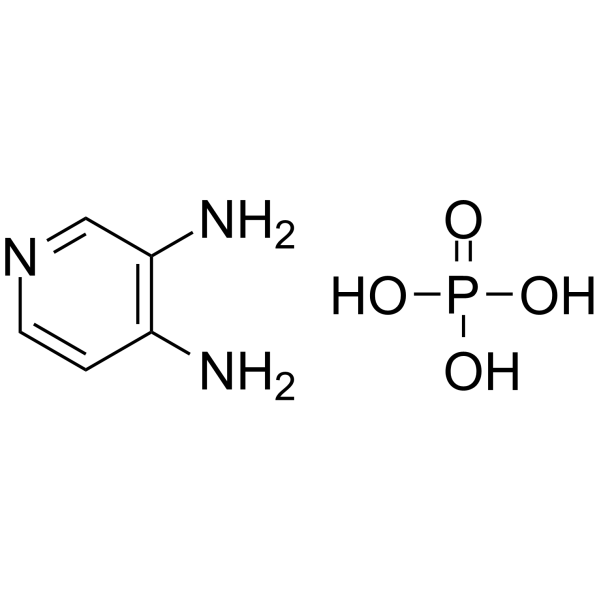
Amifampridine phosphate
Amifampridine (3,4-Diaminopyridine) phosphate is an orally active, potent and cell permeable voltage-gated potassium (Kv) channel blocker (PCB). Amifampridine phosphate is efficacy in the reversal of BoNT/A (HY-P79153) intoxication. Amifampridine phosphate increases transmitter release from neuromuscular junctions (NMJs). Amifampridine phosphate can be used for Lambert-Eaton myasthenic syndrome (LEMS) research.
For research use only. We do not sell to patients.
- CAS No.: 446254-47-3
- Formula: C5H10N3O4P
- Molecular Weight:207.12
-
Storage:
Please store the product under the recommended conditions in the Certificate of Analysis.

To place orders, for customer services and technical support, please contact: MedChemExpress USA
Tel: 609-228-6898 E-mail: [email protected] [email protected]


-
 Biological Activity
-
Chemical Information
- Purity & Documentation
- References
-
 Help & FAQs




Biological Activity
Description
In Vitro
Amifampridine phosphate (1.5 μM) significantly reduces Kv3.3 and Kv3.4 currents by about 10% in HEK293T cells, has no effect on Cav2.1 or Cav1.2 current[3].
Amifampridine phosphate (0-100 μM) increases the duration of the presynaptic AP (action potential) waveform at mammalian and frog NMJs in a dose-dependent manner[3].
MedChemExpress (MCE) has not independently confirmed the accuracy of these methods. They are for reference only. .
In Vivo
Amifampridine phosphate (2.5 mg/kg (IV); 10 mg/kg (PO); once) shows 1 hour plasma half-life and about 57% bioavailability (F) in mice[2].
Amifampridine phosphate has a short plasma half-life and can induce seizures when present at high concentrations, following penetration of the blood-brain barrier[2].
MedChemExpress (MCE) has not independently confirmed the accuracy of these methods. They are for reference only.
-
Animal Model:CD-1 mouse (female,25 g, 6 weeks old)[2]
-
Dosage:10 mg/kg
-
Administration:Oral gavage, once, after BoNT/A administration (IP)
-
Result:Revealed that neither LEMs alone (182 ± 43 min) nor the maximum safe orally deliverable dose of 3,4-DAP alone (225 ± 24 min) could significantly increase the time to death following toxin administration (216 ± 29 min). However, when the 10/50/40 3,4-DAP/LEM/shellac formulation was administered at 25 mg/kg the time to death was 302 ± 26 min - a 40% increase as compared to toxin alone.
-
Animal Model:CD-1 mouse (30-35 g, 8 weeks old)[2]
-
Dosage:2.5 mg/kg (IV); 10 mg/kg (PO)
-
Administration:IV, orally, once (Pharmacokinetic Analysis)
-
Result:Pharmacokinetic Parameters of Amifampridine in CD-1 mouse[1].
IV (2.5 mg/kg) PO (10 mg/kg) t1/2 (h) 1.04 1.28 AUC0-24 (μM·h) 4.29 9.72 F (%) 100 56.7


Chemical Information
-
CAS No. 446254-47-3
-
Molecular Weight 207.12
-
Formula C5H10N3O4P
-
SMILES
NC1=C(N)C=CN=C1.O=P(O)(O)O
-
Synonyms
3,4-Diaminopyridine phosphate
-
Shipping
Room temperature in continental US; may vary elsewhere.
-
Storage
Please store the product under the recommended conditions in the Certificate of Analysis.


Purity & Documentation
References
[1]. Maarten J Titulaer, et al. Lambert-Eaton myasthenic syndrome: from clinical characteristics to therapeutic strategies. Lancet Neurol. 2011 Dec;10(12):1098-107. [Content Brief]
[2]. T L Harris, et al. Lycopodium clavatum exine microcapsules enable safe oral delivery of 3,4-diaminopyridine for treatment of botulinum neurotoxin A intoxication. Chem Commun (Camb). 2016 Mar 18;52(22):4187-90. [Content Brief]
[3]. Ojala KS, et al. A high-affinity, partial antagonist effect of 3,4-diaminopyridine mediates action potential broadening and enhancement of transmitter release at NMJs. J Biol Chem. 2021 Jan-Jun;296:100302. [Content Brief]

Calculators
Concentration (start) × Volume (start) = Concentration (final) × Volume (final)


Amifampridine phosphate Related Classifications
HY-14946A Related Classifications
 Powered by Bioz