



Amiloride (Standard)

Based on 1 Customer Validation
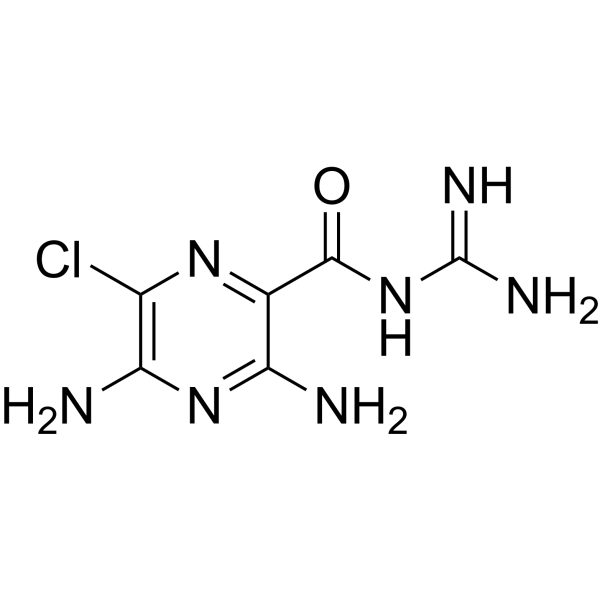
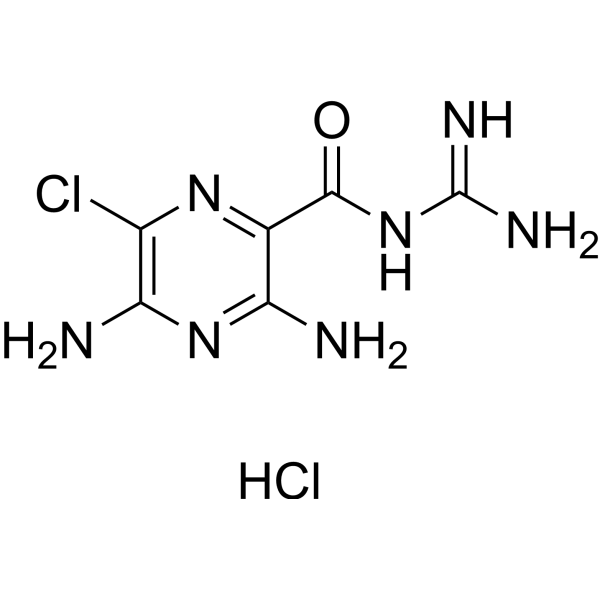
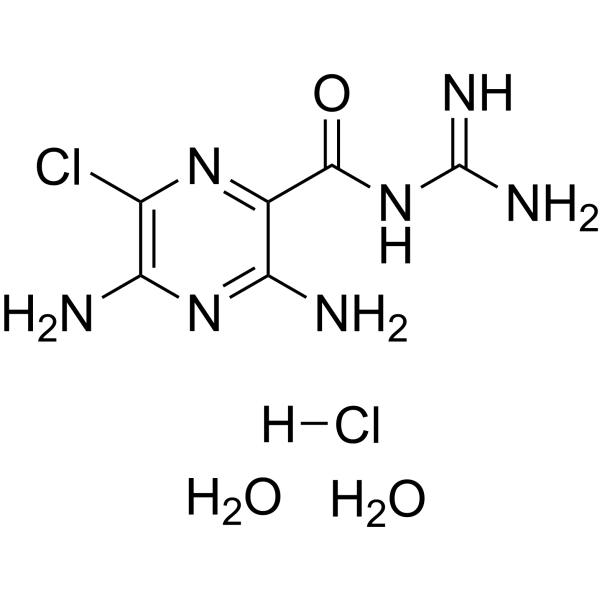
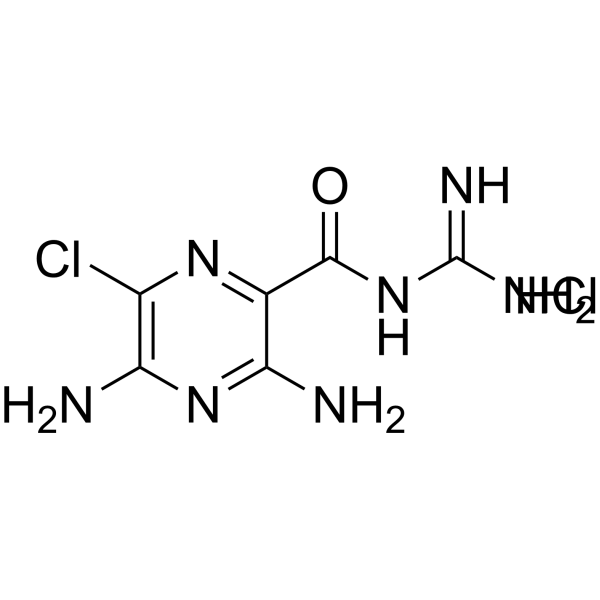
Amiloride (Standard) is the analytical standard of Amiloride. This product is intended for research and analytical applications. Amiloride (MK-870) is an inhibitor of both epithelial sodium channel (ENaC) and urokinase-type plasminogen activator receptor (uTPA). Amiloride is a blocker of polycystin-2 (PC2; TRPP2) channel.
For research use only. We do not sell to patients.
- CAS No.: 2609-46-3
- Formula: C6H8ClN7O
- Molecular Weight:229.63
-
Storage:
Please store the product under the recommended conditions in the Certificate of Analysis.


To place orders, for customer services and technical support, please contact: MedChemExpress USA
Tel: 609-228-6898 E-mail: [email protected] [email protected]


-
 Product Information
-
Chemical Information
- Purity & Documentation
-
 Help & FAQs




Product Information
Information
Application
The compound is the grade of analytical standard, which is the reference standard supplied assay. It is commonly used in qualitative, quantitative and methodological research experiments in HPLC, GC and MS.


Chemical Information
-
CAS No. 2609-46-3
-
Appearance Solid
-
Molecular Weight 229.63
-
Formula C6H8ClN7O
-
Color Off-white to light yellow
-
SMILES
O=C(C1=NC(Cl)=C(N)N=C1N)NC(N)=N
-
Synonyms
MK-870 (Standard)
-
Shipping
Room temperature in continental US; may vary elsewhere.
-
Storage
Please store the product under the recommended conditions in the Certificate of Analysis.


Purity & Documentation
-
SDS (480 KB)
- English - EN (480 KB)
- Français - FR (480 KB)
- Deutsch - DE (480 KB)
- Norwegian - NO (480 KB)
- Español - ES (480 KB)
- Swedish - SV (480 KB)
- Italian - IT (480 KB)
- Korean - KR (480 KB)
- Portuguese - PT (480 KB)
-
Handling Instructions (2659 KB)
References
[1]. Ji, H.L., et al. delta ENaC: a novel divergent amiloride-inhibitable sodium channel. Am J Physiol Lung Cell Mol Physiol, 2012. 303(12): p. L1013-26. [Content Brief]
[2]. Teiwes J, et al. Epithelial sodium channel inhibition in cardiovascular disease. A potential role for amiloride. Am J Hypertens. 2007 Jan;20(1):109-17. [Content Brief]
[3]. Giamarchi A, et al. A polycystin-2 (TRPP2) dimerization domain essential for the function of heteromeric polycystin complexes. EMBO J. 2010 Apr 7;29(7):1176-91. [Content Brief]

Calculators
Concentration (start) × Volume (start) = Concentration (final) × Volume (final)


Amiloride (Standard) Related Classifications
HY-B0285R Related Classifications
 Powered by Bioz