



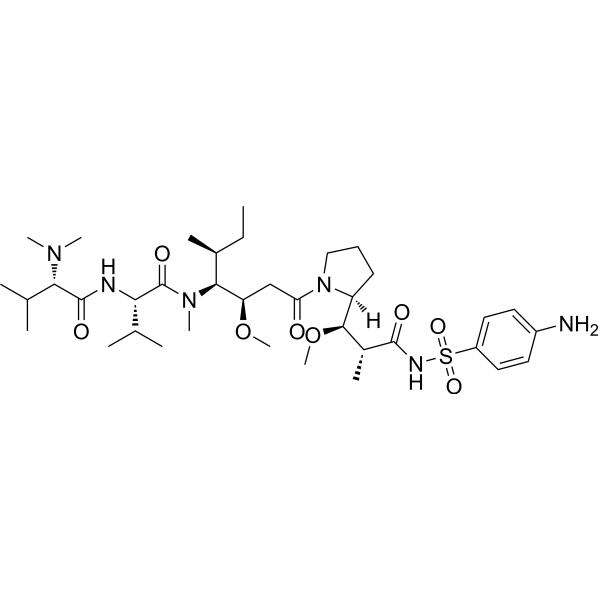
Aminobenzenesulfonic auristatin E
Aminobenzenesulfonic auristatin E is a agent-linker conjugate for ADC. Aminobenzenesulfonic auristatin E has potent antitumor activity by using Auristatin E (a cytotoxic tubulin modifier), linked via the ADC linker Aminobenzenesulfonic.
For research use only. We do not sell to patients.
- CAS No.: 1800462-99-0
- Formula: C37H64N6O8S
- Molecular Weight:753.00
-
Storage:
Please store the product under the recommended conditions in the Certificate of Analysis.

To place orders, for customer services and technical support, please contact: MedChemExpress USA
Tel: 609-228-6898 E-mail: [email protected] [email protected]


-
 Biological Activity
-
Chemical Information
-
Solvent & Solubility
- Protocols
- Purity & Documentation
- References
-
 Help & FAQs


All Drug-Linker Conjugates for ADC Isoforms
More

Biological Activity
Description
IC50 & Target
[1]|
Auristatin |
In Vitro
ADCs are comprised of an antibody to which is attached an ADC cytotoxin through an ADC linker[1].
MedChemExpress (MCE) has not independently confirmed the accuracy of these methods. They are for reference only. Further protocols information, click here.


Chemical Information
-
CAS No. 1800462-99-0
-
Molecular Weight 753.00
-
Formula C37H64N6O8S
-
SMILES
C[C@@H](C(N[S](=O)(C(C=C1)=CC=C1N)=O)=O)[C@H]([C@@](CCC2)([H])N2C(C[C@@H](OC)[C@H]([C@@H](C)CC)N(C)C([C@H](C(C)C)NC([C@@H](N(C)C)C(C)C)=O)=O)=O)OC
-
Shipping
Room temperature in continental US; may vary elsewhere.
-
Storage
Please store the product under the recommended conditions in the Certificate of Analysis.


Solvent & Solubility
In Vitro:
DMSO : 330 mg/mL (438.25 mM; Need ultrasonic; Hygroscopic DMSO has a significant impact on the solubility of product, please use newly opened DMSO)
Concentration (start) × Volume (start) = Concentration (final) × Volume (final)

Protocols
-
Subcutaneous Cell-Line-Derived Xenograft
Subcutaneous cell-line-derived xenograft (CDX) models are established by implanting cultured human cancer cell lines into immunodeficient mice, where the injected cells form localized tumors that can be monitored in vivo as a measure of tumorigenic potential, growth kinetics, and treatment response. These models are widely used in oncology research because they allow reproducible tumor formation and enable comparative assessment of tumor growth between different cell lines or genetic manipulations in a controlled in vivo microenvironment. Subcutaneous implantation of cancer cells in immunodeficient mice is a standard approach for evaluating tumor growth behavior and therapeutic response across multiple cancer types, including prostate, esophageal, pancreatic, and colon cancer models.
-
Cell Viability Determination by MTT Colorimetric Assay
The following protocol uses the MTT colorimetric assay as a classic literature-established method for assessing cell viability/metabolic activity in cultured mammalian cells. MTT[3-(4,5-dimethylthiazol-2-yl)-2,5-diphenyltetrazolium bromide] is reduced by metabolically active cells to a colored formazan product; the amount of formazan is quantified spectrophotometrically and provides an indirect measure of metabolically active viable cells. Importantly, MTT reduction reflects cellular oxidoreductase/metabolic activity rather than an absolute direct count of living cells, so changes in cellular metabolism can alter the signal independently of cell number.


Purity & Documentation
References


Complete Stock Solution Preparation Table
| Optional Solvent | Concentration Solvent Mass | 1 mg | 5 mg | 10 mg | 25 mg |
|---|---|---|---|---|---|
| DMSO | 1 mM | 1.3280 mL | 6.6401 mL | 13.2802 mL | 33.2005 mL |
| 5 mM | 0.2656 mL | 1.3280 mL | 2.6560 mL | 6.6401 mL | |
| 10 mM | 0.1328 mL | 0.6640 mL | 1.3280 mL | 3.3201 mL | |
| 15 mM | 0.0885 mL | 0.4427 mL | 0.8853 mL | 2.2134 mL | |
| 20 mM | 0.0664 mL | 0.3320 mL | 0.6640 mL | 1.6600 mL | |
| 25 mM | 0.0531 mL | 0.2656 mL | 0.5312 mL | 1.3280 mL | |
| 30 mM | 0.0443 mL | 0.2213 mL | 0.4427 mL | 1.1067 mL | |
| 40 mM | 0.0332 mL | 0.1660 mL | 0.3320 mL | 0.8300 mL | |
| 50 mM | 0.0266 mL | 0.1328 mL | 0.2656 mL | 0.6640 mL | |
| 60 mM | 0.0221 mL | 0.1107 mL | 0.2213 mL | 0.5533 mL | |
| 80 mM | 0.0166 mL | 0.0830 mL | 0.1660 mL | 0.4150 mL | |
| 100 mM | 0.0133 mL | 0.0664 mL | 0.1328 mL | 0.3320 mL |


Aminobenzenesulfonic auristatin E Related Classifications
HY-145989 Related Classifications
 Powered by Bioz