



BACE Antibody (YA1914)
(Synonyms: BACE1; BACE; KIAA1149; Beta-secretase 1; Aspartyl protease 2; ASP2; Asp 2; Beta-site amyloid precursor protein cleaving enzyme 1; Beta-site APP cleaving enzyme 1; Memapsin-2; Membrane-associated aspartic protease 2)
Based on 1 Customer Validation
BACE Antibody (YA1914) is a Rabbit-derived and non-conjugated IgG monoclonal antibody, targeting to BACE.
-
Host:
Rabbit
-
Isotype:
IgG
-
Application:
WB, IP
-
Reactivity :
Human, Mouse, Rat
-
Formulation:
Supplied in 50mM Tris-Glycine(pH 7.4), 0.15M NaCl, 40%Glycerol, 0.01% sodium azide and 0.05% BSA.
-
Conjugation:
Non-conjugated


To place orders, for customer services and technical support, please contact: MedChemExpress USA
Tel: 609-228-6898 E-mail: [email protected] [email protected]





Applications
| Application |
WB

WB: Western Blot
|
IP
IP: Immunoprecipitation
|
|---|---|---|
| Dilution Ratio | 1:500-1:1000 | 1:40 |


Product Details
BACE Antibody (YA1914) is a Rabbit-derived and non-conjugated IgG monoclonal antibody, targeting to BACE.
-
Host Rabbit

-
Clonality Recombinant, Monoclonal

-
Species ReactivityHuman, Mouse, Rat
-
Observed Molecular WeightObserved band size: 68 kDa
Note: Due to possible protein modifications or aggregation, the molecular weight should be confirmed by actual measurement, and the predicted value is for reference only.

-
Calculated Molecular Weight Predicted band size: 56 kDa

Entrez Gene: 23621 Human ; 23821 Mouse ; 29392 Rat
SwissProt: P56817 Human ; P56818 Mouse ; P56819 Rat
OMIM: 604252 Human
A synthesized peptide derived from human BACE1 aa450-501.
Endogenous
Affinity Chromatography
Non-conjugated
Unmodified
IgG


Product Properties
-
Appearance
Liquid
-
Formulation
Supplied in 50mM Tris-Glycine(pH 7.4), 0.15M NaCl, 40%Glycerol, 0.01% sodium azide and 0.05% BSA.
-
Concentration
Batch-dependent, Please check the COA for the concentration of each lot. Check Lot Concentration
-
Storage & Stability
Stored at -20°C for 1 year. Avoid repeated freeze / thaw cycles.
-
Shipping
Shipping with blue ice.


Verification Images
-
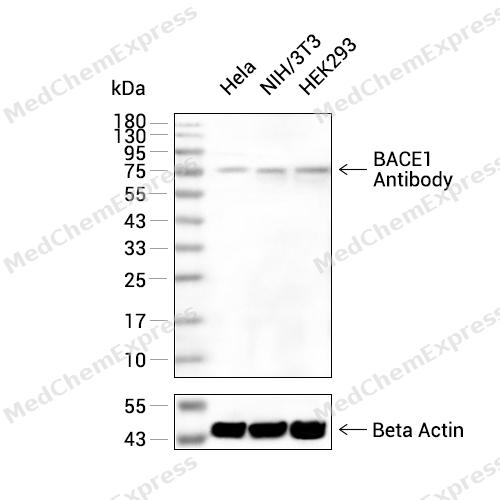 Western blot analysis of extracts from Hela(lane 2(20ug) , NIH/3T3(lane 3(20ug) and HEK293(lane 4(20ug) using BACE1 Antibody (HY-P82169) Rabbit mAb. Proteins were transferred to a PVDF membrane and blocked with 5% non-fat milk in TBST for 2 hour at room temperature. The primary antibody (1/1000) and Loading control antibody (Beta Actin, HY-P80438, 1/10000) was used in 5% non-fat milk in TBST at 4°C overnight. Goat Anti-Mouse/Rabbit IgG-HRP Secondary Antibody (1/10000) was used for 1 hour at room temperature.


Background
-
Function
BACE is responsible for the proteolytic processing of the amyloid precursor protein (APP). Cleaves at the N-terminus of the A-beta peptide sequence, between residues 671 and 672 of APP, leads to the generation and extracellular release of beta-cleaved soluble APP, and a corresponding cell-associated C-terminal fragment which is later released by gamma-secretase. Cleaves CHL1[1][2][3].
-
Subcellular Localization
Cell membrane; Single-pass type I membrane protein; Golgi apparatus, trans-Golgi network; Endoplasmic reticulum; Endosome; Cell surface; Cytoplasmic vesicle membrane; Single-pass type I membrane protein; Membrane raft; Lysosome; Late endosome; Early endosome; Recycling endosome; Cell projection, axon; Cell projection, dendrite
-
Expression
Tissue_specificity:It is highly expressed in the brain and pancreas. In the brain, the highest expression levels are found in the substantia nigra, locus coeruleus, and medulla oblongata.
Induction:Up-regulated by the Ca (2+) -regulated transcription factor NFATC4 -
Isoforms & Post-Translational Modification
P56817 has 6 isomers: P56817-1: 55764 Da (predicted); P56817-2: 52908 Da (predicted); P56817-3: 51068 Da (predicted); P56817-4: 48212 Da (predicted); P56817-5: 45017 Da (predicted); P56817-6: 42160 Da (predicted).
N-Glycosylated (PubMed:11083922, PubMed:17425515). Addition of a bisecting N-acetylglucosamine by MGAT3 blocks lysosomal targeting, further degradation and is required for maintaining stability under stress conditions (By similarity);Acetylated in the endoplasmic reticulum at Lys-126, Lys-275, Lys-279, Lys-285, Lys-299, Lys-300 and Lys-307. Acetylation by NAT8 and NAT8B is transient and deacetylation probably occurs in the Golgi. Acetylation regulates the maturation, the transport to the plasma membrane, the stability and the expression of the protein;Palmitoylation mediates lipid raft localization;Ubiquitinated at Lys-501, ubiquitination leads to lysosomal degradation (PubMed:16033761, PubMed:20484053, PubMed:23109336, PubMed:27302062). Monoubiquitinated and 'Lys-63'-linked polyubitinated (PubMed:20484053). Deubiquitnated by USP8; inhibits lysosomal degradation (PubMed:27302062);Phosphorylation at Ser-498 is required for interaction with GGA1 and retrograded transport from endosomal compartments to the trans-Golgi network. Non-phosphorylated BACE1 enters a direct recycling route to the cell surface -
Subunit
Monomer. Interacts (via DXXLL motif) with GGA1, GGA2 and GGA3 (via their VHS domain); the interaction highly increases when BACE1 is phosphorylated at Ser-498 (PubMed:14567678, PubMed:15886016). Interacts with RTN1; RTN2; RTN3 and RTN4; the interaction leads to inhibition of amyloid precursor protein processing (PubMed:15286784, PubMed:16965550, PubMed:16979658). Interacts with SNX6 (PubMed:20354142). Interacts with PCSK9 (PubMed:18660751). Interacts with NAT8 and NAT8B (PubMed:19011241). Interacts with BIN1 (PubMed:27179792). Interacts (via extracellular domain) with ADAM10 (via extracellular domain) (By similarity). Interacts with SORL1; this interaction may affect binding with APP and hence reduce APP cleavage (PubMed:16407538). Interacts with NRDC AND NRG1 (By similarity)
-
SwissProt ID
-
Synonyms
BACE1; BACE; KIAA1149; Beta-secretase 1; Aspartyl protease 2; ASP2; Asp 2; Beta-site amyloid precursor protein cleaving enzyme 1; Beta-site APP cleaving enzyme 1; Memapsin-2; Membrane-associated aspartic protease 2
-
Research Field
Neuroscience


Documentation
-
Data Sheet (258 KB)
-
SDS (252 KB)
- English - EN (252 KB)
- Français - FR (252 KB)
- Deutsch - DE (252 KB)
- Norwegian - NO (252 KB)
- Español - ES (252 KB)
- Swedish - SV (252 KB)
- Italian - IT (252 KB)
- Korean - KR (252 KB)
- Portuguese - PT (252 KB)
-
User Guide for Antibodies (1077 KB)

 Powered by Bioz
