



Caspase-7 Antibody (YA4099)
(Synonyms: MCH3; CMH-1; LICE2; CASP7; ICE-LAP3)Caspase-7 Antibody (YA4099) is a Mouse-derived and non-conjugated IgG1 monoclonal antibody, targeting to Caspase-7.
-
Host:
Mouse
-
Isotype:
IgG
-
Application:
WB, IHC-P, FC, ELISA
-
Reactivity :
Human
-
Formulation:
Supplied in PBS with 0.05% sodium azide.
-
Conjugation:
Non-conjugated


To place orders, for customer services and technical support, please contact: MedChemExpress USA
Tel: 609-228-6898 E-mail: [email protected] [email protected]





Applications
| Application |
WB

WB: Western Blot
|
IHC-P
IHC-P: Immunohistochemistry-Paraffin
|
FC
FC: Flow Cytometry
|
ELISA
ELISA: Enzyme Linked Immunosorbent Assay
|
|---|---|---|---|---|
| Dilution Ratio | 1:500-1:2000 | 1:200-1:1000 | 1:200-1:400 | 1:10000 |


Product Details
Caspase-7 Antibody (YA4099) is a Mouse-derived and non-conjugated IgG1 monoclonal antibody, targeting to Caspase-7.
-
Host Mouse

-
Clonality Monoclonal

-
Species ReactivityHuman
-
Observed Molecular WeightObserved band size: 34 kDa
Note: Due to possible protein modifications or aggregation, the molecular weight should be confirmed by actual measurement, and the predicted value is for reference only.

-
Calculated Molecular Weight Predicted band size: 34 kDa

Purified recombinant fragment of human CASP-7 (AA: 29-198) expressed in E. Coli.
affinity purified.
Non-conjugated
Unmodified
IgG


Product Properties
-
Appearance
Solution
-
Formulation
Supplied in PBS with 0.05% sodium azide.
-
Storage & Stability
Stored at -20°C for 1 year. Avoid repeated freeze / thaw cycles.
-
Shipping
Shipping with blue ice.


Verification Images
-
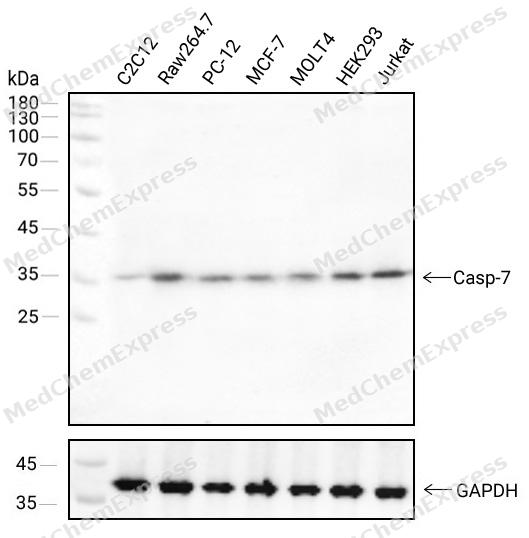 Western blot analysis of extracts from C1C12(lane 1(40μg) ),Raw264.7(lane 2(40μg) ),PC-12(lane 3(40μg) ),MCF-7(lane 4(40μg) ),MOLT4(lane 5(40μg) ),HEK293(lane 6(40μg) )and Jurkat(lane 7(40μg) ) using CASP-7 antibody. Proteins were transferred to a NC membrane and blocked with 5% Skim milk in TBST for 2 hour at room temperature. The primary antibody ( 1/1000) and Loading control antibody (GAPDH,1/1000) was used in 5% Skim milk in TBST at 4°C overnight. Goat Anti-Mouse IgG-HRP Secondary Antibody (1/10,000) was used for 1 hour at room temperature.
 -
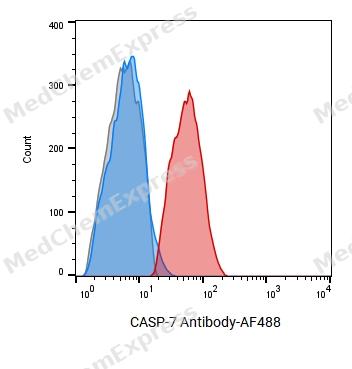 Flow cytometric analysis of 1X10^6 HepG2 cells labeling CASP-7 Antibody(red). Cells were fixed with 4% paraformaldehyde and permeabilised with 0.2% Triton X-100. Then stained with the primary antibody at 1/400 dilution overnight at 4℃. AF 488 Goat Anti-mouse IgG H&L was used as the secondary antibody at 1/1,000 dilution for 45 minutes at room temperature. Mouse IgG Isotype Control (blue) was used as the isotype control, cells without incubation with primary antibody were used as the unlabeled control (black).


Background
-
Function
Caspase 7 is an executioner cysteine protease that cleaves after aspartate residues and participates in programmed cell death and inflammation[1][2]. Mechanistically, death receptor and DNA-damage pathways activate caspase 7 through caspase 8 and caspase 9, placing it within apoptosis signaling cascades[1]. In Fas-stimulated Jurkat cells, caspase 8 activates caspase 3 and caspase 7, supporting a branched protease cascade during apoptotic execution[3]. In inflammatory models, caspase 1 inflammasomes activate caspase 7, and caspase 7 can mediate caspase 1-induced apoptosis upstream of caspase 3[1][4]. Disease and model evidence links caspase 7 to endotoxemia resistance in deficient mice, Salmonella-infected macrophages, neuropathic rat spinal cord apoptosis, and CHO-cell viability studies[1][4][5][6]. Compared with caspase 3, caspase 7 shares substrate recognition and some endogenous substrates, but specific substrates, caspase 1-dependent activation, and endotoxemia phenotypes distinguish the isoforms[1]. For experimental applications, isatin sulfonamides inhibit caspases 3 and 7 and serve as PET or SPECT apoptosis-imaging recognition units after radiolabeling[7].
-
Subcellular Localization
Cytoplasm, cytosol; Nucleus; Secreted, extracellular space
-
Expression
Tissue_specificity:It is highly expressed in the lungs, skeletal muscle, liver, kidneys, spleen, and heart, and moderately expressed in the testes. It is not expressed in the brain. -
Isoforms & Post-Translational Modification
P55210 has 4 isomers: P55210-1: 34277 Da (predicted); P55210-2: 28030 Da (predicted); P55210-3: 37815 Da (predicted); P55210-4: 31614 Da (predicted).
Cleavage by different proteases, such as granzyme B (GZMB), caspase-1 (CASP1), caspase-8 (CASP8), caspase-9 (CASP9) or caspase-10 (CASP10) generate the two active subunits (PubMed:12824163, PubMed:16352606, PubMed:16916640, PubMed:35338844, PubMed:35446120, PubMed:9852092). Its involvement in different programmed cell death processes is probably specified by the protease that activates CASP7 (PubMed:16916640, PubMed:9852092). Cleaved and activated by initiator caspases (CASP8, CASP9 and/or CASP10), leading to execution phase of apoptosis (PubMed:16352606, PubMed:16916640, PubMed:21555521, PubMed:27889207). Cleavage and maturation by GZMB regulates granzyme-mediated programmed cell death (By similarity). Cleaved and activated by CASP1 in response to bacterial infection (By similarity). Propeptide domains can also be cleaved efficiently by CASP3 (PubMed:8755496). Active heterodimers between the small subunit of caspase-7 and the large subunit of CASP3, and vice versa, also occur (PubMed:8755496). Also cleaved at the N-terminus at alternative sites by CAPN1, leading to its activation (PubMed:19617626);Phosphorylation at Ser-30 and Ser-239 by PAK2 inhibits its activity (PubMed:21555521, PubMed:27889207). Phosphorylation at Ser-30 prevents cleavage and activation by initiator caspase CASP9, while phosphorylation at Ser-239 prevents thiol protease activity by preventing substrate-binding (PubMed:21555521, PubMed:27889207);(Microbial infection) ADP-riboxanation by C.violaceum CopC blocks CASP7 processing, preventing CASP7 activation and ability to recognize and cleave substrates;Ubiquitinated by BIRC6; this activity is inhibited by DIABLO/SMAC -
Subunit
Heterotetramer that consists of two anti-parallel arranged heterodimers, each one formed by a 20 kDa (p20) and a 11 kDa (p11) subunit (PubMed:11701129, PubMed:11752425, PubMed:16916640, PubMed:20566630). Interacts with XIAP (via its second BIR domain); inhibiting CASP7 activity (PubMed:11257230, PubMed:11257231, PubMed:16916640). Interacts with BIRC6/bruce (PubMed:15200957). Interacts with ATXN3 (short isoform 1) (PubMed:30455355). Interacts with HSPA5 (PubMed:26045166)
-
SwissProt ID
-
Synonyms
MCH3; CMH-1; LICE2; CASP7; ICE-LAP3


Documentation
References
[1]. Lamkanfi M, et al. Caspase-7: a protease involved in apoptosis and inflammation. Int J Biochem Cell Biol. 2010 Jan;42(1):21-4. [Content Brief]
[2]. Denault JB, et al. Caspases. Curr Protoc Protein Sci. 2002 Feb;Chapter 21:21.8.1-21.8.16. [Content Brief]
[3]. Hirata H, et al. Caspases are activated in a branched protease cascade and control distinct downstream processes in Fas-induced apoptosis. J Exp Med. 1998 Feb 16;187(4):587-600. [Content Brief]
[4]. Mahib MR, et al. Caspase-7 mediates caspase-1-induced apoptosis independently of Bid. Microbiol Immunol. 2020 Feb;64(2):143-152. [Content Brief]
[5]. Siniscalco D, et al. Involvement of subtype 1 metabotropic glutamate receptors in apoptosis and caspase-7 over-expression in spinal cord of neuropathic rats. Pharmacol Res. 2008 Mar;57(3):223-33. [Content Brief]
[6]. Safari F, et al. Caspase-7 deficiency in Chinese hamster ovary cells reduces cell proliferation and viability. Biol Res. 2020 Nov 13;53(1):52. [Content Brief]
[7]. Limpachayaporn P, et al. Isatin sulfonamides: potent caspases-3 and -7 inhibitors, and promising PET and SPECT radiotracers for apoptosis imaging. Future Med Chem. 2015;7(9):1173-96. [Content Brief]

 Powered by Bioz
