



CBR1 Antibody (YA810)(PBS only)
(Synonyms: 15 hydroxyprostaglandin dehydrogenase [NADP ]; 15-hydroxyprostaglandin dehydrogenase [NADP ]; Carbonyl reductase [NADPH] 1; CBR 1; CBR1; CBR1_HUMAN; CRN; NADPH dependent carbonyl reductase 1; NADPH-dependent carbonyl reductase 1; Prostaglandin 9 ketoreduc)CBR1 Antibody (YA810) is a Mouse-derived and non-conjugated IgG1 monoclonal antibody, targeting to CBR1.
-
Host:
Mouse
-
Isotype:
IgG
-
Application:
WB, ICC/IF
-
Reactivity :
Human
-
Formulation:
Supplied in PBS, pH 7.4.
-
Conjugation:
Non-conjugated


To place orders, for customer services and technical support, please contact: MedChemExpress USA
Tel: 609-228-6898 E-mail: [email protected] [email protected]





Applications
| Application |
WB

WB: Western Blot
|
ICC/IF
ICC/IF: Immunocytochemistry/
Immunofluorescence |
|---|---|---|
| Dilution Ratio | 1:500-1:1000 | 1:50-1:200 |


Product Details
CBR1 Antibody (YA810) is a Mouse-derived and non-conjugated IgG1 monoclonal antibody, targeting to CBR1.
-
Host Mouse

-
Species ReactivityHuman

-
Observed Molecular WeightObserved band size: 30 kDa
Note: Due to possible protein modifications or aggregation, the molecular weight should be confirmed by actual measurement, and the predicted value is for reference only.

-
Calculated Molecular Weight Predicted band size: 30 kDa

Synthetic peptide corresponding to Human CBR1.The exact sequence is proprietary to MCE.
affinity purified
Non-conjugated
IgG


Product Properties
-
Appearance
Solution
-
Formulation
Supplied in PBS, pH 7.4.
-
Storage & Stability
Stored at -20°C for 1 year. Avoid repeated freeze / thaw cycles.
-
Shipping
Shipping with blue ice.


Verification Images
-
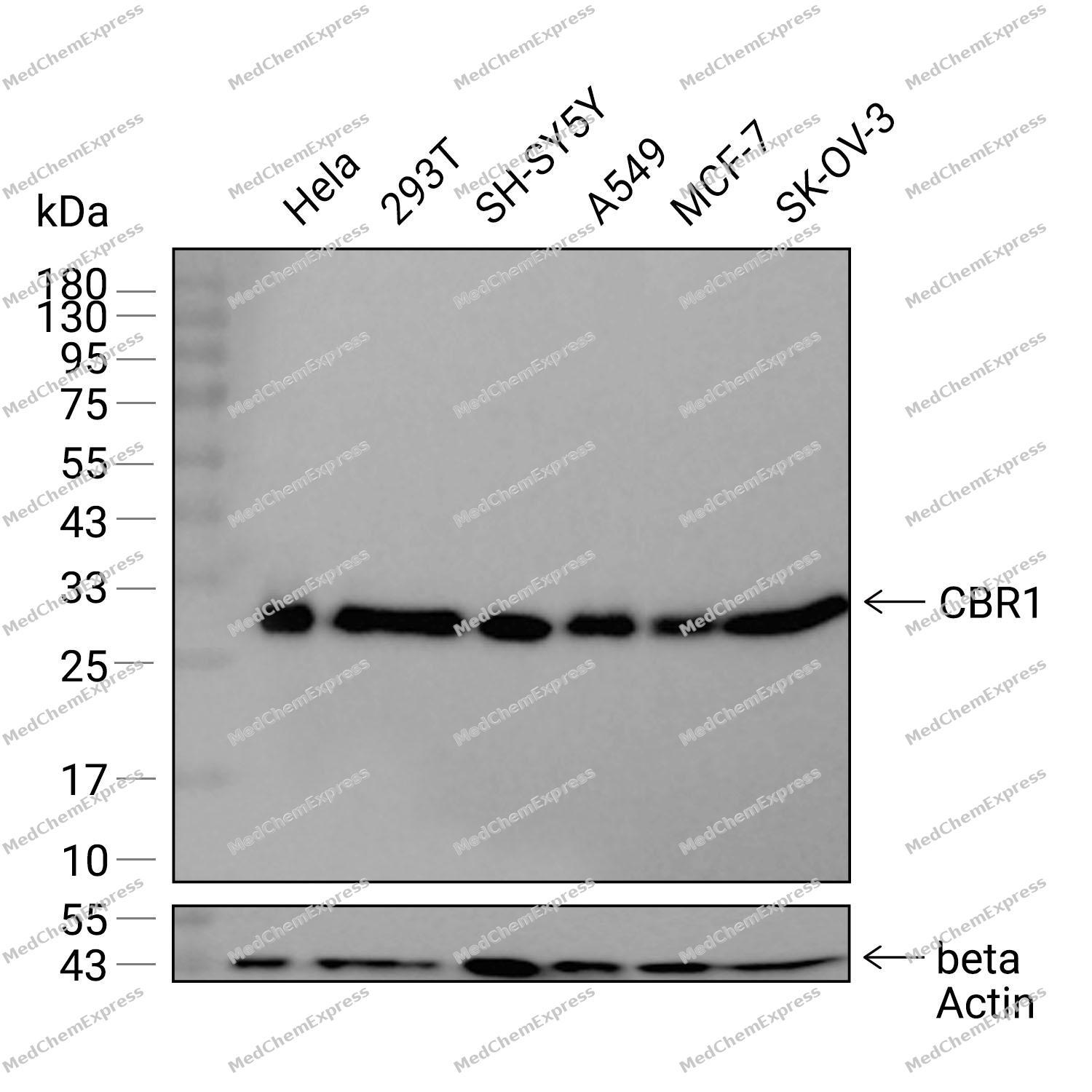 Western blot analysis was performed on extracts from Hela (lane 1, 15 μg), 293T (lane 2, 15 μg), SH-SY5Y (lane 3, 15 μg), A549 (lane 4, 15 μg), MCF-7 (lane 5, 15 μg), and SK-OV-3 (lane 6, 15 μg) using CBR1 Mouse mAb.Proteins were transferred to a PVDF membrane and blocked with 5% non - fat milk in TBST at 4°C overnight.The primary antibody (1:1000 dilution) and the loading control antibody (beta-Actin, HY-P83730, 1:20000 dilution) were incubated in 5% non-fat milk in TBST for 1 hour at 37°C.Goat Anti - Mouse/Rabbit IgG - HRP Secondary Antibody (1:20000 dilution) was then applied for 40 minutes at 37°C.


Background
-
Function
Cannabinoid receptor 1 (CBR1/CB1R) is a Gi/o-coupled G protein-coupled receptor that functions as a major regulator of endocannabinoid signaling in the central nervous system and peripheral tissues, where it modulates neurotransmitter release and synaptic activity through presynaptic mechanisms[1]. Mechanistically, CBR1 inhibits adenylyl cyclase, regulates cyclic AMP-dependent signaling, activates mitogen-activated protein kinase pathways, and modulates voltage-gated calcium and inwardly rectifying potassium channels, thereby controlling neuronal excitability and cellular responses[2]. Endocannabinoid-mediated CBR1 signaling acts as a feedback system that limits excessive synaptic transmission and contributes to neuronal plasticity and neuroprotection[3]. In disease-related experimental models, CBR1 activation promotes cell-survival pathways involving PI3K/Akt/mTORC1 signaling and brain-derived neurotrophic factor expression, supporting neuronal viability in models of striatal injury and Huntington’s disease[3]. Compared with the related cannabinoid receptor CB2, which is predominantly associated with immune tissues and immunomodulatory functions, CBR1 is highly enriched in neuronal populations and uniquely exhibits prominent ion-channel regulation[2]. For experimental applications, selective CBR1 agonists and antagonists are widely used to distinguish receptor-specific functions, investigate feeding behavior, metabolic regulation, synaptic plasticity, and neurodegenerative mechanisms, although centrally acting antagonists have shown psychiatric liabilities in clinical development[1][4].
-
Subcellular Localization
Cytoplasm
-
Expression
Tissue_specificity:Expressed in the kidneys (protein level) -
Isoforms & Post-Translational Modification
P16152 has 2 isomers: P16152-1: 30375 Da (predicted); P16152-2: 18762 Da (predicted).
-
Subunit
Monomer
-
SwissProt ID
-
Synonyms
15 hydroxyprostaglandin dehydrogenase [NADP ]; 15-hydroxyprostaglandin dehydrogenase [NADP ]; Carbonyl reductase [NADPH] 1; CBR 1; CBR1; CBR1_HUMAN; CRN; NADPH dependent carbonyl reductase 1; NADPH-dependent carbonyl reductase 1; Prostaglandin 9 ketoreduc
-
Research Field
Signal Transduction


Documentation
References
[1]. Howlett AC, et al. CB1 and CB2 Receptor Pharmacology. Adv Pharmacol. 2017;80:169-206. [Content Brief]
[3]. Blázquez C, et al. The CB₁ cannabinoid receptor signals striatal neuroprotection via a PI3K/Akt/mTORC1/BDNF pathway. Cell Death Differ. 2015 Oct;22(10):1618-29. [Content Brief]
[4]. Rabezanahary H, et al. Live virus neutralizing antibodies against pre and post Omicron strains in food and retail workers in Québec, Canada. Heliyon. 2024 May 21;10(10):e31026. [Content Brief]

 Powered by Bioz
