



CD369 Antibody (YA4466)
(Synonyms: CLEC7A; BGR; CANDF4; SCARE2; DECTIN1; CLECSF12)Based on 1 Customer Validation
CD369 Antibody (YA4466) is a Mouse-derived and non-conjugated IgG1 monoclonal antibody, targeting to CD369.
-
Host:
Mouse
-
Isotype:
IgG1
-
Application:
ICC/IF, FC, ELISA
-
Reactivity :
Human
-
Formulation:
Supplied in PBS with 0.05% sodium azide
-
Conjugation:
Non-conjugated


To place orders, for customer services and technical support, please contact: MedChemExpress USA
Tel: 609-228-6898 E-mail: [email protected] [email protected]





Applications
| Application |
ICC/IF

ICC/IF: Immunocytochemistry/
Immunofluorescence |
FC
FC: Flow Cytometry
|
ELISA
ELISA: Enzyme Linked Immunosorbent Assay
|
|---|---|---|---|
| Dilution Ratio | 1:200-1:1000 | 1:200-1:400 | 1:10000 |


Product Details
CD369 Antibody (YA4466) is a Mouse-derived and non-conjugated IgG1 monoclonal antibody, targeting to CD369.
-
Host Mouse

-
Clonality Monoclonal

-
Species ReactivityHuman
-
Observed Molecular WeightObserved band size: 28 kDa
Note: Due to possible protein modifications or aggregation, the molecular weight should be confirmed by actual measurement, and the predicted value is for reference only.

-
Calculated Molecular Weight Predicted band size: 28 kDa

Purified recombinant fragment of human CD369 (AA: extra 66-247) expressed in E. Coli.
affinity purified.
Non-conjugated
Unmodified
IgG1


Product Properties
-
Appearance
Solution
-
Formulation
Supplied in PBS with 0.05% sodium azide
-
Concentration
Batch-dependent, Please check the COA for the concentration of each lot. Check Lot Concentration
-
Storage & Stability
Stored at -20°C for 1 year. Avoid repeated freeze / thaw cycles.
-
Shipping
Shipping with blue ice.


Verification Images
-
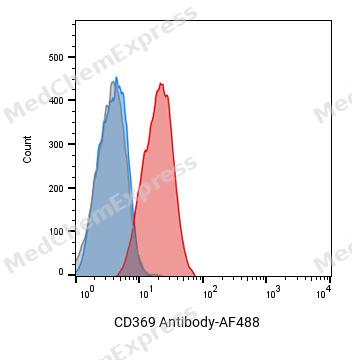 Flow cytometric analysis of 1X10^6 HL-60 cells labeling CD369 Antibody(red). Cells were fixed with 4% paraformaldehyde and permeabilised with 0.2% Triton X-100. Then stained with the primary antibody at 1/400 dilution overnight at 4℃. AF 488 Goat Anti-mouse IgG H&L was used as the secondary antibody at 1/1,000 dilution for 45 minutes at room temperature. Mouse IgG Isotype Control (blue) was used as the isotype control, cells without incubation with primary antibody were used as the unlabeled control (black).
 -
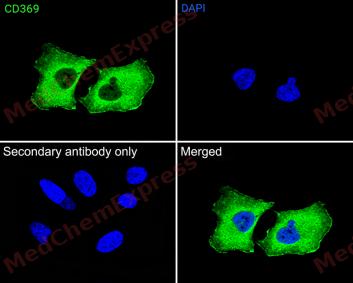 Immunofluorescence analysis of Hela cells labeling CD369 antibody at 1/50 dilution. Cells were fixed in 4% paraformaldehyde for 15 minutes at room temperature, permeabilized with 0.1% Triton X-100 in PBS for 15 minutes at room temperature, then blocked with 1% BSA in 10% negative goat serum for 1 hour at room temperature.Cells were then incubated with CD369 antibody at 1/50 dilution in 1% BSA in PBST overnight at 4 ℃. AF 488 Goat Anti-mouse IgG H&L ( green) was used as the secondary antibody at 1/500 dilution. PBS instead of the primary antibody was used as the secondary antibody only control. The Nuclear counterstain was DAPI (Blue)


Background
-
Function
CD369 is a Lectin that functions as a pattern recognizing receptor (PRR) specific for beta-1,3-linked and beta-1,6-linked glucans, which constitute cell wall constituents from pathogenic bacteria and fungi. Necessary for the TLR2-mediated inflammatory response and activation of NF-kappa-B: upon beta-glucan binding, recruits SYK via its ITAM motif and promotes a signaling cascade that activates some CARD domain-BCL10-MALT1 (CBM) signalosomes, leading to the activation of NF-kappa-B and MAP kinase p38 (MAPK11, MAPK12, MAPK13 and/or MAPK14) pathways which stimulate expression of genes encoding pro-inflammatory cytokines and chemokines. Enhances cytokine production in macrophages and dendritic cells. Mediates production of reactive oxygen species in the cell. Mediates phagocytosis of C.albicans conidia. Binds T-cells in a way that does not involve their surface glycans and plays a role in T-cell activation. Stimulates T-cell proliferation. Induces phosphorylation of SCIMP after binding beta-glucans[1][2][3].
-
Subcellular Localization
Cell membrane; Single-pass type II membrane protein; Cytoplasm; Cytoplasm; Cytoplasm
-
Expression
Tissue_specificity:Highly expressed in peripheral blood leukocytes and dendritic cells. Detected in spleen, bone marrow, lung, muscle, stomach and placenta
Induction:Up-regulated during differentiation from monocytes into dendritic cells -
Isoforms & Post-Translational Modification
Q9BXN2 has 10 isomers: Q9BXN2-1: 27627 Da (predicted); Q9BXN2-2: 22563 Da (predicted); Q9BXN2-3: 21065 Da (predicted); Q9BXN2-4: 21130 Da (predicted); Q9BXN2-5: 19218 Da (predicted); Q9BXN2-6: 14787 Da (predicted); Q9BXN2-7: 16000 Da (predicted); Q9BXN2-8: 5164 Da (predicted); Q9BXN2-9: 8363 Da (predicted); Q9BXN2-10: 13138 Da (predicted).
Phosphorylated on tyrosine residues in response to beta-glucan binding -
Subunit
Homodimer. Interacts with SYK; participates in leukocyte activation in presence of fungal pathogens. Interacts with CD37; this interaction controls CLEC7A-mediated IL-6 production (PubMed:17182550)
-
SwissProt ID
-
Synonyms
CLEC7A; BGR; CANDF4; SCARE2; DECTIN1; CLECSF12


Documentation
-
Data Sheet (235 KB)
-
SDS (251 KB)
- English - EN (251 KB)
- Français - FR (251 KB)
- Deutsch - DE (251 KB)
- Norwegian - NO (251 KB)
- Español - ES (251 KB)
- Swedish - SV (251 KB)
- Italian - IT (251 KB)
- Korean - KR (251 KB)
- Portuguese - PT (251 KB)
-
User Guide for Antibodies (1077 KB)

 Powered by Bioz
