



GAPDH Antibody (YA848)
(Synonyms: GAPDH; GAPD; CDABP0047; OK/SW-cl.12; Glyceraldehyde-3-phosphate dehydrogenase; Peptidyl-cysteine S-nitrosylase GAPDH)
Based on 1 Customer Validation
GAPDH Antibody (YA848) is a non-conjugated and Mouse origined IgM monoclonal antibody. It can be used as a loading control antibody.
-
Host:
Mouse
-
Isotype:
IgM
-
Application:
WB
-
Reactivity :
Human, Monkey, Rat, Mouse, Saccharomyces cerevisiae, Pichia pastoris, Hamster
-
Formulation:
Supplied in PBS containing 50% glycerol, 0.5% BSA and 0.02% sodium azide, pH 7.3.
-
Conjugation:
Non-conjugated


To place orders, for customer services and technical support, please contact: MedChemExpress USA
Tel: 609-228-6898 E-mail: [email protected] [email protected]





Applications
| Application |
WB

WB: Western Blot
|
|---|---|
| Dilution Ratio | 1:5000-1:10000 |


Product Details
GAPDH Antibody (YA848) is a non-conjugated and Mouse origined IgM monoclonal antibody. It can be used as a loading control antibody.
-
Host Mouse

-
Clonality Monoclonal

-
Species ReactivityHuman, Monkey, Rat, Mouse, Saccharomyces cerevisiae, Pichia pastoris, Hamster
-
Observed Molecular WeightObserved band size: 36 kDa
Note: Due to possible protein modifications or aggregation, the molecular weight should be confirmed by actual measurement, and the predicted value is for reference only.

-
Calculated Molecular Weight Predicted band size: 36 kDa

Entrez Gene: 374193 Chicken ; 2597 Human ; 100042025 Mouse ; 14433 Mouse ; 24383 Rat685186
SwissProt: P00356 Chicken ; P04406 Human ; P16858 Mouse ; P04797 Rat
OMIM: 138400 Human
Synthetic peptide corresponding to Human GAPDH aa72-248.
Endogenous
Non-conjugated
Unmodified
IgM


Product Properties
-
Appearance
Solution
-
Formulation
Supplied in PBS containing 50% glycerol, 0.5% BSA and 0.02% sodium azide, pH 7.3.
-
Concentration
Batch-dependent, Please check the COA for the concentration of each lot. Check Lot Concentration
-
Storage & Stability
Stored at -20°C for 1 year. Avoid repeated freeze / thaw cycles.
-
Shipping
Shipping with blue ice.


Verification Images
-
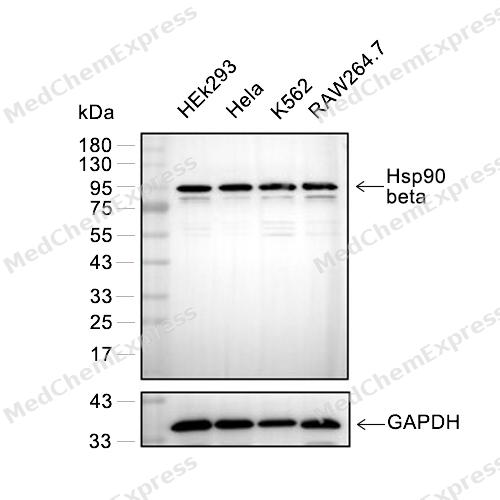 Western blot analysis of extracts from HEK293(lane 2(20μg), Hela(lane 3(20μg), K562(lane 4(20μg) ) ,RAW264.7(lane 5(20μg) ) using Hsp90 beta (HY-P80187) Rabbit mAb. Proteins were transferred to a PVDF membrane and blocked with 5% BSA in TBST for 2 hour at room temperature. The primary antibody (HY-P80187, 1/1000) and Loading control antibody (GAPDH, HY-P80954, 1/3000) was used in 5% BSA in TBST at 4°C overnight. Goat Anti-Mouse/Rabbit IgG-HRP Secondary Antibody (HY-P8004/HY-P8001, 1/10,000) was used for 1 hour at room temperature.
 -
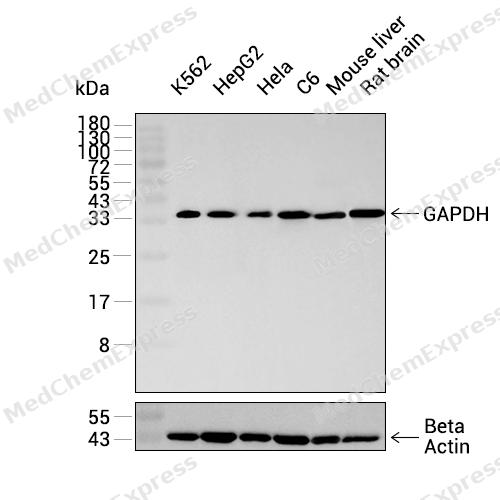 Western blot analysis was performed on extracts from K562 (lane 1, 15 μg), HepG2 (lane 2, 15 μg), Hela (lane 3, 15 μg), C6 (lane 4, 15 μg), Mouse liver (lane 5, 15 μg), and Rat brain (lane 6, 15 μg) using GAPDH Mouse mAb.Proteins were transferred to a PVDF membrane and blocked with 5% non-fat milk in TBST at 4°C overnight.The primary antibody (1:1000 dilution) and the loading control antibody (beta-Actin, HY-P83730, 1:20000 dilution) were incubated in 5% non-fat milk in TBST for 1 hour at 37°C.Goat Anti-Mouse/Rabbit IgG-HRP Secondary Antibody (1:20000 dilution) was then applied for 40 minutes at 37°C.


Background
-
Function
GAPDH is a Has both glyceraldehyde-3-phosphate dehydrogenase and nitrosylase activities, thereby playing a role in glycolysis and nuclear functions, respectively. Glyceraldehyde-3-phosphate dehydrogenase is a key enzyme in glycolysis that catalyzes the first step of the pathway by converting D-glyceraldehyde 3-phosphate (G3P) into 3-phospho-D-glyceroyl phosphate. Modulates the organization and assembly of the cytoskeleton. Facilitates the CHP1-dependent microtubule and membrane associations through its ability to stimulate the binding of CHP1 to microtubules. Component of the GAIT (gamma interferon-activated inhibitor of translation) complex which mediates interferon-gamma-induced transcript-selective translation inhibition in inflammation processes. Upon interferon-gamma treatment assembles into the GAIT complex which binds to stem loop-containing GAIT elements in the 3'-UTR of diverse inflammatory mRNAs (such as ceruplasmin) and suppresses their translation. Also plays a role in innate immunity by promoting TNF-induced NF-kappa-B activation and type I interferon production, via interaction with TRAF2 and TRAF3, respectively. Participates in nuclear events including transcription, RNA transport, DNA replication and apoptosis. Nuclear functions are probably due to the nitrosylase activity that mediates cysteine S-nitrosylation of nuclear target proteins such as SIRT1, HDAC2 and PRKDC[1][2][3][4][5].
-
Subcellular Localization
Cytoplasm, cytosol; Nucleus; Cytoplasm, perinuclear region; Membrane; Cytoplasm, cytoskeleton
-
Isoforms & Post-Translational Modification
P04406 has 2 isomers: P04406-1: 36053 Da (predicted); P04406-2: 31548 Da (predicted).
S-nitrosylation of Cys-152 leads to interaction with SIAH1, followed by translocation to the nucleus (By similarity). S-nitrosylation of Cys-247 is induced by interferon-gamma and LDL(ox) implicating the iNOS-S100A8/9 transnitrosylase complex and seems to prevent interaction with phosphorylated RPL13A and to interfere with GAIT complex activity (PubMed:22771119, PubMed:25417112);ISGylated;Sulfhydration at Cys-152 increases catalytic activity;Oxidative stress can promote the formation of high molecular weight disulfide-linked GAPDH aggregates, through a process called nucleocytoplasmic coagulation. Such aggregates can be observed in vivo in the affected tissues of patients with Alzheimer disease or alcoholic liver cirrhosis, or in cell cultures during necrosis. Oxidation at Met-46 may play a pivotal role in the formation of these insoluble structures. This modification has been detected in vitro following treatment with free radical donor (+/-)-(E)-4-ethyl-2-[(E)-hydroxyimino]-5-nitro-3-hexenamide. It has been proposed to destabilize nearby residues, increasing the likelihood of secondary oxidative damages, including oxidation of Tyr-45 and Met-105. This cascade of oxidations may augment GAPDH misfolding, leading to intermolecular disulfide cross-linking and aggregation;Succination of Cys-152 and Cys-247 by the Krebs cycle intermediate fumarate, which leads to S-(2-succinyl)cysteine residues, inhibits glyceraldehyde-3-phosphate dehydrogenase activity. Fumarate concentration as well as succination of cysteine residues in GAPDH is significantly increased in muscle of diabetic mammals. It was proposed that the S-(2-succinyl)cysteine chemical modification may be a useful biomarker of mitochondrial and oxidative stress in diabetes and that succination of GAPDH and other thiol proteins by fumarate may contribute to the metabolic changes underlying the development of diabetes complications;(Microbial infection) Glycosylated by C.rodentium protein NleB, enteropathogenic E.coli protein NleB1 and S.typhimurium protein Ssek1: arginine GlcNAcylation prevents the interaction with TRAF2 and TRAF3 (PubMed:23332158, PubMed:27387501, PubMed:28522607). This leads to reduced ubiquitination of TRAF2 and TRAF3, and subsequent inhibition of NF-kappa-B signaling and type I interferon production, respectively (PubMed:23332158, PubMed:27387501) -
Subunit
Homotetramer (PubMed:16239728, PubMed:16510976).
-
SwissProt ID
-
Synonyms
GAPDH; GAPD; CDABP0047; OK/SW-cl.12; Glyceraldehyde-3-phosphate dehydrogenase; Peptidyl-cysteine S-nitrosylase GAPDH
-
Research Field
Neuroscience


Documentation
-
Data Sheet (261 KB)
-
SDS (252 KB)
- English - EN (252 KB)
- Français - FR (252 KB)
- Deutsch - DE (252 KB)
- Norwegian - NO (252 KB)
- Español - ES (252 KB)
- Swedish - SV (252 KB)
- Italian - IT (252 KB)
- Korean - KR (252 KB)
- Portuguese - PT (252 KB)
-
User Guide for Antibodies (1077 KB)
References
[1]. Tisdale EJ, et al. Glyceraldehyde-3-phosphate dehydrogenase is phosphorylated by protein kinase Ciota /lambda and plays a role in microtubule dynamics in the early secretory pathway. J Biol Chem. 2002 Feb 1;277(5):3334-41. [Content Brief]
[2]. Ercolani L, et al. Isolation and complete sequence of a functional human glyceraldehyde-3-phosphate dehydrogenase gene. J Biol Chem. 1988 Oct 25;263(30):15335-41. [Content Brief]
[3]. Arif A, et al. Heterotrimeric GAIT complex drives transcript-selective translation inhibition in murine macrophages. Mol Cell Biol. 2012 Dec;32(24):5046-55. [Content Brief]
[4]. Gao X, et al. NleB, a bacterial effector with glycosyltransferase activity, targets GAPDH function to inhibit NF-κB activation. Cell Host Microbe. 2013 Jan 16;13(1):87-99. [Content Brief]
[5]. Gao X, et al. Citrobacter rodentium NleB Protein Inhibits Tumor Necrosis Factor (TNF) Receptor-associated Factor 3 (TRAF3) Ubiquitination to Reduce Host Type I Interferon Production. J Biol Chem. 2016 Aug 26;291(35):18232-8. [Content Brief]

 Powered by Bioz
