



GRP94 Antibody (YA2519)
(Synonyms: Endoplasmin; GRP-94; gp96 homolog; HSP90B1; GRP 94; TRA1)
Based on 1 Customer Validation
GRP94 Antibody (YA2519) is a Rabbit-derived and non-conjugated IgG monoclonal antibody, targeting to GRP94.
-
Host:
Rabbit
-
Isotype:
IgG
-
Application:
WB, IHC-P, ICC/IF
-
Reactivity :
Human, Mouse
-
Formulation:
Supplied in Rabbit IgG in 10mM phosphate buffered saline , pH 7.4, 150mM sodium chloride, 0.05% BSA, 0.02% sodium azide and 50% glycerol.
-
Conjugation:
Non-conjugated


To place orders, for customer services and technical support, please contact: MedChemExpress USA
Tel: 609-228-6898 E-mail: [email protected] [email protected]





Applications
| Application |
WB

WB: Western Blot
|
IHC-P
IHC-P: Immunohistochemistry-Paraffin
|
ICC/IF
ICC/IF: Immunocytochemistry/
Immunofluorescence |
|---|---|---|---|
| Dilution Ratio | 1:500-1:1000 | 1:50-1:100 | 1:50-1:200 |


Product Details
GRP94 Antibody (YA2519) is a Rabbit-derived and non-conjugated IgG monoclonal antibody, targeting to GRP94.
-
Host Rabbit

-
Clonality Recombinant, Monoclonal

-
Species ReactivityHuman, Mouse
-
Observed Molecular WeightObserved band size: 92 kDa
Note: Due to possible protein modifications or aggregation, the molecular weight should be confirmed by actual measurement, and the predicted value is for reference only.

-
Calculated Molecular Weight Predicted band size: 92 kDa

Entrez Gene: 7184 Human ; 22027 Mouse ; 362862 Rat
SwissProt: P14625 Human ; P08113 Mouse ; Q66HD0 Rat
OMIM: 191175 Human
A synthesized peptide derived from human GRP94 aa671-730.
Endogenous
Affinity Chromatography
Non-conjugated
Unmodified
IgG


Product Properties
-
Appearance
Liquid
-
Formulation
Supplied in Rabbit IgG in 10mM phosphate buffered saline , pH 7.4, 150mM sodium chloride, 0.05% BSA, 0.02% sodium azide and 50% glycerol.
-
Concentration
Batch-dependent, Please check the COA for the concentration of each lot. Check Lot Concentration
-
Storage & Stability
Stored at -20°C for 1 year. Avoid repeated freeze / thaw cycles.
-
Shipping
Shipping with blue ice.


Verification Images
-
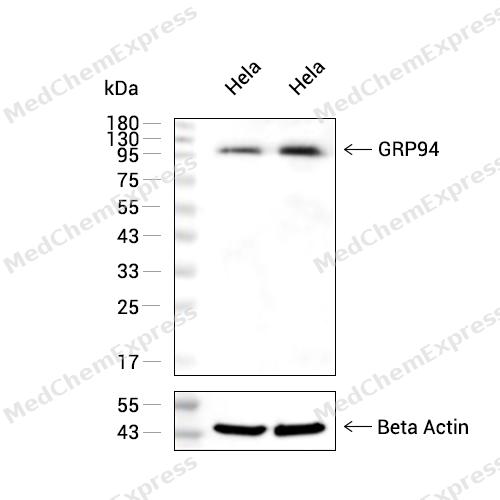 Western blot analysis of extracts from Hela (lane 2(20μg) and Hela (lane 3(40μg) using GRP94 (HY-P82774) Rabbit mAb. Proteins were transferred to a PVDF membrane and blocked with 5% non-fat milk in TBST for 2 hour at room temperature. The primary antibody (1/1000) and Loading control antibody (Beta Actin, HY-P80438, 1/10000) was used in 5% non-fat milk in TBST at 4°C overnight. Goat Anti-Mouse IgG-HRP Secondary Antibody (1/10000) was used for 1 hour at room temperature.
 -
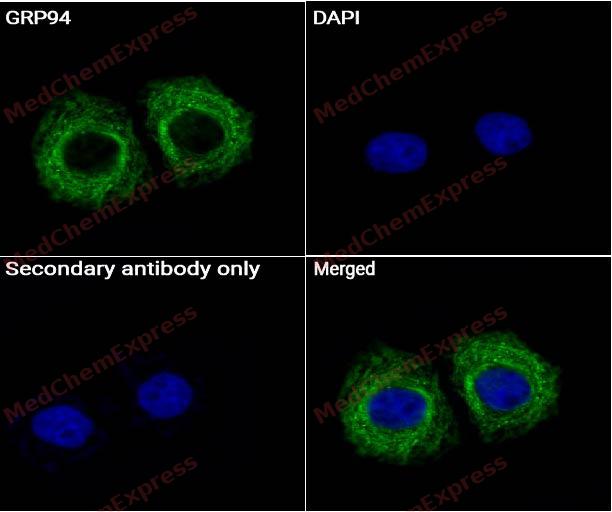 Immunocytochemistry analysis of Hela cells labeling GRP94 Antibody (HY-P82774) at 1/50 dilution. Cells were fixed in 4% paraformaldehyde for 15 minutes at room temperature, permeabilized with 0.1% Triton X-100 for 10 minutes at room temperature, then blocked with QuickBlock™ Blocking Buffer for Immunol Staining for 10 min at room temperature. Cells were then incubated with GRP94 Antibody (HY-P82774) at 1/50 dilution in QuickBlock™ Blocking Buffer for Immunol Staining at 4 ℃. Alexa Fluor® 488-conjugated AffiniPure Goat Anti-Rabbit IgG H&L(HY-P8002, Green) was used as the secondary antibody at 1/1,000 dilution. PBS instead of the primary antibody was used as the secondary antibody only control. The Nuclear counterstain was DAPI (Blue).
 -
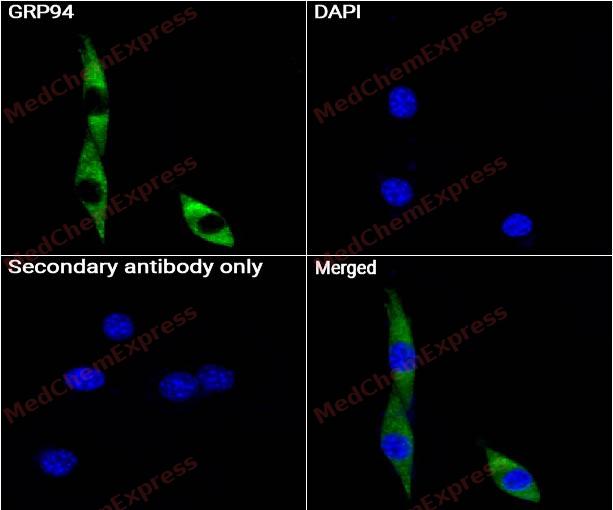 Immunocytochemistry analysis of NIH/3T3 cells labeling GRP94 Antibody (HY-P82774) at 1/50 dilution. Cells were fixed in 4% paraformaldehyde for 15 minutes at room temperature, permeabilized with 0.1% Triton X-100 for 10 minutes at room temperature, then blocked with QuickBlock™ Blocking Buffer for Immunol Staining for 10 min at room temperature. Cells were then incubated with GRP94 Antibody (HY-P82774) at 1/50 dilution in QuickBlock™ Blocking Buffer for Immunol Staining at 4 ℃. Alexa Fluor® 488-conjugated AffiniPure Goat Anti-Rabbit IgG H&L(HY-P8002, Green) was used as the secondary antibody at 1/1,000 dilution. PBS instead of the primary antibody was used as the secondary antibody only control. The Nuclear counterstain was DAPI (Blue).
 -
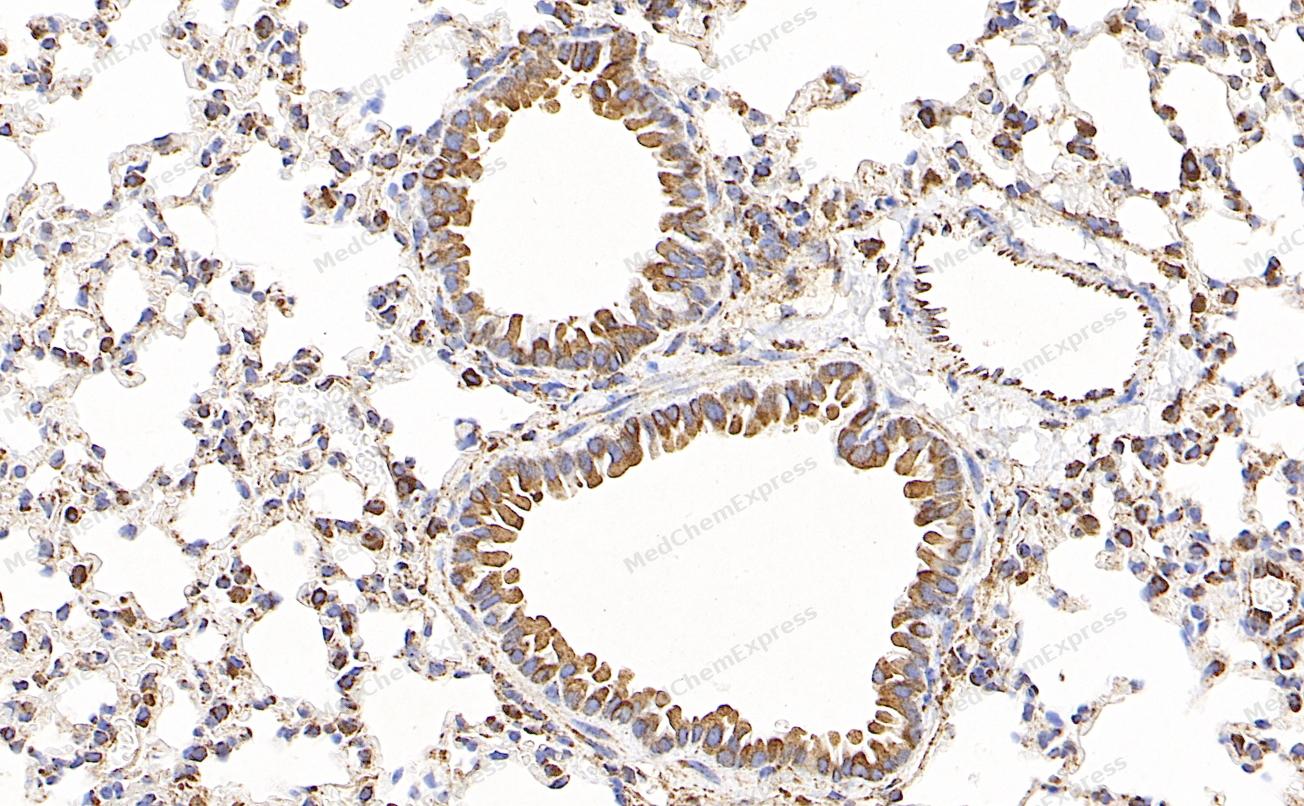 Immunohistochemical analysis of paraffin-embedded Mouse lung tissue using GRP94 Antibody (YA2519). The section was pre-treated using heat mediated antigen retrieval with sodium citrate buffer (pH 6.0) for 8 minutes. The tissues were blocked in QuickBlock for 20 minutes at room temperature, washed with ddH2O and PBS, and then probed with the primary antibody (HY-P82774, 1/100) in 4℃ overnight. The detection was performed using an HRP conjugated compact polymer system. DAB was used as the chromogen. Tissues were counterstained with hematoxylin and mounted with DPX.
 -
Immunohistochemical analysis of paraffin-embedded Mouse lung tissue using GRP94 Antibody (YA2519). The section was pre-treated using heat mediated antigen retrieval with sodium citrate buffer (pH 6.0) for 8 minutes. The tissues were blocked in QuickBlock for 20 minutes at room temperature, washed with ddH2O and PBS, and then probed with the primary antibody (HY-P82774, 1/100) in 4℃ overnight. The detection was performed using an HRP conjugated compact polymer system. DAB was used as the chromogen. Tissues were counterstained with hematoxylin and mounted with DPX.


Background
-
Function
GRP94 is an ATP-dependent chaperone involved in the processing of proteins in the endoplasmic reticulum, regulating their transport. Together with MESD, acts as a modulator of the Wnt pathway by promoting the folding of LRP6, a coreceptor of the canonical Wnt pathway. When associated with CNPY3, required for proper folding of Toll-like receptors. Promotes folding and trafficking of TLR4 to the cell surface. May participate in the unfolding of cytosolic leaderless cargos (lacking the secretion signal sequence) such as the interleukin 1/IL-1 to facilitate their translocation into the ERGIC (endoplasmic reticulum-Golgi intermediate compartment) and secretion; the translocation process is mediated by the cargo receptor TMED10[1][2][3][4].
-
Subcellular Localization
Endoplasmic reticulum lumen; Sarcoplasmic reticulum lumen; Melanosome
-
Subunit
Homodimer; disulfide-linked. Component of an EIF2 complex at least composed of CELF1/CUGBP1, CALR, CALR3, EIF2S1, EIF2S2, HSP90B1 and HSPA5 (By similarity). Part of a large chaperone multiprotein complex comprising DNAJB11, HSP90B1, HSPA5, HYOU, PDIA2, PDIA4, PDIA6, PPIB, SDF2L1, UGGT1 and very small amounts of ERP29, but not, or at very low levels, CALR nor CANX. Interacts with AIMP1; regulates its retention in the endoplasmic reticulum. Hyperglycosylated form interacts with OS9; promoting its degradation by the endoplasmic reticulum associated degradation (ERAD) (PubMed:18264092, PubMed:24899641). Interacts with CNPY3. This interaction is disrupted in the presence of ATP (By similarity). Interacts with TLR4 and TLR9, but not with TLR3 (PubMed:20865800). Interacts with MZB1 in a calcium-dependent manner (By similarity). Interacts with METTL23 (PubMed:23349634). Interacts with IL1B; the interaction facilitates cargo translocation into the ERGIC (PubMed:32272059). Interacts with EIF2AK3 (PubMed:11907036)
-
SwissProt ID
-
Synonyms
Endoplasmin; GRP-94; gp96 homolog; HSP90B1; GRP 94; TRA1
-
Research Field
Tags & Cell Markers


Documentation
-
Data Sheet (258 KB)
-
SDS (251 KB)
- English - EN (251 KB)
- Français - FR (251 KB)
- Deutsch - DE (251 KB)
- Norwegian - NO (251 KB)
- Español - ES (251 KB)
- Swedish - SV (251 KB)
- Italian - IT (251 KB)
- Korean - KR (251 KB)
- Portuguese - PT (251 KB)
-
User Guide for Antibodies (1077 KB)

 Powered by Bioz
