



HDAC11 Antibody (YA2884)
(Synonyms: HDAC11; HD11; Histone deacetylase 11)
Based on 1 Customer Validation
HDAC11 Antibody (YA2884) is a Rabbit-derived and non-conjugated IgG monoclonal antibody, targeting to HDAC11.
-
Host:
Rabbit
-
Isotype:
IgG
-
Application:
WB, IP
-
Reactivity :
Human
-
Formulation:
Supplied in 50mM Tris-Glycine(pH 7.4), 0.15M NaCl, 40%Glycerol, 0.01% sodium azide and 0.05% BSA.
-
Conjugation:
Non-conjugated


To place orders, for customer services and technical support, please contact: MedChemExpress USA
Tel: 609-228-6898 E-mail: [email protected] [email protected]





Applications
| Application |
WB

WB: Western Blot
|
IP
IP: Immunoprecipitation
|
|---|---|---|
| Dilution Ratio | 1:500-1:1000 | 1:50 |


Product Details
HDAC11 Antibody (YA2884) is a Rabbit-derived and non-conjugated IgG monoclonal antibody, targeting to HDAC11.
-
Host Rabbit

-
Clonality Recombinant,Monoclonal

-
Species ReactivityHuman
-
Observed Molecular WeightObserved band size: 39 kDa
Note: Due to possible protein modifications or aggregation, the molecular weight should be confirmed by actual measurement, and the predicted value is for reference only.

-
Calculated Molecular Weight Predicted band size: 39 kDa

A synthesized peptide derived from human HDAC11 aa205-269.
Endogenous
Affinity Chromatography
Non-conjugated
Unmodified
IgG


Product Properties
-
Appearance
Solution
-
Formulation
Supplied in 50mM Tris-Glycine(pH 7.4), 0.15M NaCl, 40%Glycerol, 0.01% sodium azide and 0.05% BSA.
-
Concentration
Batch-dependent, Please check the COA for the concentration of each lot. Check Lot Concentration
-
Storage & Stability
Stored at -20°C for 1 year. Avoid repeated freeze / thaw cycles.
-
Shipping
Shipping with blue ice.


Verification Images
-
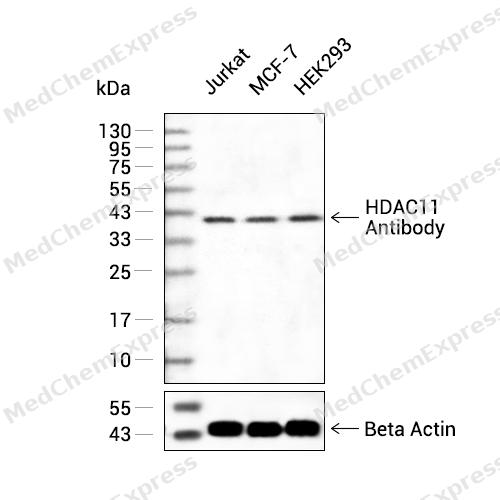 Western blot analysis of extracts from Jurkat(lane 2(20ug) , MCF-7(lane 3(20ug) and HEK293(lane 4(20ug) using HDAC11 Antibody (HY-P83139) Rabbit mAb. Proteins were transferred to a PVDF membrane and blocked with 5% non-fat milk in TBST for 2 hour at room temperature. The primary antibody (1/1000) and Loading control antibody (Beta Actin, HY-P80438, 1/10000) was used in 5% non-fat milk in TBST at 4°C overnight. Goat Anti-Mouse/Rabbit IgG-HRP Secondary Antibody (1/10000) was used for 1 hour at room temperature.


Background
-
Function
HDAC11 is the sole member of class IV histone deacetylases and represents the smallest zinc-dependent HDAC isoform, with distinctive catalytic properties that differentiate it from other HDAC family members[1][2]. Mechanistically, HDAC11 functions as an epigenetic regulator that controls gene expression through deacylation and deacetylation reactions, and accumulating evidence indicates that its long-chain fatty acid defatty-acylase activity is substantially more efficient than its intrinsic deacetylase activity[3][1]. Therefore, HDAC11 influences multiple biological pathways involved in immune regulation, metabolism, and cellular homeostasis[1][4]. In immune signaling, HDAC11 regulates interleukin-10 expression, immune tolerance, and type I interferon signaling, highlighting its role as a key modulator of inflammatory responses[5][6][7]. In metabolic systems, HDAC11 participates in adipogenesis, lipid metabolism, energy expenditure, and insulin-related processes, linking the enzyme to obesity and metabolic syndrome models[4][8]. Disease-associated studies further demonstrate involvement of HDAC11 in cancer, neuroinflammation, and immune-mediated disorders, supporting its relevance as a therapeutic target across diverse experimental settings[1][9]. Compared with related HDAC isoforms, HDAC11 exhibits unique substrate specificity and prominent defatty-acylase activity, providing a functional distinction that has stimulated intensive drug-discovery efforts[1][3]. For experimental applications, several selective HDAC11 inhibitors have been developed and are widely used as chemical probes to investigate HDAC11-dependent pathways and evaluate therapeutic potential in disease models[1][10].
-
Subcellular Localization
Nucleus
-
Expression
Tissue_specificity:Weakly expressed in most tissues. Strongly expressed in brain, heart, skeletal muscle, kidney and testis -
Isoforms & Post-Translational Modification
Q96DB2 has 2 isomers: Q96DB2-1: 39183 Da (predicted); Q96DB2-2: 33124 Da (predicted).
-
Subunit
Interacts with HDAC6
-
SwissProt ID
-
Synonyms
HDAC11; HD11; Histone deacetylase 11
-
Research Field
Epigenetics and Nuclear Signaling


Documentation
-
Data Sheet (262 KB)
-
SDS (251 KB)
- English - EN (251 KB)
- Français - FR (251 KB)
- Deutsch - DE (251 KB)
- Norwegian - NO (251 KB)
- Español - ES (251 KB)
- Swedish - SV (251 KB)
- Italian - IT (251 KB)
- Korean - KR (251 KB)
- Portuguese - PT (251 KB)
-
User Guide for Antibodies (1077 KB)
References
[1]. Jia G, et al. Biological function and small molecule inhibitors of histone deacetylase 11. Eur J Med Chem. 2024 Oct 5;276:116634. [Content Brief]
[2]. Ujlaky-Nagy L, et al. Disrupting EGFR-HER2 Transactivation by Pertuzumab in HER2-Positive Cancer: Quantitative Analysis Reveals EGFR Signal Input as Potential Predictor of Therapeutic Outcome. Int J Mol Sci. 2024 May 29;25(11):5978. [Content Brief]
[3]. Núñez-Álvarez Y, et al. HDAC11: a multifaceted histone deacetylase with proficient fatty deacylase activity and its roles in physiological processes. FEBS J. 2022 May;289(10):2771-2792. [Content Brief]
[4]. Chen H, et al. HDAC11, an emerging therapeutic target for metabolic disorders. Front Endocrinol (Lausanne). 2022 Oct 20;13:989305. [Content Brief]
[5]. Villagra A, et al. The histone deacetylase HDAC11 regulates the expression of interleukin 10 and immune tolerance. Nat Immunol. 2009 Jan;10(1):92-100. [Content Brief]
[6]. Cao J, et al. HDAC11 regulates type I interferon signaling through defatty-acylation of SHMT2. Proc Natl Acad Sci U S A. 2019 Mar 19;116(12):5487-5492. [Content Brief]
[7]. Jung E, et al. Global analysis of AGO2-bound RNAs reveals that miRNAs induce cleavage of target RNAs with limited complementarity. Biochim Biophys Acta Gene Regul Mech. 2017 Nov;1860(11):1148-1158. [Content Brief]
[8]. Skubisz MM, et al. Gefitinib and Methotrexate to Treat Ectopic Pregnancies with a Pre-Treatment Serum hCG 1000-10,000 IU/L: Phase II Open Label, Single Arm Multi-Centre Trial. EBioMedicine. 2018 Jul;33:276-281. [Content Brief]
[9]. Liu Y, et al. HDAC11: A novel target for improved cancer therapy. Biomed Pharmacother. 2023 Oct;166:115418. [Content Brief]
[10]. Ho TT, et al. Trapoxin A Analogue as a Selective Nanomolar Inhibitor of HDAC11. ACS Chem Biol. 2023 Apr 21;18(4):803-809. [Content Brief]

 Powered by Bioz
