



Hsp40 Antibody (YA731)
(Synonyms: DNAJB1; DNAJ1; HDJ1; HSPF1; DnaJ homolog subfamily B member 1; DnaJ protein homolog 1; Heat shock 40 kDa protein 1; HSP40; Heat shock protein 40; Human DnaJ protein 1; hDj-1)Based on 1 Customer Validation
Hsp40 Antibody (YA731) is a Mouse-derived and non-conjugated IgG monoclonal antibody, targeting to Hsp40.
-
Host:
Mouse
-
Isotype:
IgG
-
Application:
WB
-
Reactivity :
Human
-
Formulation:
Supplied in 1*PBS (pH 7.3), 50% glycerol and 0.5% BSA. Preservative: 0.02% sodium azide.
-
Conjugation:
Non-conjugated


To place orders, for customer services and technical support, please contact: MedChemExpress USA
Tel: 609-228-6898 E-mail: [email protected] [email protected]





Applications
| Application |
WB

WB: Western Blot
|
|---|---|
| Dilution Ratio | 1:500-1:1000 |


Product Details
Hsp40 Antibody (YA731) is a Mouse-derived and non-conjugated IgG monoclonal antibody, targeting to Hsp40.
-
Host Mouse

-
Clonality Monoclonal

-
Species ReactivityHuman
-
Observed Molecular WeightObserved band size: 38 kDa
Note: Due to possible protein modifications or aggregation, the molecular weight should be confirmed by actual measurement, and the predicted value is for reference only.

-
Calculated Molecular Weight Predicted band size: 38 kDa

Synthetic peptide corresponding to Hsp40.The exact sequence is proprietary to MCE.
Endogenous
affinity purified
Non-conjugated
Unmodified
IgG


Product Properties
-
Appearance
Solution
-
Formulation
Supplied in 1*PBS (pH 7.3), 50% glycerol and 0.5% BSA. Preservative: 0.02% sodium azide.
-
Concentration
Batch-dependent, Please check the COA for the concentration of each lot. Check Lot Concentration
-
Storage & Stability
Stored at -20°C for 1 year. Avoid repeated freeze / thaw cycles.
-
Livraison
Shipping with blue ice.


Verification Images
-
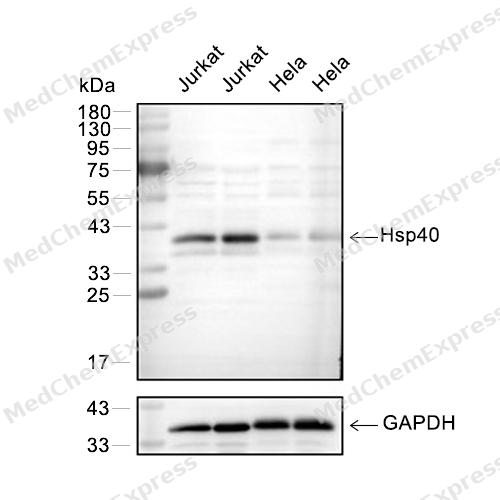 Western blot analysis of extracts from Jurkat(lane 2(20μg) or lane 3(40μg) ) and Hela(lane 4(20μg) or lane 5(40μg) ) using Hsp40(HY-P80710) Mouse mAb. Proteins were transferred to a PVDF membrane and blocked with 5% BSA in TBST for 2 hour at room temperature. The primary antibody (HY-P80710, 1/1000) and Loading control antibody (GAPDH, HY-P80954, 1/3000) was used in 5% BSA in TBST at 4°C overnight. Goat Anti-Mouse IgG-HRP Secondary Antibody (HY-P8004, 1/10,000) was used for 1 hour at room temperature.
 -
 Western blot analysis was performed on protein extracts (25 μg) from Jurkat (lane 2), HeLa (lane 3), A549 (lane 4, Negative), HCT 116 (lane 5), 293T (lane 6), and HepG2 (lane 7) using Hsp40 antibody. Proteins were transferred onto a 0.45 μm PVDF membrane using the Trans-Blot® Turbo™ system for 13 min. The membrane was then blocked with 5% nonfat milk in TBST (HY-K1025) for 1 h at room temperature. The primary antibody (1:1000) and loading control antibody GAPDH Antibody (HRP) (HY-P80954A) (1:5000) were diluted in 5% nonfat milk in TBST and incubated with the membrane overnight at 4°C. After washing, the membrane of primary antibody was incubated with HRP-conjugated goat anti-rabbit/mouse IgG secondary antibody (HY-P8001/HY-P8004) (1:5000) diluted in 5% nonfat milk in TBST for 1 h at room temperature. Protein bands were visualized using an Ultra High Sensitivity ECL detection kit (HY-K1005).


Background
-
Function
HSP40 (also known as DnaJ proteins) functions as a molecular co-chaperone that regulates HSP70 activity and assists protein folding[1][2][3]. Mechanistically, HSP40 recognizes unfolded or misfolded client proteins and delivers them to HSP70, stimulating ATP hydrolysis and promoting proper substrate folding[1][2]. HSP40 participates in key cellular processes including protein quality control, endoplasmic reticulum-associated degradation (ERAD), and stress-induced proteostasis, which are essential for maintaining neuronal and cardiac cell integrity[2][3]. In disease models, HSP40 dysfunction contributes to neurodegenerative disorders such as Parkinson’s disease and protein-misfolding myopathies, including LGMDD1, through disrupted client recognition and HSP70 cooperation[3][4]. Compared with related isoforms, specific HSP40 members like DNAJB6 exhibit unique substrate specificity and domain-dependent regulatory mechanisms that influence client degradation or stabilization[4][2]. Experimental studies demonstrate that HSP40 modulates the stability and trafficking of ion channels, including hERG and KCNQ4, indicating its utility in therapeutic protein rescue strategies[2]. Small-molecule modulators and genetic manipulations targeting HSP40 interactions provide insights into co-chaperone regulation and offer potential intervention points for proteostasis-related pathologies[1][5]. Therefore, HSP40 acts as a versatile node within chaperone networks, integrating stress signals, client specificity, and co-chaperone dynamics for cellular homeostasis and experimental applications.
-
Subcellular Localization
Cytoplasm; Nucleus; Nucleus, nucleolus
-
Expression
Induction:By heat shock -
Isoforms & Post-Translational Modification
P25685 has 2 isomers: P25685-1: 38044 Da (predicted); P25685-2: 27016 Da (predicted).
-
Subunit
Interacts with DNAJC3 (PubMed:9920933). Interacts with HSF1 (via transactivation domain); this interaction results in the inhibition of heat shock- and HSF1-induced transcriptional activity during the attenuation and recovery phase period of the heat shock response (PubMed:9499401). Interacts with BAG3 (PubMed:30559338)
-
SwissProt ID
-
Synonyms
DNAJB1; DNAJ1; HDJ1; HSPF1; DnaJ homolog subfamily B member 1; DnaJ protein homolog 1; Heat shock 40 kDa protein 1; HSP40; Heat shock protein 40; Human DnaJ protein 1; hDj-1
-
Research Field
Signal Transduction


Documentation
-
Fiche technique (261 KB)
-
SDS (252 KB)
- English - EN (252 KB)
- Français - FR (252 KB)
- Deutsch - DE (252 KB)
- Norwegian - NO (252 KB)
- Español - ES (252 KB)
- Swedish - SV (252 KB)
- Italian - IT (252 KB)
- Korean - KR (252 KB)
- Portuguese - PT (252 KB)
-
User Guide for Antibodies (1077 KB)
References
[1]. Melville MW, et al. The molecular chaperone hsp40 regulates the activity of P58IPK, the cellular inhibitor of PKR. Proc Natl Acad Sci U S A. 1997 Jan 7;94(1):97-102. [Content Brief]
[2]. Walker VE, et al. Hsp40 chaperones promote degradation of the HERG potassium channel. J Biol Chem. 2010 Jan 29;285(5):3319-29. [Content Brief]
[3]. Hasegawa T, et al. DnaJ/Hsp40 Family and Parkinson's Disease. Front Neurosci. 2018 Jan 10;11:743. [Content Brief]
[4]. Bhadra AK, et al. Mutations in Hsp40 co-chaperone change the canonical interdomain interactions stimulating LGMDD1 myopathy. J Biol Chem. 2026 Jan;302(1):110945. [Content Brief]
[5]. Ferraro M, et al. Allosteric Modulators of HSP90 and HSP70: Dynamics Meets Function through Structure-Based Drug Design. J Med Chem. 2019 Jan 10;62(1):60-87. [Content Brief]

 Powered by Bioz
