



IFN gamma Antibody (YA3520)
(Synonyms: IFNG; IFG; IFI; IFN Gamma; IFN Immune; IFN-gamma; IFNG; IFNG_HUMAN; Immune Interferon; Interferon gamma; Interferon Gamma Precursor; Macrophage Activating Factor; MAF; T Cell Interferon; Type II Interferon.)Based on 2 publication(s) in Google Scholar
IFN gamma Antibody (YA3520) is a Rabbit-derived and non-conjugated IgG monoclonal antibody, targeting to IFN gamma.
-
Host:
Rabbit
-
Isotype:
IgG
-
Application:
WB, ICC/IF, FC
-
Reactivity :
Human, Mouse, Rat
-
Formulation:
Supplied in Rabbit IgG in 10mM phosphate buffered saline , pH 7.4, 150mM sodium chloride, 0.05% BSA, 0.02% sodium azide and 50% glycerol.
-
Conjugation:
Non-conjugated



To place orders, for customer services and technical support, please contact: MedChemExpress USA
Tel: 609-228-6898 E-mail: [email protected] [email protected]



Publications Citing Use of MedChemExpress (MCE) IFN gamma Antibody (YA3520)
More

Applications
| Application |
WB

WB: Western Blot
|
ICC/IF
ICC/IF: Immunocytochemistry/
Immunofluorescence |
FC
FC: Flow Cytometry
|
|---|---|---|---|
| Dilution Ratio | 1:500-1:1000 | 1:50-1:200 | 1:50-1:100 |


Product Details
IFN gamma Antibody (YA3520) is a Rabbit-derived and non-conjugated IgG monoclonal antibody, targeting to IFN gamma.
-
Host Rabbit

-
Clonality Monoclonal,Recombinant

-
Species ReactivityHuman, Mouse, Rat
-
Observed Molecular WeightObserved band size: 25 kDa
Note: Due to possible protein modifications or aggregation, the molecular weight should be confirmed by actual measurement, and the predicted value is for reference only.

-
Calculated Molecular Weight Predicted band size: 19 kDa

Entrez Gene: 3458 Human ; 15978 Mouse ; 25712 Rat
SwissProt: P01579 Human ; P01580 Mouse ; P01581 Rat
OMIM: 609135 Human
A synthesized peptide derived from human Interferon gamma aa25-50.
Endogenous
affinity purified
Non-conjugated
Unmodified
IgG


Product Properties
-
Appearance
Solution
-
Formulation
Supplied in Rabbit IgG in 10mM phosphate buffered saline , pH 7.4, 150mM sodium chloride, 0.05% BSA, 0.02% sodium azide and 50% glycerol.
-
Concentration
Batch-dependent, Please check the COA for the concentration of each lot. Check Lot Concentration
-
Storage & Stability
Stored at -20°C for 1 year. Avoid repeated freeze / thaw cycles.
-
Shipping
Shipping with blue ice.


Publications (2)
-
Journal Impact Factor
-
Most Recent
-
J Pharm Anal
Ginkgolic acid inhibits CD8+ T cell activation and induces ferroptosis by lactate dehydrogenase A to exert immunosuppressive effect. [Abstract]2025 Jul;15(7):101233. PMID: 40727944 -
J Cell Mol Med
Sinomenine Ameliorated Microglial Activation and Neuropathic Pain After Chronic Constriction Injury Via TGF-β1/ALK5/Smad3 Signalling Pathway. [Abstract]2024 Nov;28(22):e70214. PMID: 39586784


Verification Images
-
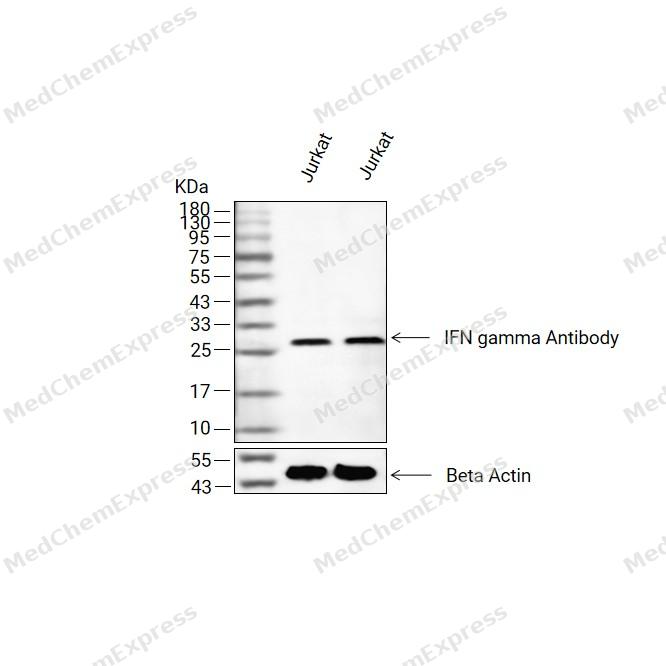 Western blot analysis of extracts from Jurkat(lane 2(20ug) and Jurkat(lane 3(40ug) using IFN gamma Antibody (HY-P81111) Rabbit mAb. Proteins were transferred to a PVDF membrane and blocked with 5% non-fat milk in TBST for 2 hour at room temperature. The primary antibody (1/1000) and Loading control antibody (Beta Actin, HY-P80438, 1/10000) was used in 5% non-fat milk in TBST at 4°C overnight. Goat Anti-Mouse/Rabbit IgG-HRP Secondary Antibody (1/10000) was used for 1 hour at room temperature.
 -
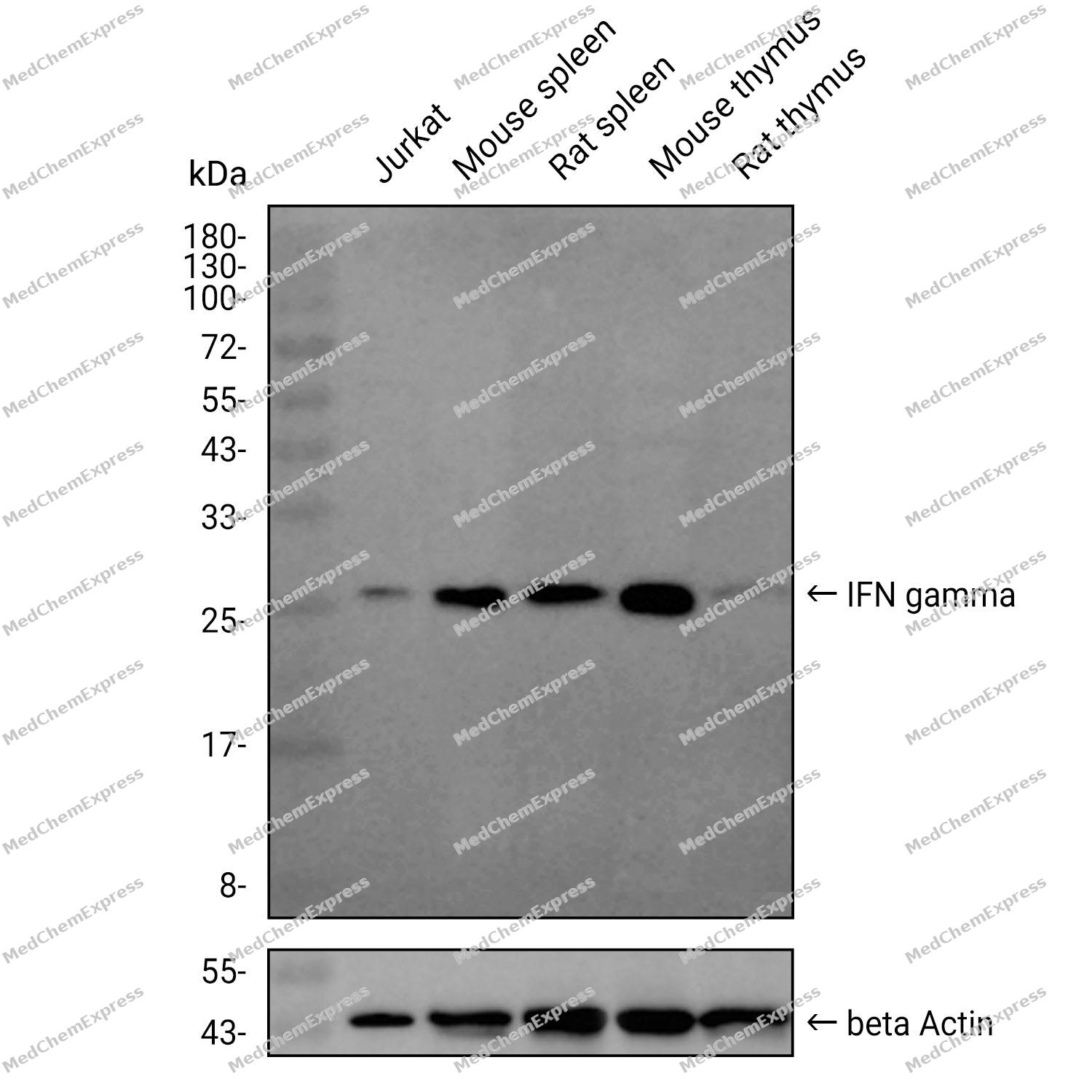
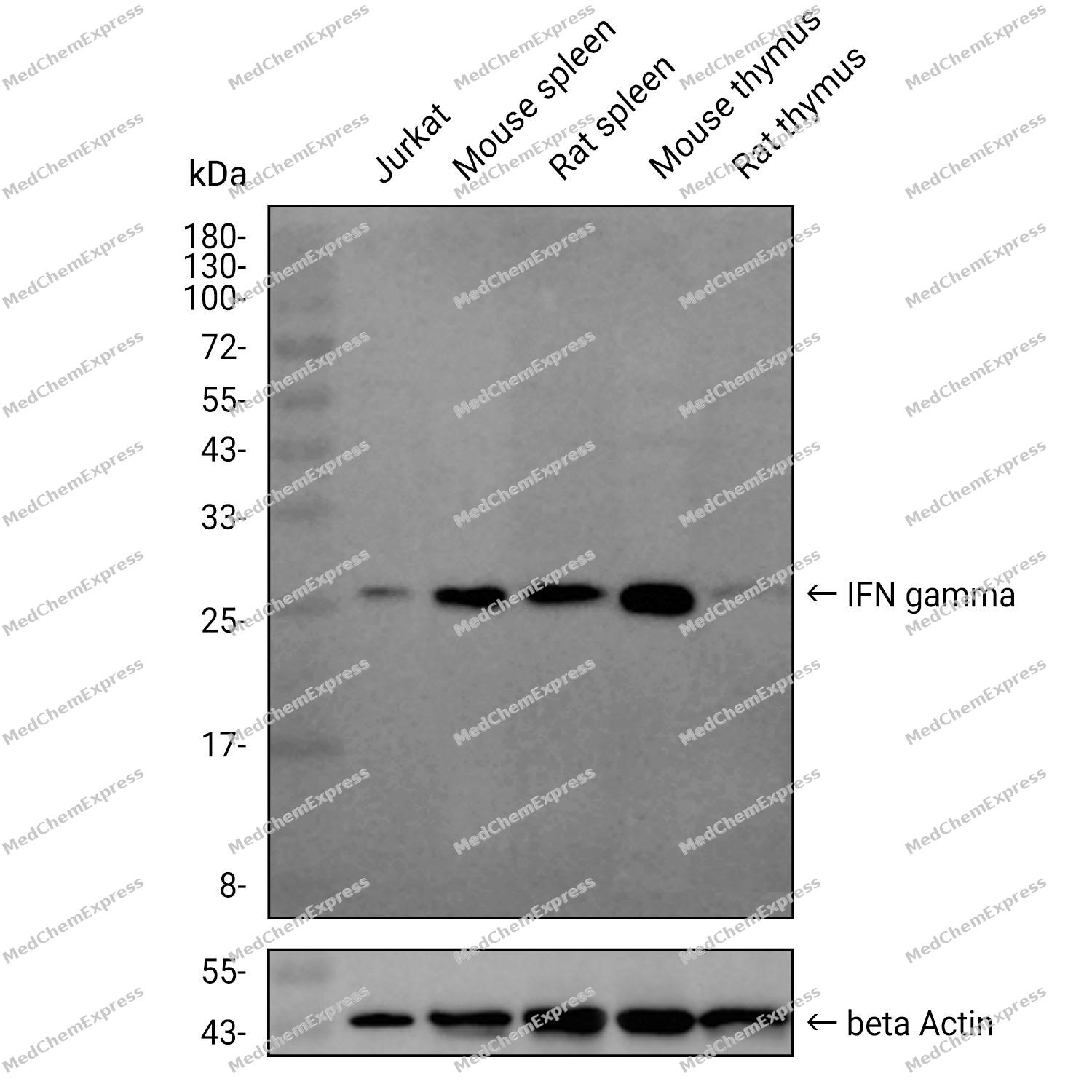 Western blot analysis was performed on extracts from Jurkat (lane 1, 15 μg), Mouse spleen (lane 2, 15 μg), Rat spleen (lane 3, 15 μg), Mouse thymus (lane 4, 15 μg), and Rat thymus (lane 5, 15 μg) using IFN gamma Rabbit mAb.Proteins were transferred to a PVDF membrane and blocked with 5% non-fat milk in TBST at 4°C overnight.The primary antibody (1:1000 dilution) and the loading control antibody (beta-Actin, HY-P80438, 1:20000 dilution) were incubated in 5% non-fat milk in TBST for 1 hour at 37°C.Goat Anti-Rabbit IgG-HRP Secondary Antibody (1:20000 dilution) was then applied for 40 minutes at 37°C.


Background
-
Function
IFN-γ (Interferon-gamma) is a key immune cytokine produced by NK cells, Th1 cells, and CD8⁺ T cells. It regulates macrophage activation, Th1 differentiation, antigen presentation, and anti-tumor immunity via the IFNGR-JAK-STAT1 pathway. IFN-γ serves as an important indicator for assessing cellular immune function, T-cell activation status, and the efficacy of immunotherapy.
-
Subcellular Localization
Secreted
-
Expression
Tissue_specificity:Mainly released by activated T lymphocytes
Induction:By cytokines, most notably interleukin IL-12, secreted by professional antigen-presenting cells such as monocytes/macrophages and dendritic cells -
Subunit
Homodimer. Interacts with IFNGR1 (via extracellular domain); this interaction promotes IFNGR1 dimerization
-
SwissProt ID
-
Synonyms
IFNG; IFG; IFI; IFN Gamma; IFN Immune; IFN-gamma; IFNG; IFNG_HUMAN; Immune Interferon; Interferon gamma; Interferon Gamma Precursor; Macrophage Activating Factor; MAF; T Cell Interferon; Type II Interferon.
Documentation
-
Data Sheet (261 KB)
-
SDS (252 KB)
- English - EN (252 KB)
- Français - FR (252 KB)
- Deutsch - DE (252 KB)
- Norwegian - NO (252 KB)
- Español - ES (252 KB)
- Swedish - SV (252 KB)
- Italian - IT (252 KB)
- Korean - KR (252 KB)
- Portuguese - PT (252 KB)
-
User Guide for Antibodies (1077 KB)
References
[1]. El Bougrini J, et al. Arsenic enhances the apoptosis induced by interferon gamma: key role of IRF-1. Cell Mol Biol (Noisy-le-grand). 2006 May 15;52(1):9-15. [Content Brief]
[2]. Hisamatsu H, et al. Newly identified pair of proteasomal subunits regulated reciprocally by interferon gamma. J Exp Med. 1996 Apr 1;183(4):1807-16. [Content Brief]
[3]. Greenlund AC, et al. Interferon-gamma induces receptor dimerization in solution and on cells. J Biol Chem. 1993 Aug 25;268(24):18103-10. [Content Brief]
[4]. Akiyama K, et al. Replacement of proteasome subunits X and Y by LMP7 and LMP2 induced by interferon-gamma for acquirement of the functional diversity responsible for antigen processing. FEBS Lett. 1994 Apr 18;343(1):85-8. [Content Brief]
[5]. Fabunmi RP, et al. Interferon gamma regulates accumulation of the proteasome activator PA28 and immunoproteasomes at nuclear PML bodies. J Cell Sci. 2001 Jan;114(Pt 1):29-36. [Content Brief]
[6]. Lah TT, et al. Gamma-interferon causes a selective induction of the lysosomal proteases, cathepsins B and L, in macrophages. FEBS Lett. 1995 Apr 17;363(1-2):85-9. [Content Brief]

 Powered by Bioz
