



KAT7/ Hbo1/MYST2 Antibody (YA3027)
(Synonyms: HBO1; HBOA; MYST2; ZC2HC7)
Based on 1 Customer Validation
KAT7/ Hbo1/MYST2 Antibody (YA3027) is a Rabbit-derived and non-conjugated IgG monoclonal antibody, targeting to KAT7/ Hbo1/MYST2.
-
Host:
Rabbit
-
Isotype:
IgG
-
Application:
WB, IHC-F, IHC-P, ICC/IF, IP
-
Reactivity :
Human
-
Formulation:
Supplied in 50mM Tris-Glycine(pH 7.4), 0.15M NaCl, 40% Glycerol, 0.01% Sodium azide and 0.05% BSA
-
Conjugation:
Non-conjugated


To place orders, for customer services and technical support, please contact: MedChemExpress USA
Tel: 609-228-6898 E-mail: [email protected] [email protected]





Applications
| Application |
WB

WB: Western Blot
|
IHC-P
IHC-P: Immunohistochemistry-Paraffin
|
IHC-F
IHC-F: Immunohistochemistry-Frozen
|
ICC/IF
ICC/IF: Immunocytochemistry/
Immunofluorescence |
IP
IP: Immunoprecipitation
|
|---|---|---|---|---|---|
| Dilution Ratio | 1:500-1:1000 | 1:50-1:100 | 1:50-1:100 | 1:50-1:200 | 1:20 |


Product Details
KAT7/ Hbo1/MYST2 Antibody (YA3027) is a Rabbit-derived and non-conjugated IgG monoclonal antibody, targeting to KAT7/ Hbo1/MYST2.
-
Host Rabbit

-
Clonality Recombinant,Monoclonal

-
Species ReactivityHuman
-
Observed Molecular WeightObserved band size: 83 kDa
Note: Due to possible protein modifications or aggregation, the molecular weight should be confirmed by actual measurement, and the predicted value is for reference only.

-
Calculated Molecular Weight Predicted band size: 71 kDa

Recombinant protein of human KAT7/Hbo1/MYST2
Endogenous
Affinity Purified
Non-conjugated
Unmodified
IgG


Product Properties
-
Appearance
Solution
-
Formulation
Supplied in 50mM Tris-Glycine(pH 7.4), 0.15M NaCl, 40% Glycerol, 0.01% Sodium azide and 0.05% BSA
-
Concentration
Batch-dependent, Please check the COA for the concentration of each lot. Check Lot Concentration
-
Storage & Stability
Stored at -20°C for 1 year. Avoid repeated freeze / thaw cycles.
-
Shipping
Shipping with blue ice.


Verification Images
-
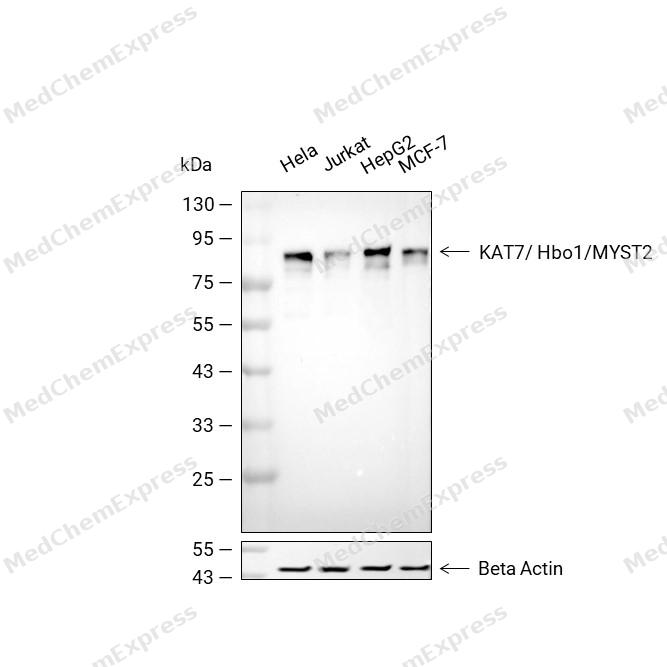 Western blot analysis of extracts from Hela (lane2, 20μg), Jurkat (lane3, 20μg), HepG2 (lane4, 20μg) and MCF-7 (lane5, 20μg) using KAT7/ Hbo1/MYST2 Antibody (HY-P83282). Proteins were transferred to a PVDF membrane and blocked with 5% non-fat milk in TBST at 4°C overnight. The primary antibody (1/1000) and Loading control antibody (Beta Actin, HY-P80993, 1/10,000) was used in 5% non-fat milk in TBST for 2 hour at room temperature. Goat Anti-Rabbit IgG-HRP Secondary Antibody (HY-P8001, 1/10,000) was used for 1 hour at room temperature.
 -
 Immunocytochemistry analysis of HUVEC cells labeling KAT7 with KAT7 Antibody (HY-P83282) at 1/50 dilution. Cells were fixed in 4% paraformaldehyde for 15 minutes at room temperature, permeabilized with 0.1% Triton X-100 for 10 minutes at room temperature, then blocked with QuickBlock™ Blocking Buffer for Immunol Staining for 10 min at room temperature. Cells were then incubated with KAT7 Antibody (HY-P83282) at 1/50 dilution in QuickBlock™ Blocking Buffer for Immunol Staining at 4 ℃. Alexa Fluor® 488-conjugated AffiniPure Goat Anti-Rabbit IgG H&L(HY-P8002, Green) was used as the secondary antibody at 1/1,000 dilution. PBS instead of the primary antibody was used as the secondary antibody only control. The Nuclear counterstain was DAPI (Blue).
 -
 Immunocytochemistry analysis of HUVEC cells labeling KAT7 with KAT7 Antibody (HY-P83282) at 1/100 dilution. Cells were fixed in 4% paraformaldehyde for 15 minutes at room temperature, permeabilized with 0.1% Triton X-100 for 10 minutes at room temperature, then blocked with QuickBlock™ Blocking Buffer for Immunol Staining for 10 min at room temperature. Cells were then incubated with KAT7 Antibody (HY-P83282) at 1/100 dilution in QuickBlock™ Blocking Buffer for Immunol Staining at 4 ℃. Alexa Fluor® 488-conjugated AffiniPure Goat Anti-Rabbit IgG H&L(HY-P8002, Green) was used as the secondary antibody at 1/1,000 dilution. PBS instead of the primary antibody was used as the secondary antibody only control. The Nuclear counterstain was DAPI (Blue).


Background
-
Function
KAT7/ Hbo1/MYST2 is a Catalytic subunit of histone acetyltransferase HBO1 complexes, which specifically mediate acetylation of histone H3 at 'Lys-14' (H3K14ac), thereby regulating various processes, such as gene transcription, protein ubiquitination, immune regulation, stem cell pluripotent and self-renewal maintenance and embryonic development. Some complexes also catalyze acetylation of histone H4 at 'Lys-5', 'Lys-8' and 'Lys-12' (H4K5ac, H4K8ac and H4K12ac, respectively), regulating DNA replication initiation, regulating DNA replication initiation. Specificity of the HBO1 complexes is determined by the scaffold subunit: complexes containing BRPF scaffold (BRPF1, BRD1/BRPF2 or BRPF3) direct KAT7/HBO1 specificity towards H3K14ac, while complexes containing JADE (JADE1, JADE2 and JADE3) scaffold direct KAT7/HBO1 specificity towards histone H4. H3K14ac promotes transcriptional elongation by facilitating the processivity of RNA polymerase II. Acts as a key regulator of hematopoiesis by forming a complex with BRD1/BRPF2, directing KAT7/HBO1 specificity towards H3K14ac and promoting erythroid differentiation. H3K14ac is also required for T-cell development. KAT7/HBO1-mediated acetylation facilitates two consecutive steps, licensing and activation, in DNA replication initiation: H3K14ac facilitates the activation of replication origins, and histone H4 acetylation (H4K5ac, H4K8ac and H4K12ac) facilitates chromatin loading of MCM complexes, promoting DNA replication licensing. Acts as a positive regulator of centromeric CENPA assembly: recruited to centromeres and mediates histone acetylation, thereby preventing centromere inactivation mediated by SUV39H1, possibly by increasing histone turnover/exchange. Involved in nucleotide excision repair: phosphorylation by ATR in response to ultraviolet irradiation promotes its localization to DNA damage sites, where it mediates histone acetylation to facilitate recruitment of XPC at the damaged DNA sites. Acts as an inhibitor of NF-kappa-B independently of its histone acetyltransferase activity; Plays a central role in the maintenance of leukemia stem cells in acute myeloid leukemia (AML). Acts by mediating acetylation of histone H3 at 'Lys-14' (H3K14ac), thereby facilitating the processivity of RNA polymerase II to maintain the high expression of key genes, such as HOXA9 and HOXA10 that help to sustain the functional properties of leukemia stem cells[1][2][3][4][5][6][7][8][9][10][11][12][13][14][15].
-
Subcellular Localization
Nucleus; Chromosome; Chromosome, centromere; Cytoplasm, cytosol
-
Expression
Tissue_specificity:It is widely expressed, with the highest expression level in the testes. -
Isoforms & Post-Translational Modification
O95251 has 5 isomers: O95251-1: 70642 Da (predicted); O95251-2: 58136 Da (predicted); O95251-3: 51440 Da (predicted); O95251-4: 66947 Da (predicted); O95251-5: 55135 Da (predicted).
Phosphorylated at Ser-50 and Ser-53 by ATR in response to DNA damage, promoting its ubiquitination by the CRL4(DDB2) complex and subsequent degradation (PubMed:26572825). Phosphorylation at Ser-50 and Ser-53 by ATR in response to ultraviolet-induced DNA, promotes localization to DNA damage sites (PubMed:28719581). Phosphorylation at Ser-57 by PLK1 during mitosis seems important for prereplicative complex formation and DNA replication licensing, and requires prior phosphorylation at Thr-85 and Thr-88 by CDK1 (PubMed:18250300). Phosphorylated by MAP2K1, which accelerates its degradation (By similarity);Ubiquitinated at Lys-338, leading to proteasomal degradation (PubMed:23319590). Ubiquitinated by the CRL4(DDB2) complex following phosphorylation by ATR, leading to its subsequent degradation (PubMed:26572825);Autoacetylation at Lys-432 is required for proper function -
Subunit
Component of the HBO1 complex composed of KAT7/HBO1, MEAF6, ING4 or ING5, and one scaffold subunit: complexes containing BRPF scaffold (BRPF1, BRD1/BRPF2 or BRPF3) direct KAT7/HBO1 specificity towards H3K14ac, while complexes containing JADE scaffold (JADE1, JADE2 and JADE3) mediate acetylation of histone H4 (PubMed:16387653, PubMed:19187766, PubMed:20129055, PubMed:21753189, PubMed:24065767, PubMed:26620551, PubMed:29382722). Interacts with MCM2 and ORC1 (PubMed:10438470, PubMed:11278932, PubMed:16387653). Interacts with the androgen receptor (AR); in the presence of dihydrotestosterone (PubMed:10930412). Interacts with CDT1 (PubMed:18832067). Interacts with MAP2K1 and CUL1 (By similarity). Interacts with p53/TP53; leading to inhibit histone acetyltransferase activity (PubMed:17954561). Interacts with MIS18BP1 (PubMed:27270040)
-
SwissProt ID
-
Synonyms
HBO1; HBOA; MYST2; ZC2HC7
-
Research Field
Epigenetics and Nuclear Signaling


Documentation
-
Data Sheet (262 KB)
-
SDS (251 KB)
- English - EN (251 KB)
- Français - FR (251 KB)
- Deutsch - DE (251 KB)
- Norwegian - NO (251 KB)
- Español - ES (251 KB)
- Swedish - SV (251 KB)
- Italian - IT (251 KB)
- Korean - KR (251 KB)
- Portuguese - PT (251 KB)
-
User Guide for Antibodies (1077 KB)
References
[1]. Doyon Y, et al. ING tumor suppressor proteins are critical regulators of chromatin acetylation required for genome expression and perpetuation. Mol Cell. 2006 Jan 6;21(1):51-64. [Content Brief]
[2]. Mishima Y, et al. The Hbo1-Brd1/Brpf2 complex is responsible for global acetylation of H3K14 and required for fetal liver erythropoiesis. Blood. 2011 Sep 1;118(9):2443-53. [Content Brief]
[3]. Lalonde ME, et al. Exchange of associated factors directs a switch in HBO1 acetyltransferase histone tail specificity. Genes Dev. 2013 Sep 15;27(18):2009-24. [Content Brief]
[4]. Feng Y, et al. BRPF3-HBO1 regulates replication origin activation and histone H3K14 acetylation. EMBO J. 2016 Jan 18;35(2):176-92. [Content Brief]
[5]. Kueh AJ, et al. HBO1 (KAT7) Does Not Have an Essential Role in Cell Proliferation, DNA Replication, or Histone 4 Acetylation in Human Cells. Mol Cell Biol. 2020 Jan 30;40(4):. [Content Brief]
[6]. MacPherson L, et al. HBO1 is required for the maintenance of leukaemia stem cells. Nature. 2020 Jan;577(7789):266-270. [Content Brief]
[7]. Iizuka M, et al. Histone acetyltransferase HBO1 interacts with the ORC1 subunit of the human initiator protein. J Biol Chem. 1999 Aug 13;274(33):23027-34. [Content Brief]
[8]. Saksouk N, et al. HBO1 HAT complexes target chromatin throughout gene coding regions via multiple PHD finger interactions with histone H3 tail. Mol Cell. 2009 Jan 30;33(2):257-65. [Content Brief]
[9]. Miotto B, et al. HBO1 histone acetylase activity is essential for DNA replication licensing and inhibited by Geminin. Mol Cell. 2010 Jan 15;37(1):57-66. [Content Brief]
[10]. Burke TW, et al. Replication factors MCM2 and ORC1 interact with the histone acetyltransferase HBO1. J Biol Chem. 2001 May 4;276(18):15397-408. [Content Brief]
[11]. Miotto B, et al. HBO1 histone acetylase is a coactivator of the replication licensing factor Cdt1. Genes Dev. 2008 Oct 1;22(19):2633-8. [Content Brief]
[12]. Miotto B, et al. JNK1 phosphorylation of Cdt1 inhibits recruitment of HBO1 histone acetylase and blocks replication licensing in response to stress. Mol Cell. 2011 Oct 7;44(1):62-71. [Content Brief]
[13]. Ohzeki J, et al. KAT7/HBO1/MYST2 Regulates CENP-A Chromatin Assembly by Antagonizing Suv39h1-Mediated Centromere Inactivation. Dev Cell. 2016 Jun 6;37(5):413-27. [Content Brief]
[14]. Niida H, et al. Phosphorylated HBO1 at UV irradiated sites is essential for nucleotide excision repair. Nat Commun. 2017 Jul 18;8:16102. [Content Brief]
[15]. Contzler R, et al. Histone acetyltransferase HBO1 inhibits NF-kappaB activity by coactivator sequestration. Biochem Biophys Res Commun. 2006 Nov 10;350(1):208-13. [Content Brief]

 Powered by Bioz
