



MARK3 Antibody (YA2150)
(Synonyms: C-TAK1 antibody; Cdc25C associated protein kinase 1 antibody; Cdc25C-associated protein kinase 1 antibody; cTAK1 antibody; ELKL motif kinase 2 antibody; EMK-2 antibody; Emk2 antibody; ETK 1 antibody; KIAA4230 antibody; KP78 antibody; MAP microtubule affinity regulating kinase 3 antibody; MAP/microtubule affinity-regulating kinase 3 antibody; Mark3 antibody; MARK3_HUMAN antibody; Par 1a antibody; PAR1A antibody; Protein kinase STK10 antibody; Ser/Thr protein kinase PAR-1 antibody; Serine threonine protein kinase p78 antibody; Serine/threonine-protein kinase p78 antibody; SerThr protein kinase PAR 1 antibody; )
Based on 1 Customer Validation
MARK3 Antibody (YA2150) is a Rabbit-derived and non-conjugated IgG monoclonal antibody, targeting to MARK3.
-
Host:
Rabbit
-
Isotype:
IgG
-
Application:
WB, ICC/IF, IP, FC
-
Reactivity :
Mouse, Human
-
Formulation:
Supplied in rabbit IgG in phosphate buffered saline , pH 7.4, 150mM NaCl, 0.02% sodium azide and 50% glycerol.
-
Conjugation:
Non-conjugated


To place orders, for customer services and technical support, please contact: MedChemExpress USA
Tel: 609-228-6898 E-mail: [email protected] [email protected]





Applications
| Application |
WB

WB: Western Blot
|
ICC/IF
ICC/IF: Immunocytochemistry/
Immunofluorescence |
IP
IP: Immunoprecipitation
|
FC
FC: Flow Cytometry
|
|---|---|---|---|---|
| Dilution Ratio | 1:500-1:1000 | 1:50-1:200 | 1:30 | 1:50-1:100 |


Product Details
MARK3 Antibody (YA2150) is a Rabbit-derived and non-conjugated IgG monoclonal antibody, targeting to MARK3.
-
Host Rabbit

-
Clonality Recombinant,Monoclonal

-
Species ReactivityMouse, Human
-
Observed Molecular WeightObserved band size: 84 kDa
Note: Due to possible protein modifications or aggregation, the molecular weight should be confirmed by actual measurement, and the predicted value is for reference only.

-
Calculated Molecular Weight Predicted band size: 84 kDa

A synthesized peptide derived from human MARK3 aa550-600/753.
Endogenous
Affinity Chromatography
Non-conjugated
Unmodified
IgG


Product Properties
-
Appearance
Solution
-
Formulation
Supplied in rabbit IgG in phosphate buffered saline , pH 7.4, 150mM NaCl, 0.02% sodium azide and 50% glycerol.
-
Concentration
Batch-dependent, Please check the COA for the concentration of each lot. Check Lot Concentration
-
Storage & Stability
Stored at -20°C for 1 year. Avoid repeated freeze / thaw cycles.
-
Shipping
Shipping with blue ice.


Verification Images
-
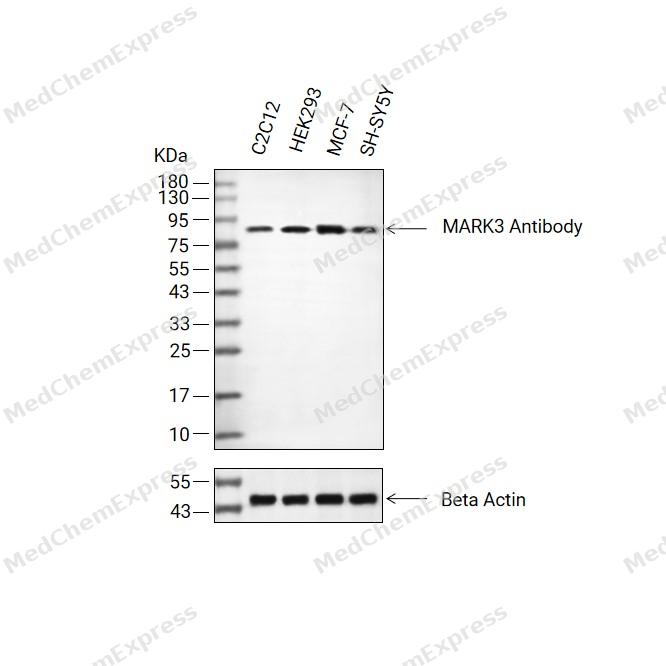 Western blot analysis of extracts from C2C12 (lane 2(20μg), HEK293 (lane 3(20μg), MCF-7 (lane 4(20μg), SH-SY5Y (lane 5(20μg) using MARK3 Antibody. Proteins were transferred to a PVDF membrane and blocked with 5% BSA in TBST for 2 hour at room temperature. The primary antibody (1/1000)and Loading control antibody (Beta Actin, HY-P80438, 1/3000) was used in 5% BSA in TBST at 4°C overnight. Goat Anti-Mouse/Rabbit IgG-HRP Secondary Antibody (HY-P8004/HY-P8001, 1/10,000) was used for 1 hour at room temperature.


Background
-
Function
MARK3 (microtubule affinity-regulating kinase 3) functions as a serine/threonine kinase that regulates cell cycle progression, cytoskeletal dynamics, and stress-response signaling[2][19]. Mechanistically, MARK3 phosphorylates microtubule-associated proteins, thereby modulating microtubule stability and intracellular transport, particularly during mitosis and cellular polarization[2][19]. This kinase influences the Hippo signaling cascade, acting as a negative regulator of LATS1/2 and promoting YAP/TAZ nuclear localization, which is critical for cell proliferation and survival[2]. In disease models, MARK3 activity has been implicated in oncogenesis, with overexpression enhancing tumor growth, while knockdown reduces cancer cell proliferation[2][19]. Compared with related isoforms MARK1 and MARK4, MARK3 exhibits distinct substrate specificity and tissue expression patterns, which provide opportunities for isoform-selective intervention[2]. Small-molecule inhibitors targeting MARK3 have shown potential in reducing hyperproliferation in cancer models, whereas selective agonists remain underexplored due to limited structural characterization[2][19]. Experimentally, MARK3 modulation is employed to study cytoskeletal remodeling, stress responses, and cell cycle checkpoints, supporting its utility in both cancer biology and neurodegenerative research[2][19]. Therefore, understanding MARK3’s isoform-specific roles and its regulation of microtubule-associated pathways is essential for designing targeted therapeutic strategies and experimental models.
-
Subcellular Localization
Cell membrane; Peripheral membrane protein; Cell projection, dendrite; Cytoplasm
-
Expression
Tissue_specificity:general expression -
Isoforms & Post-Translational Modification
P27448 has 7 isomers: P27448-5: 84429 Da (predicted); P27448-2: 83955 Da (predicted); P27448-3: 81439 Da (predicted); P27448-4: 83248 Da (predicted); P27448-6: 79876 Da (predicted); P27448-7: 85381 Da (predicted); P27448-8: 74091 Da (predicted).
Phosphorylated at Thr-211 by STK11/LKB1 in complex with STE20-related adapter-alpha (STRADA) pseudo kinase and CAB39 (PubMed:14976552). Phosphorylation at Thr-564 by PRKCZ/aPKC inhibits the kinase activity (PubMed:15084291) -
Subunit
Interacts with MAPT/TAU (PubMed:23666762). Interacts with DLG5 (via coiled-coil domain). Interacts with STK3/MST2 and STK4/MST1 in the presence of DLG5 (PubMed:28087714). Interacts with YWHAB, YWHAG, YWHAQ and YWHAZ (PubMed:16959763). Interacts with PKP2 (via N-terminus) (PubMed:12941695). Interacts with CDC25C (PubMed:12941695). Interacts with KSR1 (PubMed:12941695)
-
SwissProt ID
-
Synonyms
C-TAK1 antibody; Cdc25C associated protein kinase 1 antibody; Cdc25C-associated protein kinase 1 antibody; cTAK1 antibody; ELKL motif kinase 2 antibody; EMK-2 antibody; Emk2 antibody; ETK 1 antibody; KIAA4230 antibody; KP78 antibody; MAP microtubule affinity regulating kinase 3 antibody; MAP/microtubule affinity-regulating kinase 3 antibody; Mark3 antibody; MARK3_HUMAN antibody; Par 1a antibody; PAR1A antibody; Protein kinase STK10 antibody; Ser/Thr protein kinase PAR-1 antibody; Serine threonine protein kinase p78 antibody; Serine/threonine-protein kinase p78 antibody; SerThr protein kinase PAR 1 antibody;
-
Research Field
Signal Transduction


Documentation
-
Data Sheet (260 KB)
-
SDS (254 KB)
- English - EN (254 KB)
- Français - FR (254 KB)
- Deutsch - DE (254 KB)
- Norwegian - NO (254 KB)
- Español - ES (254 KB)
- Swedish - SV (254 KB)
- Italian - IT (254 KB)
- Korean - KR (254 KB)
- Portuguese - PT (254 KB)
-
User Guide for Antibodies (1077 KB)
References
[1]. Alam M, et al. Therapeutic targeting of microtubule affinity-regulating kinase 4 in cancer and neurodegenerative diseases. J Cell Biochem. 2023 Sep;124(9):1223-1240. [Content Brief]
[2]. Azoitei N, et al. Protein kinase D2: a versatile player in cancer biology. Oncogene. 2018 Mar;37(10):1263-1278. [Content Brief]

 Powered by Bioz
