



Notch1 Antibody (YA262)
(Synonyms: TAN1, NOTCH1, Neurogenic locus notch homolog protein 1, Notch 1, hN1, Translocation-associated notch protein TAN-1)
Based on 1 Customer Validation
Notch1 Antibody (YA262) is a Rabbit-derived and non-conjugated IgG monoclonal antibody, targeting to Notch1.
-
Host:
Rabbit
-
Isotype:
IgG
-
Application:
WB, ICC/IF, IHC-P, IP, FC
-
Reactivity :
Human, Mouse
-
Formulation:
Supplied in 1*TBS (pH7.4), 0.05% BSA and 40% Glycerol. Preservative: 0.05% Sodium Azide.
-
Conjugation:
Non-conjugated


To place orders, for customer services and technical support, please contact: MedChemExpress USA
Tel: 609-228-6898 E-mail: [email protected] [email protected]





Applications
| Application |
WB

WB: Western Blot
|
ICC/IF
ICC/IF: Immunocytochemistry/
Immunofluorescence |
IHC-P
IHC-P: Immunohistochemistry-Paraffin
|
FC
FC: Flow Cytometry
|
IP
IP: Immunoprecipitation
|
|---|---|---|---|---|---|
| Dilution Ratio | 1:1000-1:2000 | 1:50-1:200 | 1:50-1:200 | 1:50-1:100 | Use at an assay dependent concentration. |


Product Details
Notch1 Antibody (YA262) is a Rabbit-derived and non-conjugated IgG monoclonal antibody, targeting to Notch1.
-
Host Rabbit

-
Clonality Recombinant,Monoclonal

-
Species ReactivityHuman, Mouse
-
Observed Molecular WeightObserved band size: 125 kDa
Note: Due to possible protein modifications or aggregation, the molecular weight should be confirmed by actual measurement, and the predicted value is for reference only.

-
Calculated Molecular Weight Predicted band size: 273 kDa

Synthetic peptide corresponding to Human Notch 1.AA range:2481-2530.
Endogenous
Protein A affinity purified.
Non-conjugated
Unmodified
IgG


Product Properties
-
Appearance
Solution
-
Formulation
Supplied in 1*TBS (pH7.4), 0.05% BSA and 40% Glycerol. Preservative: 0.05% Sodium Azide.
-
Concentration
Batch-dependent, Please check the COA for the concentration of each lot. Check Lot Concentration
-
Storage & Stability
Stored at -20°C for 1 year. Avoid repeated freeze / thaw cycles.
-
Shipping
Shipping with blue ice.


Verification Images
-
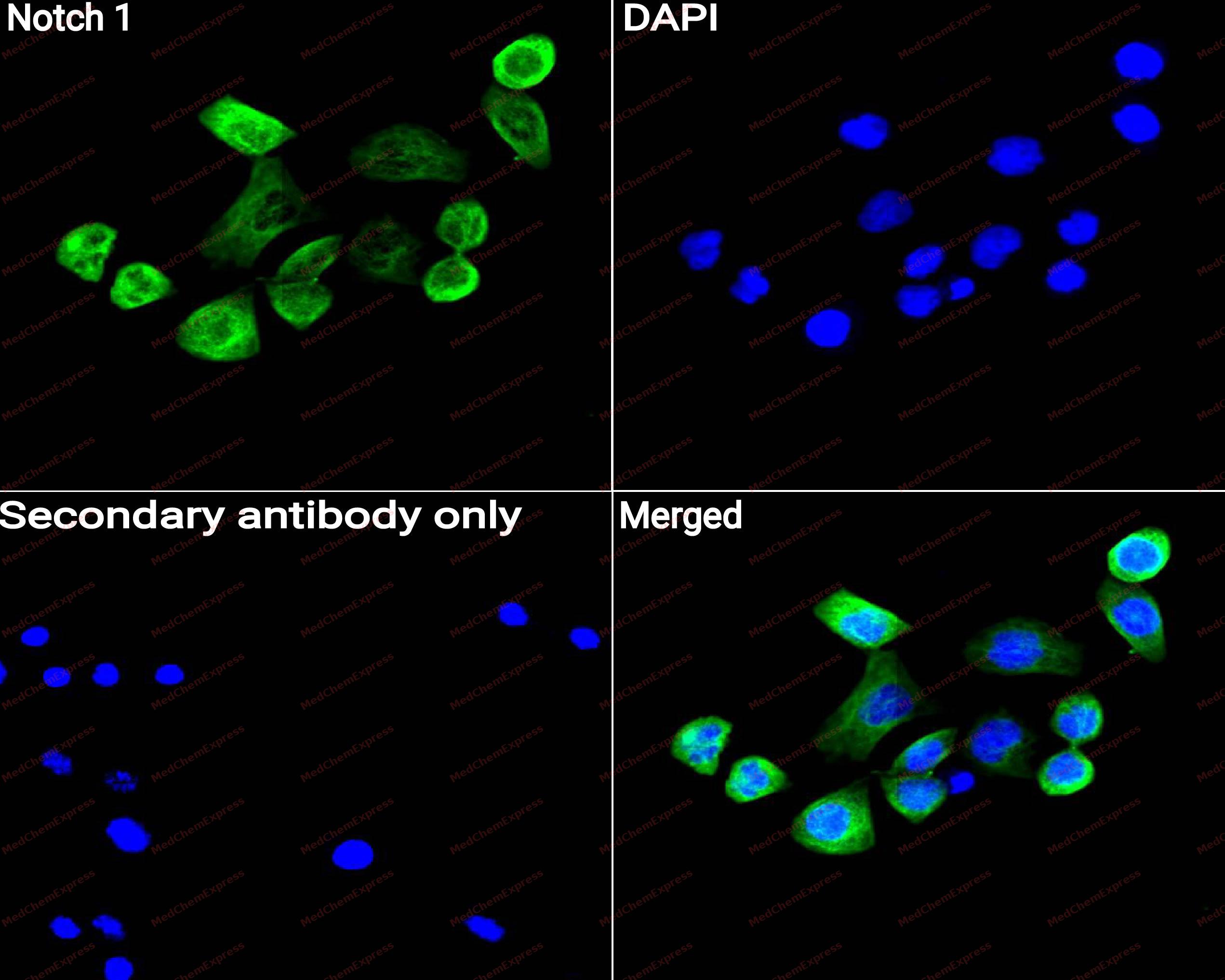 Immunocytochemistry analysis of Hela cells labeling Notch 1 with Notch 1 antibody (HY-P80426) at 1/50 dilution. Cells were fixed in 4% paraformaldehyde for 15 minutes at room temperature, then blocked with QuickBlock™ Blocking Buffer for Immunol Staining for 10 min at room temperature. Cells were then incubated with Notch 1 antibody (HY-P80426) at 1/50 dilution in QuickBlock™ Blocking Buffer for Immunol Staining at 4 ℃. Alexa Fluor® 488-conjugated AffiniPure Goat Anti-Rabbit IgG H&L(HY-P8002, Green) was used as the secondary antibody at 1/1,000 dilution. PBS instead of the primary antibody was used as the secondary antibody only control. The Nuclear counterstain was DAPI (Blue).
 -
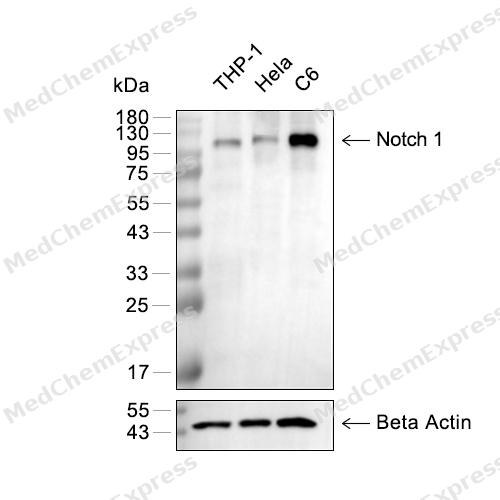 Western blot analysis of extracts from THP-1(lane 2(20μg)), HeLa(lane 3(20μg)) and C6(lane 4(40μg)) using Notch 1 (HY-P80426) Rabbit mAb. Proteins were transferred to a PVDF membrane and blocked with 5% BSA in TBST for 2 hour at room temperature. The primary antibody (1/1000) and Loading control antibody (Beta Actin, HY-P80438, 1/10000) was used in 5% BSA in TBST at 4°C overnight. Goat Anti-Rabbit IgG-HRP Secondary Antibody (1/10,000) was used for 1 hour at room temperature.
 -
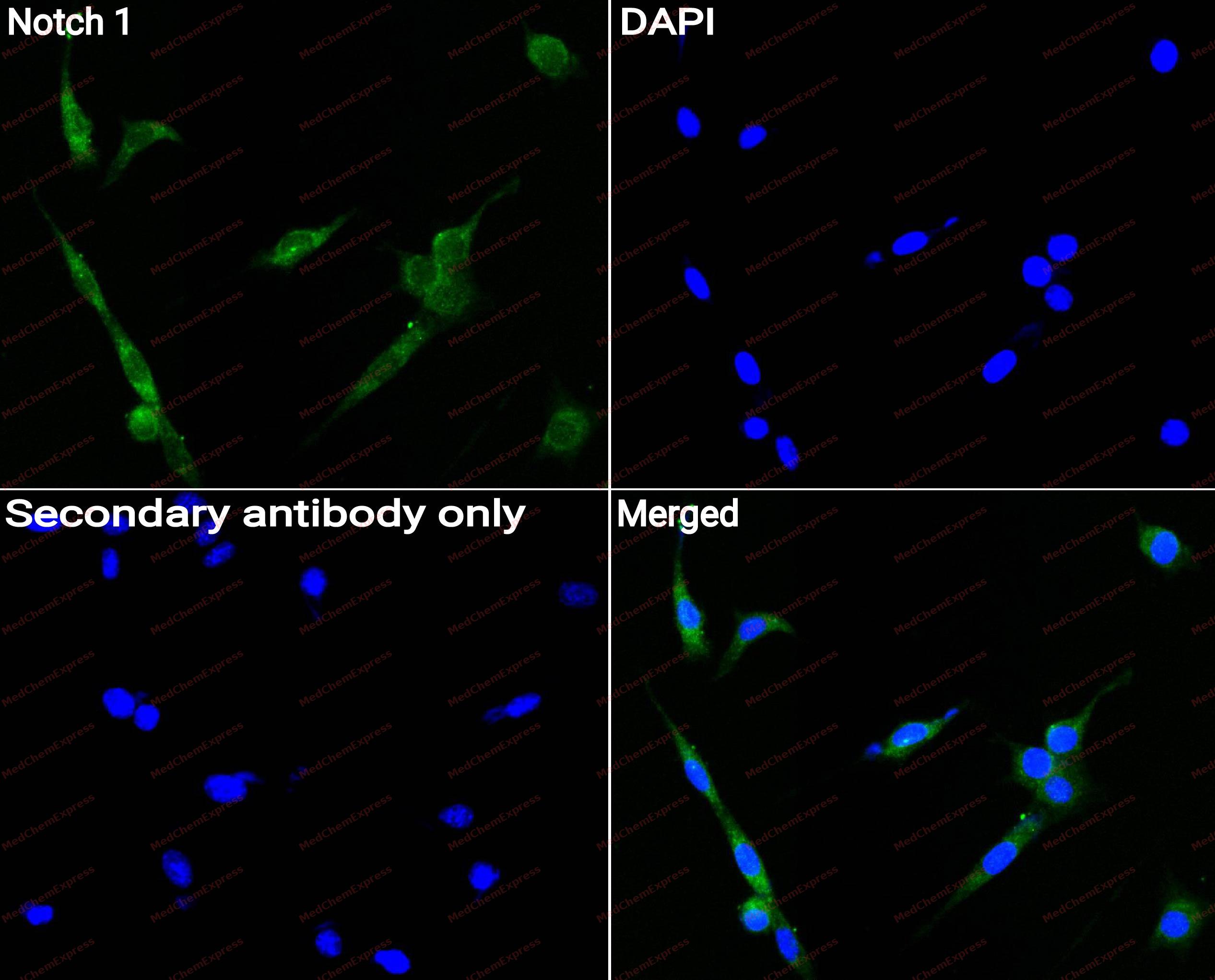 Immunocytochemistry analysis of NIH3T3cells labeling Notch 1 with Notch 1 antibody (HY-P80426) at 1/50 dilution. Cells were fixed in 4% paraformaldehyde for 15 minutes at room temperature, then blocked with QuickBlock™ Blocking Buffer for Immunol Staining for 10 min at room temperature. Cells were then incubated with Notch 1 antibody (HY-P80426) at 1/50 dilution in QuickBlock™ Blocking Buffer for Immunol Staining at 4 ℃. Alexa Fluor® 488-conjugated AffiniPure Goat Anti-Rabbit IgG H&L(HY-P8002, Green) was used as the secondary antibody at 1/1,000 dilution. PBS instead of the primary antibody was used as the secondary antibody only control. The Nuclear counterstain was DAPI (Blue).
 -
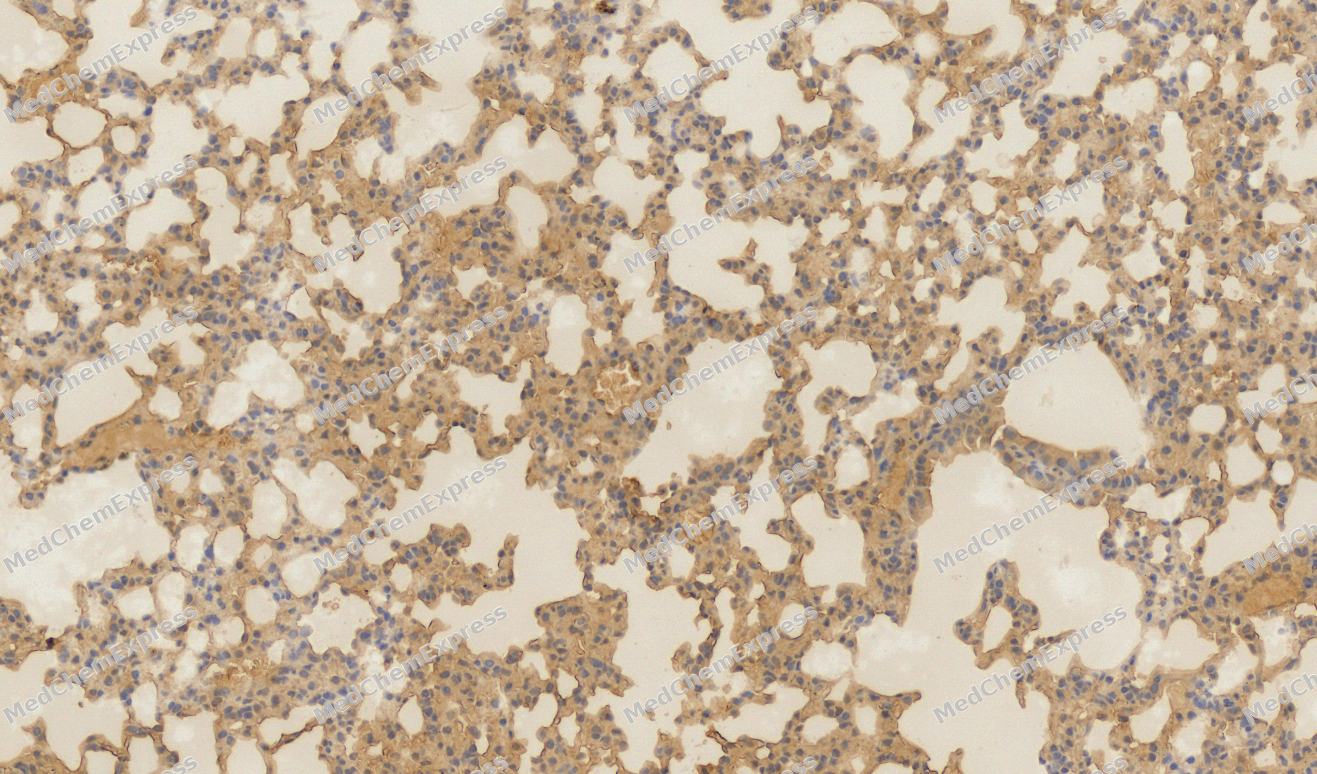 Immunohistochemical analysis of paraffin-embedded Mouse lung tissue using Notch 1 Antibody. The section was pre-treated using heat mediated antigen retrieval with sodium citrate buffer (pH 6.0) for 8 minutes. The tissues were blocked in QuickBlock for 20 minutes at room temperature, washed with ddH2O and PBS, and then probed with the primary antibody (HY-P80426, 1/100) in 4℃ overnight. The detection was performed using an HRP conjugated compact polymer system. DAB was used as the chromogen. Tissues were counterstained with hematoxylin and mounted with DPX.
 -
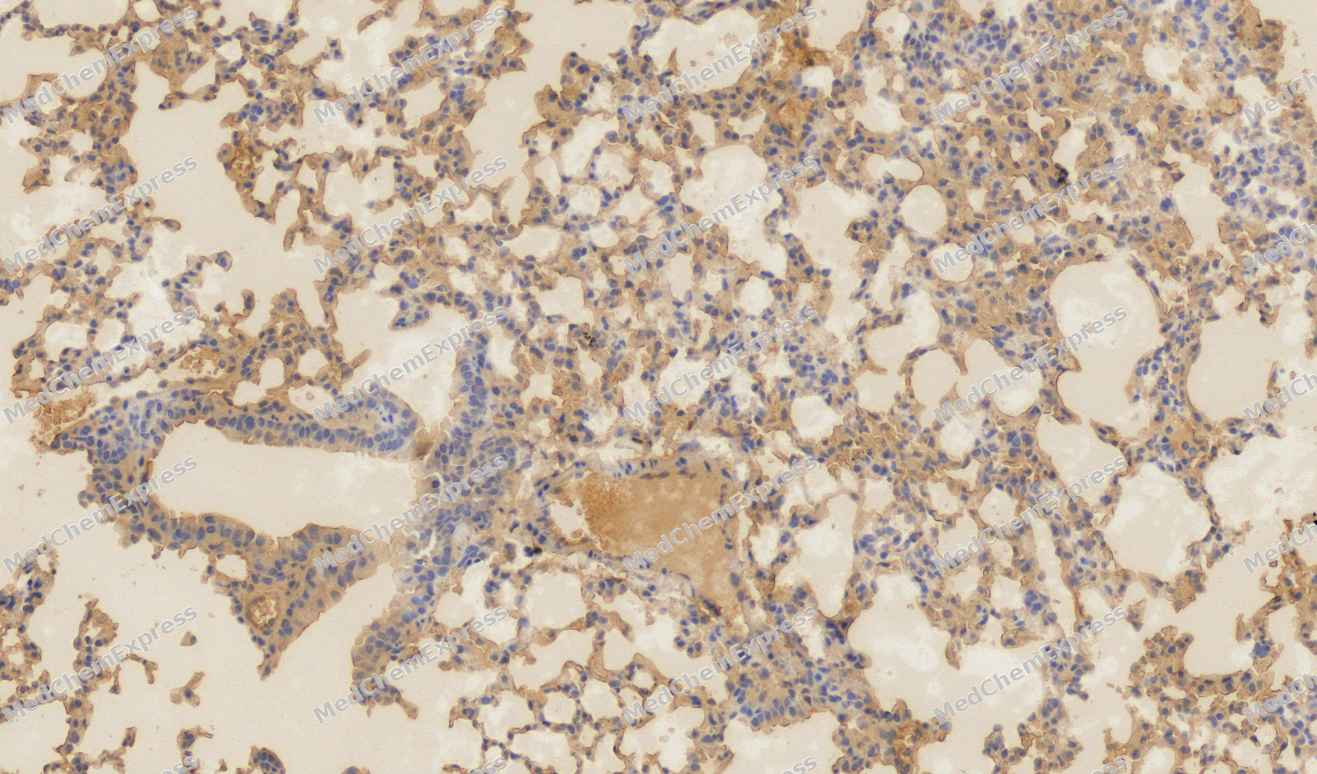 Immunohistochemical analysis of paraffin-embedded Mouse lung tissue using Notch 1 Antibody. The section was pre-treated using heat mediated antigen retrieval with sodium citrate buffer (pH 6.0) for 8 minutes. The tissues were blocked in QuickBlock for 20 minutes at room temperature, washed with ddH2O and PBS, and then probed with the primary antibody (HY-P80426, 1/100) in 4℃ overnight. The detection was performed using an HRP conjugated compact polymer system. DAB was used as the chromogen. Tissues were counterstained with hematoxylin and mounted with DPX.


Background
-
Function
Notch1 functions as a receptor for membrane-bound ligands Jagged-1 (JAG1), Jagged-2 (JAG2) and Delta-1 (DLL1) to regulate cell-fate determination. Upon ligand activation through the released notch intracellular domain (NICD) it forms a transcriptional activator complex with RBPJ/RBPSUH and activates genes of the enhancer of split locus. Affects the implementation of differentiation, proliferation and apoptotic programs. Involved in angiogenesis; negatively regulates endothelial cell proliferation and migration and angiogenic sprouting. Involved in the maturation of both CD4(+) and CD8(+) cells in the thymus. Important for follicular differentiation and possibly cell fate selection within the follicle. During cerebellar development, functions as a receptor for neuronal DNER and is involved in the differentiation of Bergmann glia. Represses neuronal and myogenic differentiation. May play an essential role in postimplantation development, probably in some aspect of cell specification and/or differentiation. May be involved in mesoderm development, somite formation and neurogenesis. May enhance HIF1A function by sequestering HIF1AN away from HIF1A. Required for the THBS4 function in regulating protective astrogenesis from the subventricular zone (SVZ) niche after injury. Involved in determination of left/right symmetry by modulating the balance between motile and immotile (sensory) cilia at the left-right organiser (LRO)
-
Subcellular Localization
Cell membrane; Single-pass type I membrane protein; Late endosome membrane; Single-pass type I membrane protein; Nucleus
-
Expression
Tissue_specificity:In fetal tissues, the spleen, brainstem, and lungs contain the most abundant amounts of this substance. It is also distributed in most human tissues, primarily in lymphatic tissues. -
Subunit
Heterodimer of a C-terminal fragment N(TM) and an N-terminal fragment N(EC) which are probably linked by disulfide bonds. Interacts with DNER, DTX1, DTX2 and RBPJ/RBPSUH. Also interacts with MAML1, MAML2 and MAML3 which act as transcriptional coactivators for NOTCH1 (PubMed:11101851, PubMed:12370315). The NOTCH1 intracellular domain interacts with SNW1; the interaction involves multimerized NOTCH1 NICD and is implicated in a formation of an intermediate preactivation complex which associates with DNA-bound CBF-1/RBPJ (PubMed:10713164). The activated membrane-bound form interacts with AAK1 which promotes NOTCH1 stabilization. Forms a trimeric complex with FBXW7 and SGK1. Interacts with HIF1AN. HIF1AN negatively regulates the function of notch intracellular domain (NICD), accelerating myogenic differentiation (PubMed:17573339). Interacts (via NICD) with SNAI1 (via zinc fingers); the interaction induces SNAI1 degradation via MDM2-mediated ubiquitination and inhibits SNAI1-induced cell invasion. Interacts (via NICD) with MDM2A. Interacts (via NICD) with BCL6; the interaction decreases MAML1 recruitment by NOTCH1 NICD on target genes DNA and inhibits NOTCH1 transactivation activity. Interacts with THBS4 (By similarity). Interacts (via the EGF-like repeat region) with CCN3 (via CTCK domain) (PubMed:12050162). Interacts (via EGF-like domains) with DLL4 (via N-terminal DSL and MNNL domains) (By similarity). Interacts with ZMIZ1. Interacts (via NICD domain) with MEGF10 (via the cytoplasmic domain). Interacts with DLL1 and JAG1 (By similarity). Interacts (via NICD domain) with PRAG1 (By similarity). Forms a complex with PRAG1, N1ICD and MAML1, in a MAML1-dependent manner (By similarity). Interacts (via transmembrane region) with PSEN1; the interaction is direct (PubMed:30598546). Interacts with ZFP64 (By similarity)
-
SwissProt ID
-
Synonyms
TAN1, NOTCH1, Neurogenic locus notch homolog protein 1, Notch 1, hN1, Translocation-associated notch protein TAN-1
-
Research Field
Neuroscience


Documentation
-
Data Sheet (235 KB)
-
SDS (251 KB)
- English - EN (251 KB)
- Français - FR (251 KB)
- Deutsch - DE (251 KB)
- Norwegian - NO (251 KB)
- Español - ES (251 KB)
- Swedish - SV (251 KB)
- Italian - IT (251 KB)
- Korean - KR (251 KB)
- Portuguese - PT (251 KB)
-
User Guide for Antibodies (1077 KB)

 Powered by Bioz
