



PKA alpha+beta Antibody
(Synonyms: PRKACA/PRKACB; PRKACA + PRKACB; PKA alpha + beta; PKA alpha; PKA beta; cAMP dependent protein kinase alpha catalytic subunit; cAMP dependent protein kinase beta catalytic subunit; cAMP dependent protein kinase catalytic subunit alpha; cAMP dependent protein kinase catalytic subunit beta; DKFZp781I2452; MGC102831; MGC41879; MGC48865; MGC9320; PKA C alpha; PKA C beta; PKACA; PKACB; PRKACA; PRKACB; Protein kinase A catalytic subunit alpha; Protein kinase A catalytic subunit; Protein kinase A catalytic subunit beta; Protein kinase cAMP dependent catalytic alpha; Protein kinase cAMP dependent catalytic beta; cAMP dependent protein kinase catalytic subunit alpha isoform 1; cAMP-dependent protein kinase catalytic subunit alpha; KAPCA_HUMAN; KAPCB_HUMAN; PKA C alpha; PKA C-alpha; PKACA; PRKACA; Protein kinase A catalytic subunit; Protein kinase cAMP dependent catalytic alpha.)
Based on 1 Customer Validation
PKA alpha+beta Antibody is a Rabbit-derived and non-conjugated IgG polyclonal antibody, targeting to PKA alpha+beta.
-
Host:
Rabbit
-
Isotype:
IgG
-
Application:
WB, ICC/IF
-
Reactivity :
Human, Mouse, Rat
-
Formulation:
1.Supplied in 0.01M TBS(pH7.4) with 1% BSA, 0.03% Proclin300 and 50% Glycerol.
2.Supplied in 0.01M TBS (pH7.4) with 1% BSA, 0.02% Proclin300 and 50% Glycerol.
Please refer to the lot-specific COA for specific buffer information.
-
Conjugation:
Non-conjugated


To place orders, for customer services and technical support, please contact: MedChemExpress USA
Tel: 609-228-6898 E-mail: [email protected] [email protected]





Applications
| Application |
WB

WB: Western Blot
|
ICC/IF
ICC/IF: Immunocytochemistry/
Immunofluorescence |
|---|---|---|
| Dilution Ratio | 1:500-2000 | 1:100-500 |


Product Details
PKA alpha+beta Antibody is a Rabbit-derived and non-conjugated IgG polyclonal antibody, targeting to PKA alpha+beta.
-
Host Rabbit

-
Clonality Polyclonal

-
Species ReactivityHuman, Mouse, Rat Predicted Reactivity: Rat
Note: The predicted reactivity is for reference only and should not be considered a guarantee of product performance.
-
Observed Molecular WeightObserved band size: 40 kDa
Note: Due to possible protein modifications or aggregation, the molecular weight should be confirmed by actual measurement, and the predicted value is for reference only.

-
Calculated Molecular Weight Predicted band size: 40 kDa

KLH conjugated synthetic peptide derived from human PRKACA/PRKACB : 17-100/351
Endogenous
affinity purified
Non-conjugated
Unmodified
IgG


Product Properties
-
Appearance
Liquid
-
Formulation
1.Supplied in 0.01M TBS(pH7.4) with 1% BSA, 0.03% Proclin300 and 50% Glycerol.
2.Supplied in 0.01M TBS (pH7.4) with 1% BSA, 0.02% Proclin300 and 50% Glycerol.
Please refer to the lot-specific COA for specific buffer information. -
Concentration
Batch-dependent, Please check the COA for the concentration of each lot. Check Lot Concentration
-
Storage & Stability
Stored at -20°C for 1 year. Avoid repeated freeze / thaw cycles.
-
Shipping
Shipping with blue ice.


Verification Images
-
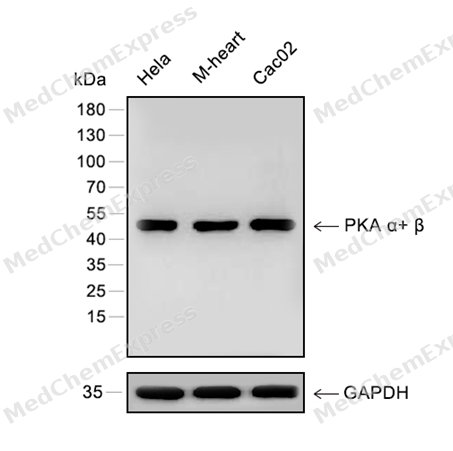 Western blot analysis of extracts from Hela (lane 1) and M-heart (lane 2) and CaCO2 (lane 3) and using PKA α+β antibody. Proteins were transferred to a PVDF membrane and blocked with 5% nonfat powdered milk in PBST for 2 hour at room temperature. The primary antibody (1/1000) and Loading control antibody (GAPDH, 1/3000) was diluted with 5% nonfat powdered milk in PBST at 4°C overnight. Goat Anti-Rabbit IgG-HRP Secondary Antibody (1/8,000) was incubated for 45min at room temperature.
 -
 Immunocytochemistry analysis of Hela cells labeling PKA alpha+beta with PKA alpha+beta Antibody (HY-P81127) at 1/100 dilution. Cells were fixed in 4% paraformaldehyde for 15 minutes at room temperature, permeabilized with 0.1% Triton X-100 in PBS for 15 minutes at room temperature, then blocked with quick block buffer for 10 minutes at room temperature. Cells were then incubated with PKA alpha+beta Antibody (HY-P81127) at 1/100 dilution in quick block buffer overnight at 4 ℃. AF488-conjugated Goat Anti-Rabbit IgG H&L(HY-P8002, Green) was used as the secondary antibody at 1/1,000 dilution. PBS instead of the primary antibody was used as the secondary antibody only control. The Nuclear counterstain was DAPI (Blue).
 -
 Immunocytochemistry analysis of Hela cells labeling PKA alpha+beta with PKA alpha+beta Antibody (HY-P81127) at 1/400 dilution. Cells were fixed in 4% paraformaldehyde for 15 minutes at room temperature, permeabilized with 0.1% Triton X-100 in PBS for 15 minutes at room temperature, then blocked with quick block buffer for 10 minutes at room temperature. Cells were then incubated with PKA alpha+beta Antibody (HY-P81127) at 1/400 dilution in quick block buffer overnight at 4 ℃. AF488-conjugated Goat Anti-Rabbit IgG H&L(HY-P8002, Green) was used as the secondary antibody at 1/1,000 dilution. PBS instead of the primary antibody was used as the secondary antibody only control. The Nuclear counterstain was DAPI (Blue).


Background
-
Function
PKA alpha+beta phosphorylates a large number of substrates in the cytoplasm and the nucleus. Phosphorylates CDC25B, ABL1, NFKB1, CLDN3, PSMC5/RPT6, PJA2, RYR2, RORA, SOX9 and VASP. Regulates the abundance of compartmentalized pools of its regulatory subunits through phosphorylation of PJA2 which binds and ubiquitinates these subunits, leading to their subsequent proteolysis. RORA is activated by phosphorylation. Required for glucose-mediated adipogenic differentiation increase and osteogenic differentiation inhibition from osteoblasts. Involved in chondrogenesis by mediating phosphorylation of SOX9. Involved in the regulation of platelets in response to thrombin and collagen; maintains circulating platelets in a resting state by phosphorylating proteins in numerous platelet inhibitory pathways when in complex with NF-kappa-B (NFKB1 and NFKB2) and I-kappa-B-alpha (NFKBIA), but thrombin and collagen disrupt these complexes and free active PRKACA stimulates platelets and leads to platelet aggregation by phosphorylating VASP. Prevents the antiproliferative and anti-invasive effects of alpha-difluoromethylornithine in breast cancer cells when activated. RYR2 channel activity is potentiated by phosphorylation in presence of luminal Ca(2+), leading to reduced amplitude and increased frequency of store overload-induced Ca(2+) release (SOICR) characterized by an increased rate of Ca(2+) release and propagation velocity of spontaneous Ca(2+) waves, despite reduced wave amplitude and resting cytosolic Ca(2+). PSMC5/RPT6 activation by phosphorylation stimulates proteasome. Negatively regulates tight junctions (TJs) in ovarian cancer cells via CLDN3 phosphorylation. NFKB1 phosphorylation promotes NF-kappa-B p50-p50 DNA binding. Required for phosphorylation of GLI transcription factors which inhibits them and prevents transcriptional activation of Hedgehog signaling pathway target genes. GLI transcription factor phosphorylation is inhibited by interaction of PRKACA with SMO which sequesters PRKACA at the cell membrane. Involved in embryonic development by down-regulating the Hedgehog (Hh) signaling pathway that determines embryo pattern formation and morphogenesis most probably through the regulation of OFD1 in ciliogenesis. Prevents meiosis resumption in prophase-arrested oocytes via CDC25B inactivation by phosphorylation. May also regulate rapid eye movement (REM) sleep in the pedunculopontine tegmental (PPT). Phosphorylates APOBEC3G and AICDA. Phosphorylates HSF1; this phosphorylation promotes HSF1 nuclear localization and transcriptional activity upon heat shock. Acts as a negative regulator of mTORC1 by mediating phosphorylation of RPTOR; Phosphorylates and activates ABL1 in sperm flagellum to promote spermatozoa capacitation[1][2][3][4][5][6][7][8][9][10][11][12][13][14][15].
-
Subcellular Localization
Cytoplasm; Cell membrane; Membrane; Lipid-anchor; Nucleus; Mitochondrion; Cell projection, cilium, flagellum; Cytoplasmic vesicle, secretory vesicle, acrosome
-
Expression
Tissue_specificity:Isomer 1 is ubiquitous. Isomer 2 is sperm-specific, enriched in pachytene spermatocytes, but undetectable in round spermatocytes. -
Isoforms & Post-Translational Modification
P17612 has 2 isomers: P17612-1: 40590 Da (predicted); P17612-2: 39822 Da (predicted).
Autophosphorylated. Phosphorylation is enhanced by vitamin K(2) (PubMed:12372837, PubMed:17909264). Phosphorylated on threonine and serine residues. Phosphorylation on Thr-198 is required for full activity (PubMed:16765046, PubMed:20137943, PubMed:20481595, PubMed:20732331, PubMed:21774789, Ref.43). Phosphorylated at Tyr-331 by activated receptor tyrosine kinases EGFR and PDGFR; this increases catalytic efficiency (By similarity);Asn-3 is partially deaminated to Asp-3 giving rise to 2 major isoelectric variants, called CB and CA respectively;When myristoylated, Ser-11 is autophosphorylated probably in conjunction with deamidation of Asn-3 -
Subunit
A number of inactive tetrameric holoenzymes are produced by the combination of homo- or heterodimers of the different regulatory subunits associated with two catalytic subunits.
-
SwissProt ID
-
Synonyms
PRKACA/PRKACB; PRKACA + PRKACB; PKA alpha + beta; PKA alpha; PKA beta; cAMP dependent protein kinase alpha catalytic subunit; cAMP dependent protein kinase beta catalytic subunit; cAMP dependent protein kinase catalytic subunit alpha; cAMP dependent protein kinase catalytic subunit beta; DKFZp781I2452; MGC102831; MGC41879; MGC48865; MGC9320; PKA C alpha; PKA C beta; PKACA; PKACB; PRKACA; PRKACB; Protein kinase A catalytic subunit alpha; Protein kinase A catalytic subunit; Protein kinase A catalytic subunit beta; Protein kinase cAMP dependent catalytic alpha; Protein kinase cAMP dependent catalytic beta; cAMP dependent protein kinase catalytic subunit alpha isoform 1; cAMP-dependent protein kinase catalytic subunit alpha; KAPCA_HUMAN; KAPCB_HUMAN; PKA C alpha; PKA C-alpha; PKACA; PRKACA; Protein kinase A catalytic subunit; Protein kinase cAMP dependent catalytic alpha.


Documentation
-
Data Sheet (234 KB)
-
SDS (254 KB)
- English - EN (254 KB)
- Français - FR (254 KB)
- Deutsch - DE (254 KB)
- Norwegian - NO (254 KB)
- Español - ES (254 KB)
- Swedish - SV (254 KB)
- Italian - IT (254 KB)
- Korean - KR (254 KB)
- Portuguese - PT (254 KB)
-
User Guide for Antibodies (1077 KB)

 Powered by Bioz
