



RAB7 Antibody (YA110)
(Synonyms: CMT2B antibody; PRO2706 antibody; PSN antibody; RAB7, member RAS oncogene family antibody; RAB7A antibody; RAB7A, member RAS oncogene family antibody; RAB7A_HUMAN antibody; Ras associated protein RAB7 antibody; Ras related protein Rab7 antibody; Ras related protein Rab7a antibody )Based on 1 publication(s) in Google Scholar
RAB7 Antibody (YA110) is a Rabbit-derived and non-conjugated IgG monoclonal antibody, targeting to RAB7.
-
Host:
Rabbit
-
Isotype:
IgG
-
Application:
WB, IHC-P, ICC/IF, FC, IF-Tissue
-
Reactivity :
Human, Mouse, Rat
-
Formulation:
Supplied in 1*TBS (pH7.4), 0.05% BSA and 40% Glycerol. Preservative: 0.05% Sodium Azide.
-
Conjugation:
Non-conjugated


To place orders, for customer services and technical support, please contact: MedChemExpress USA
Tel: 609-228-6898 E-mail: [email protected] [email protected]



Publications Citing Use of MedChemExpress (MCE) RAB7 Antibody (YA110)
More

Applications
| Application |
WB

WB: Western Blot
|
ICC/IF
ICC/IF: Immunocytochemistry/
Immunofluorescence |
IF-Tissue
IF-Tissue: Immunofluorescence-Tissue
|
IHC-P
IHC-P: Immunohistochemistry-Paraffin
|
FC
FC: Flow Cytometry
|
|---|---|---|---|---|---|
| Dilution Ratio | 1:5000 | 1:100-1:1000 | 1:100-1:500 | 1:50-1:1000 | 1:500-1:1000 |


Product Details
RAB7 Antibody (YA110) is a Rabbit-derived and non-conjugated IgG monoclonal antibody, targeting to RAB7.
-
Host Rabbit

-
Clonality Recombinant,Monoclonal

-
Species ReactivityHuman, Mouse, Rat
-
Observed Molecular WeightObserved band size: 23 kDa
Note: Due to possible protein modifications or aggregation, the molecular weight should be confirmed by actual measurement, and the predicted value is for reference only.

-
Calculated Molecular Weight Predicted band size: 23 kDa

Synthetic peptide corresponding to Human RAB7.AA range:158-207.
Endogenous
Protein A affinity purified.
Non-conjugated
Unmodified
IgG


Product Properties
-
Appearance
Solution
-
Formulation
Supplied in 1*TBS (pH7.4), 0.05% BSA and 40% Glycerol. Preservative: 0.05% Sodium Azide.
-
Concentration
Batch-dependent, Please check the COA for the concentration of each lot. Check Lot Concentration
-
Storage & Stability
Stored at -20°C for 1 year. Avoid repeated freeze / thaw cycles.
-
Shipping
Shipping with blue ice.


Publications (1)
-
Journal Impact Factor
-
Most Recent


Verification Images
-
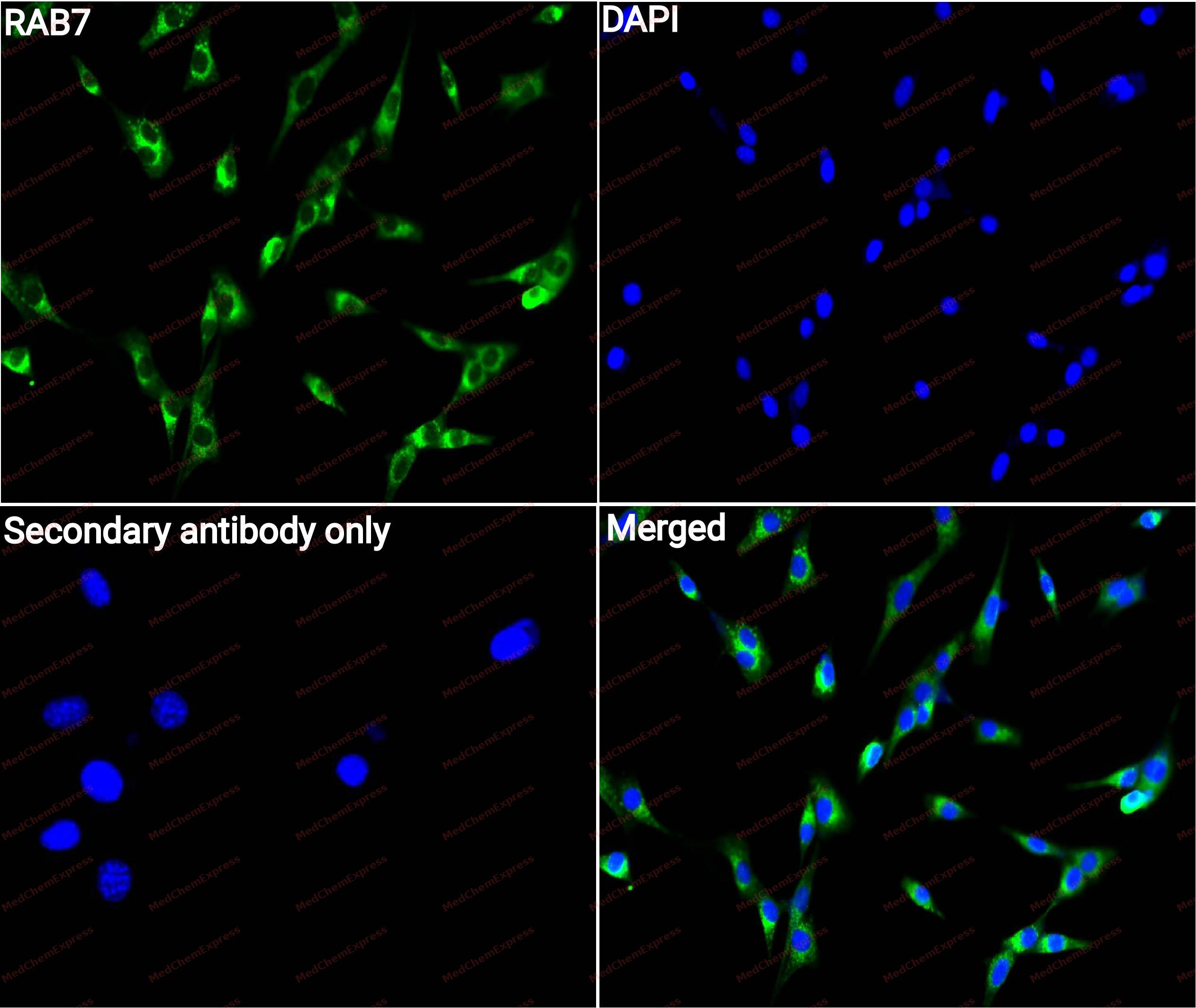 Immunocytochemistry analysis of NIH3T3 cells labeling RAB7 with RAB7 antibody (HY-P80295) at 1/100 dilution. Cells were fixed in 4% paraformaldehyde for 15 minutes at room temperature, permeabilized with 0.1% Triton X-100 for 10 minutes at room temperature, then blocked with QuickBlock™ Blocking Buffer for Immunol Staining for 10 min at room temperature. Cells were then incubated with RAB7 antibody (HY-P80295) at 1/100 dilution in QuickBlock™ Blocking Buffer for Immunol Staining at 4 ℃. Alexa Fluor® 488-conjugated AffiniPure Goat Anti-Rabbit IgG H&L(HY-P8002, Green) was used as the secondary antibody at 1/1,000 dilution. PBS instead of the primary antibody was used as the secondary antibody only control. The Nuclear counterstain was DAPI (Blue).
 -
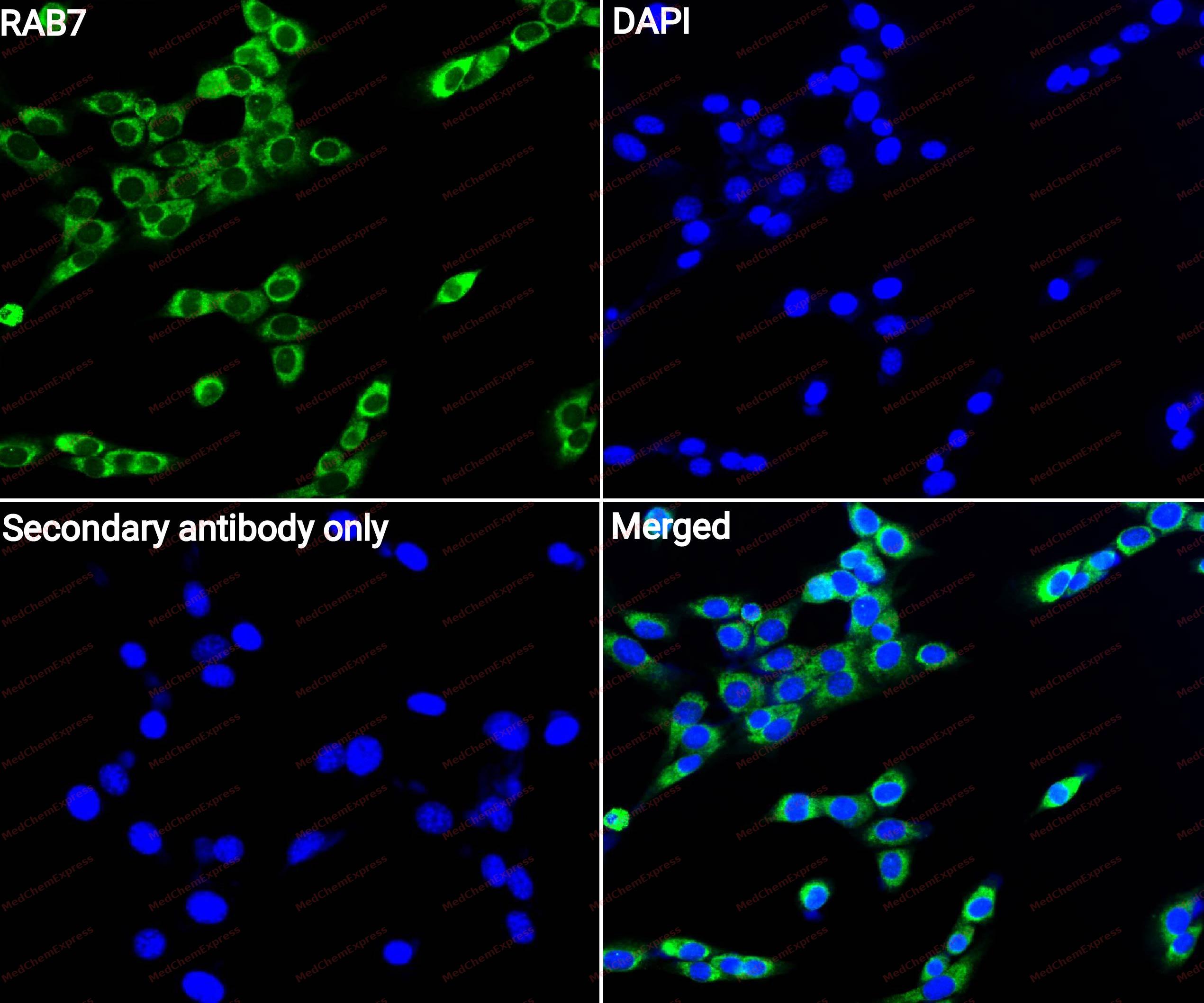 Immunocytochemistry analysis of NIH3T3 cells labeling RAB7 with RAB7 antibody (HY-P80295) at 1/250 dilution. Cells were fixed in 4% paraformaldehyde for 15 minutes at room temperature, permeabilized with 0.1% Triton X-100 for 10 minutes at room temperature, then blocked with QuickBlock™ Blocking Buffer for Immunol Staining for 10 min at room temperature. Cells were then incubated with RAB7 antibody (HY-P80295) at 1/100 dilution in QuickBlock™ Blocking Buffer for Immunol Staining at 4 ℃. Alexa Fluor® 488-conjugated AffiniPure Goat Anti-Rabbit IgG H&L(HY-P8002, Green) was used as the secondary antibody at 1/1,000 dilution. PBS instead of the primary antibody was used as the secondary antibody only control. The Nuclear counterstain was DAPI (Blue).
 -
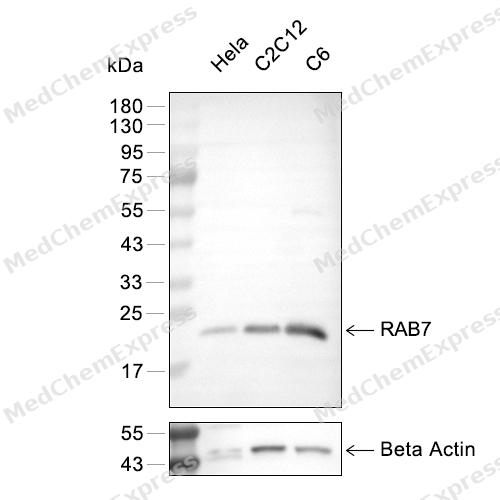 Western blot analysis of extracts from Hela (lane 2(20μg), C2C12 (lane 3(20μg), C6 (lane 4(20μg) using CD44 (HY-P80295) Rabbit mAb. Proteins were transferred to a PVDF membrane and blocked with 5% BSA in TBST for 2 hour at room temperature. The primary antibody (HY-P80295, 1/1000) and Loading control antibody (Beta Actin, HY-P80438, 1/3000) was used in 5% BSA in TBST at 4°C overnight. Goat Anti-Mouse/Rabbit IgG-HRP Secondary Antibody (HY-P8004/HY-P8001, 1/10,000) was used for 1 hour at room temperature.
 -
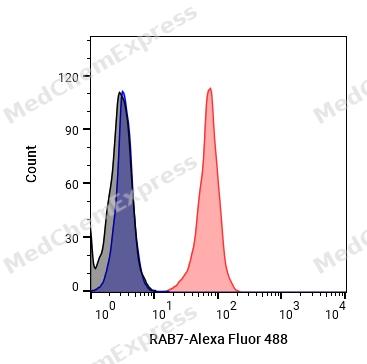 Flow cytometric analysis of 1X10^6 K562 cells labeling RAB7 Antibody (HY-P80295, red). Cells were fixed with 4% paraformaldehyde and permeabilised with 90% methanol. Then stained with the primary antibody at 1/50 dilution for an hour at 4℃. Alexa Fluor® 488-conjugated AffiniPure Goat Anti-Rabbit IgG H&L (HY-P8002) was used as the secondary antibody at 1/1,000 dilution for 30 minutes at 4℃. Rabbit IgG Isotype Control (HY-P80879, blue) was used as the isotype control, cells without incubation with primary antibody were used as the unlabeled control (black).


Background
-
Function
RAB7 is a The small GTPases Rab are key regulators of intracellular membrane trafficking, from the formation of transport vesicles to their fusion with membranes. Rabs cycle between an inactive GDP-bound form and an active GTP-bound form that is able to recruit to membranes different sets of downstream effectors directly responsible for vesicle formation, movement, tethering and fusion. In its active state, RAB7A binds to a variety of effector proteins playing a key role in the regulation of endo-lysosomal trafficking. Governs early-to-late endosomal maturation, microtubule minus-end as well as plus-end directed endosomal migration and positioning, and endosome-lysosome transport through different protein-protein interaction cascades. Also plays a central role in growth-factor-mediated cell signaling, nutrient-transportor mediated nutrient uptake, neurotrophin transport in the axons of neurons and lipid metabolism. Also involved in regulation of some specialized endosomal membrane trafficking, such as maturation of melanosomes, pathogen-induced phagosomes (or vacuoles) and autophagosomes. Plays a role in the maturation and acidification of phagosomes that engulf pathogens, such as S.aureus and M.tuberculosis. Plays a role in the fusion of phagosomes with lysosomes. In concert with RAC1, plays a role in regulating the formation of RBs (ruffled borders) in osteoclasts. Controls the endosomal trafficking and neurite outgrowth signaling of NTRK1/TRKA. Regulates the endocytic trafficking of the EGF-EGFR complex by regulating its lysosomal degradation. Involved in the ADRB2-stimulated lipolysis through lipophagy, a cytosolic lipase-independent autophagic pathway. Required for the exosomal release of SDCBP, CD63 and syndecan. Required for vesicular trafficking and cell surface expression of ACE2. May play a role in PRPH neuronal intermediate filament assembly[1][2][3][4][5][6][7][8].
-
Subcellular Localization
Cytoplasmic vesicle, phagosome membrane; Peripheral membrane protein; Cytoplasmic side; Late endosome membrane; Peripheral membrane protein; Cytoplasmic side; Lysosome membrane; Peripheral membrane protein; Cytoplasmic side; Melanosome membrane; Peripheral membrane protein; Cytoplasmic side; Cytoplasmic vesicle, autophagosome membrane; Peripheral membrane protein; Cytoplasmic side; Lipid droplet; Endosome membrane; Peripheral membrane protein; Cytoplasmic vesicle; Mitochondrion membrane; Peripheral membrane protein
-
Expression
Tissue_specificity:Widely expressed; highly expressed in skeletal muscle -
Subunit
The GTP-bound form interacts with RAC1 (By similarity). Interacts with NTRK1/TRKA (By similarity). Interacts with C9orf72 (By similarity). Interacts with CHM, the substrate-binding subunit of the Rab geranylgeranyltransferase complex (By similarity). Interacts with RILP (PubMed:11179213, PubMed:14668488, PubMed:15933719, PubMed:20028791, PubMed:22431521). Interacts with PSMA7 (PubMed:14998988). Interacts with RNF115 (PubMed:16925951). Interacts with FYCO1 (PubMed:20100911). Interacts with the PIK3C3/VPS34-PIK3R4 complex (PubMed:14617358). The GTP-bound form interacts with OSBPL1A (PubMed:16176980). Interacts with CLN3 (PubMed:22261744). Does not interact with HPS4 and the BLOC-3 complex (heterodimer of HPS1 and HPS4) (PubMed:20048159). Interacts with CLN5 (PubMed:22431521). Interacts with PLEKHM1 (via N- and C-terminus) (PubMed:28325809). Interacts with PRPH; the interaction is direct (PubMed:23179371). Interacts with VPS13A (PubMed:30709847). The GDP-bound form interacts with RIMOC1 (PubMed:34432599). Interacts with the MON1A-CCZ1B complex and this interaction is enhanced in the presence of RIMOC1 (PubMed:34432599). Interacts with VPS39 and VPS41 (PubMed:37821429). Interacts with RUFY4 (PubMed:26416964). Forms a ternary complex with LAMP2 and RUFY4; the interaction with LAMP2 is mediated by RUFY4 (via RUN and coiled coil domains) (By similarity)
-
SwissProt ID
-
Synonyms
CMT2B antibody; PRO2706 antibody; PSN antibody; RAB7, member RAS oncogene family antibody; RAB7A antibody; RAB7A, member RAS oncogene family antibody; RAB7A_HUMAN antibody; Ras associated protein RAB7 antibody; Ras related protein Rab7 antibody; Ras related protein Rab7a antibody
-
Research Field
Tags & Cell Markers
Documentation
-
Data Sheet (263 KB)
-
SDS (252 KB)
- English - EN (252 KB)
- Français - FR (252 KB)
- Deutsch - DE (252 KB)
- Norwegian - NO (252 KB)
- Español - ES (252 KB)
- Swedish - SV (252 KB)
- Italian - IT (252 KB)
- Korean - KR (252 KB)
- Portuguese - PT (252 KB)
-
User Guide for Antibodies (1077 KB)
References
[1]. Li L, et al. The HEAT repeat protein HPO-27 is a lysosome fission factor. Nature. 2024 Apr;628(8008):630-638. [Content Brief]
[2]. Cantalupo G, et al. Rab-interacting lysosomal protein (RILP): the Rab7 effector required for transport to lysosomes. EMBO J. 2001 Feb 15;20(4):683-93. [Content Brief]
[3]. Harrison RE, et al. Phagosomes fuse with late endosomes and/or lysosomes by extension of membrane protrusions along microtubules: role of Rab7 and RILP. Mol Cell Biol. 2003 Sep;23(18):6494-506. [Content Brief]
[4]. Stein MP, et al. Human VPS34 and p150 are Rab7 interacting partners. Traffic. 2003 Nov;4(11):754-71. [Content Brief]
[5]. McCray BA, et al. Disease mutations in Rab7 result in unregulated nucleotide exchange and inappropriate activation. Hum Mol Genet. 2010 Mar 15;19(6):1033-47. [Content Brief]
[6]. Seto S, et al. Rab GTPases regulating phagosome maturation are differentially recruited to mycobacterial phagosomes. Traffic. 2011 Apr;12(4):407-20. [Content Brief]
[7]. Baietti MF, et al. Syndecan-syntenin-ALIX regulates the biogenesis of exosomes. Nat Cell Biol. 2012 Jun 3;14(7):677-85. [Content Brief]
[8]. Daniloski Z, et al. Identification of Required Host Factors for SARS-CoV-2 Infection in Human Cells. Cell. 2021 Jan 7;184(1):92-105.e16. [Content Brief]

 Powered by Bioz
