



RPA32/RPA2 Antibody (YA6180)
(Synonyms: RPA2; REPA2; RPA32; RPA34; Replication protein A 32 kDa subunit; RP-A p32; Replication factor A protein 2; RF-A protein 2; Replication protein A 34 kDa subunit; RP-A p34)RPA32/RPA2 Antibody (YA6180) is a Rabbit-derived and non-conjugated IgG monoclonal antibody, targeting to RPA32/RPA2.
-
Host:
Rabbit
-
Isotype:
IgG
-
Application:
WB, IHC-P, ICC/IF, IP, ELISA
-
Reactivity :
Human, Mouse, Rat
-
Formulation:
Supplied in PBS, 50% glycerol, 0.05% Proclin 300, 0.05%BSA
-
Conjugation:
Non-conjugated


To place orders, for customer services and technical support, please contact: MedChemExpress USA
Tel: 609-228-6898 E-mail: [email protected] [email protected]





Applications
| Application |
IHC-P

IHC-P: Immunohistochemistry-Paraffin
|
WB
WB: Western Blot
|
ICC/IF
ICC/IF: Immunocytochemistry/
Immunofluorescence |
ELISA
ELISA: Enzyme Linked Immunosorbent Assay
|
IP
IP: Immunoprecipitation
|
|---|---|---|---|---|---|
| Dilution Ratio | 1:1000-1:4000 | 1:1000-1:5000 | 1:200-1:1000 | 1:5000-1:20000 | 1:50-1:200 |


Product Details
RPA32/RPA2 Antibody (YA6180) is a Rabbit-derived and non-conjugated IgG monoclonal antibody, targeting to RPA32/RPA2.
-
Host Rabbit

-
Clonality Monoclonal

-
Species ReactivityHuman, Mouse, Rat
-
Observed Molecular WeightObserved band size: 29 kDa
Note: Due to possible protein modifications or aggregation, the molecular weight should be confirmed by actual measurement, and the predicted value is for reference only.

-
Calculated Molecular Weight Predicted band size: 29 kDa

Protein A
Non-conjugated
Unmodified
IgG


Product Properties
-
Appearance
Liquid
-
Formulation
Supplied in PBS, 50% glycerol, 0.05% Proclin 300, 0.05%BSA
-
Storage & Stability
Stored at -20°C for 1 year. Avoid repeated freeze / thaw cycles.
-
Shipping
Shipping with blue ice.


Verification Images
-
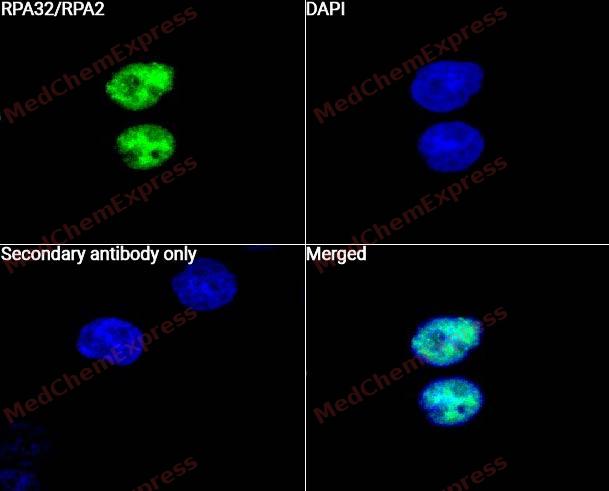 Immunocytochemistry analysis of Hela cells labeling RPA32/RPA2 with RPA32/RPA2 Antibody (HY-P86488) at 1/200 dilution. Cells were fixed in 4% paraformaldehyde for 15 minutes at room temperature, permeabilized with 0.1% Triton X-100 for 10 minutes at room temperature, then blocked with QuickBlock™ Blocking Buffer for Immunol Staining for 10 min at room temperature. Cells were then incubated with RPA32/RPA2 Antibody (HY-P86488) at 1/200 dilution in QuickBlock™ Blocking Buffer for Immunol Staining at 4 ℃. Alexa Fluor® 488-conjugated AffiniPure Goat Anti-Rabbit IgG H&L(HY-P8002, Green) was used as the secondary antibody at 1/1,000 dilution. PBS instead of the primary antibody was used as the secondary antibody only control. The Nuclear counterstain was DAPI (Blue).
 -
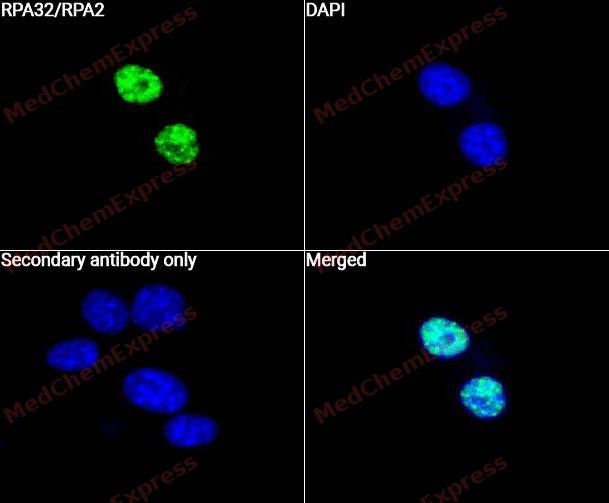 Immunocytochemistry analysis of NIH3T3 cells labeling RPA32/RPA2 with RPA32/RPA2 Antibody (HY-P86488) at 1/200 dilution. Cells were fixed in 4% paraformaldehyde for 15 minutes at room temperature, permeabilized with 0.1% Triton X-100 for 10 minutes at room temperature, then blocked with QuickBlock™ Blocking Buffer for Immunol Staining for 10 min at room temperature. Cells were then incubated with RPA32/RPA2 Antibody (HY-P86488) at 1/200 dilution in QuickBlock™ Blocking Buffer for Immunol Staining at 4 ℃. Alexa Fluor® 488-conjugated AffiniPure Goat Anti-Rabbit IgG H&L(HY-P8002, Green) was used as the secondary antibody at 1/1,000 dilution. PBS instead of the primary antibody was used as the secondary antibody only control. The Nuclear counterstain was DAPI (Blue).


Background
-
Function
RPA32/RPA2 is an As part of the heterotrimeric replication protein A complex (RPA/RP-A), binds and stabilizes single-stranded DNA intermediates that form during DNA replication or upon DNA stress. It prevents their reannealing and in parallel, recruits and activates different proteins and complexes involved in DNA metabolism. Thereby, it plays an essential role both in DNA replication and the cellular response to DNA damage. In the cellular response to DNA damage, the RPA complex controls DNA repair and DNA damage checkpoint activation. Through recruitment of ATRIP activates the ATR kinase a master regulator of the DNA damage response. It is required for the recruitment of the DNA double-strand break repair factors RAD51 and RAD52 to chromatin in response to DNA damage. Also recruits to sites of DNA damage proteins like XPA and XPG that are involved in nucleotide excision repair and is required for this mechanism of DNA repair. Also plays a role in base excision repair (BER) probably through interaction with UNG. Also recruits SMARCAL1/HARP, which is involved in replication fork restart, to sites of DNA damage. May also play a role in telomere maintenance. RPA stimulates 5'-3' helicase activity of BRIP1/FANCJ[1].
-
Subcellular Localization
Nucleus; Nucleus, PML body
-
Expression
Induction:Translationally up-regulated in response to DNA damage (at protein level) -
Isoforms & Post-Translational Modification
P15927 has 3 isomers: P15927-1: 29247 Da (predicted); P15927-2: 30156 Da (predicted); P15927-3: 38810 Da (predicted).
Differentially phosphorylated throughout the cell cycle, becoming phosphorylated at the G1-S transition and dephosphorylated in late mitosis. Mainly phosphorylated at Ser-23 and Ser-29, by cyclin A-CDK2 and cyclin B-CDK1, respectively during DNA replication and mitosis. Dephosphorylation may require the serine/threonine-protein phosphatase 4. Phosphorylation at Ser-23 and Ser-29 is a prerequisite for further phosphorylation. Becomes hyperphosphorylated on additional residues including Ser-4, Ser-8, Thr-21 and Ser-33 in response to DNA damage. Hyperphosphorylation is mediated by ATM, ATR and PRKDC. Primarily recruited to DNA repair nuclear foci as a hypophosphorylated form it undergoes subsequent hyperphosphorylation, catalyzed by ATR. Hyperphosphorylation is required for RAD51 recruitment to chromatin and efficient DNA repair. Phosphorylation at Thr-21 depends upon RFWD3 presence;DNA damage-induced 'Lys-63'-linked polyubiquitination by PRPF19 mediates ATRIP recruitment to the RPA complex at sites of DNA damage and activation of ATR (PubMed:24332808). Ubiquitinated by RFWD3 at stalled replication forks in response to DNA damage: ubiquitination by RFWD3 does not lead to degradation by the proteasome and promotes removal of the RPA complex from stalled replication forks, promoting homologous recombination (PubMed:26474068) -
Subunit
Component of the replication protein A complex (RPA/RP-A), a heterotrimeric complex composed of RPA1, RPA2 and RPA3 (PubMed:10449415, PubMed:19116208, PubMed:2406247). Interacts with PRPF19; the PRP19-CDC5L complex is recruited to the sites of DNA repair where it ubiquitinates the replication protein A complex (RPA) (PubMed:24332808). Interacts with SERTAD3 (PubMed:10982866). Interacts with TIPIN (PubMed:17141802, PubMed:17296725). Interacts with TIMELESS (PubMed:17141802). Interacts with PPP4R2; the interaction is direct, DNA damage-dependent and mediates the recruitment of the PP4 catalytic subunit PPP4C (PubMed:20154705). Interacts (hyperphosphorylated) with RAD51 (PubMed:20154705). Interacts with SMARCAL1; the interaction is direct and mediates the recruitment to the RPA complex of SMARCAL1 (PubMed:19793861, PubMed:19793862, PubMed:19793863, PubMed:24910198). Interacts with RAD52 and XPA; those interactions are direct and associate RAD52 and XPA to the RPA complex (PubMed:11081631, PubMed:17765923, PubMed:7700386, PubMed:8702565). Interacts with FBH1 (PubMed:23319600). Interacts with ETAA1; the interaction is direct and promotes ETAA1 recruitment at stalled replication forks (PubMed:27601467, PubMed:27723717, PubMed:27723720). Interacts with RFWD3 (PubMed:21504906, PubMed:21558276, PubMed:26474068, PubMed:28575657). Interacts with DDI2 (PubMed:29290612). Interacts (in unphosphorylated form via N-terminus) with EIF4EBP3; the interaction enhances EIF4EBP3-mediated inhibition of EIF4E-mediated mRNA nuclear export (PubMed:22684010). Interacts with BRIP1/FANCJ via the RPA1 subunit; following DNA damage they colocalize in foci in the nucleus (PubMed:17596542). Interacts with nuclear UNG (isoform 2); this interaction mediates UNG recruitment to RPA-coated single-stranded DNA at stalled replication forks
-
SwissProt ID
-
Synonyms
RPA2; REPA2; RPA32; RPA34; Replication protein A 32 kDa subunit; RP-A p32; Replication factor A protein 2; RF-A protein 2; Replication protein A 34 kDa subunit; RP-A p34


Documentation

 Powered by Bioz
