



SPHK1 Antibody (YA063)
(Synonyms: SK1, SPHK, SPK, SPHK1, Sphingosine kinase 1, SK 1, SPK 1, Acetyltransferase SPHK1)Based on 1 Customer Validation
SPHK1 Antibody (YA063) is a Rabbit-derived and non-conjugated IgG monoclonal antibody, targeting to SPHK1.
-
Host:
Rabbit
-
Isotype:
IgG
-
Application:
WB, IHC-P, FC
-
Reactivity :
Human
-
Formulation:
Supplied in 1*TBS (pH7.4), 0.05% BSA and 40% Glycerol. Preservative: 0.05% Sodium Azide.
-
Conjugation:
Non-conjugated


To place orders, for customer services and technical support, please contact: MedChemExpress USA
Tel: 609-228-6898 E-mail: [email protected] [email protected]





Applications
| Application |
WB

WB: Western Blot
|
IHC-P
IHC-P: Immunohistochemistry-Paraffin
|
FC
FC: Flow Cytometry
|
|---|---|---|---|
| Dilution Ratio | 1:500-1:1000 | 1:50-1:200 | 1:50 |


Product Details
SPHK1 Antibody (YA063) is a Rabbit-derived and non-conjugated IgG monoclonal antibody, targeting to SPHK1.
-
Host Rabbit

-
Clonality Recombinant,Monoclonal

-
Species ReactivityHuman
-
Observed Molecular WeightObserved band size: 53 kDa
Note: Due to possible protein modifications or aggregation, the molecular weight should be confirmed by actual measurement, and the predicted value is for reference only.

-
Calculated Molecular Weight Predicted band size: 42 kDa

Synthetic peptide corresponding to Human SPHK1.AA range:40-80.
Endogenous
Protein A affinity purified.
Non-conjugated
Unmodified
IgG


Product Properties
-
Appearance
Solution
-
Formulation
Supplied in 1*TBS (pH7.4), 0.05% BSA and 40% Glycerol. Preservative: 0.05% Sodium Azide.
-
Concentration
Batch-dependent, Please check the COA for the concentration of each lot. Check Lot Concentration
-
Storage & Stability
Stored at -20°C for 1 year. Avoid repeated freeze / thaw cycles.
-
Shipping
Shipping with blue ice.


Verification Images
-
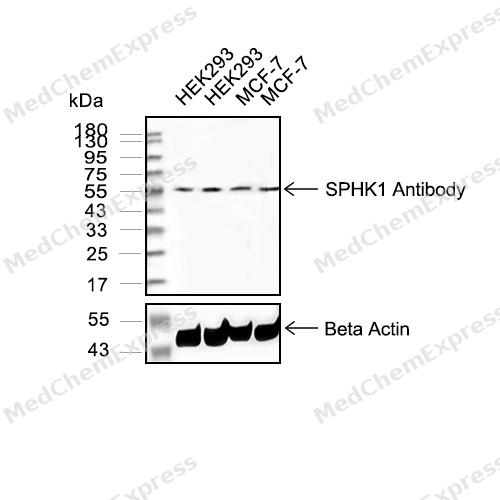 Western blot analysis of extracts from HEK293(lane 2(20μg) , HEK293(lane 3(40μg) and MCF-7(lane 4(20ug) ,MCF-7(lane 5(40ug) using SPHK1(HY-P80337Rabbit mAb. Proteins were transferred to a PVDF membrane and blocked with 5% non-fat milk in TBST for 2 hour at room temperature. The primary antibody (1/1000) and Loading control antibody (Beta Actin, HY-P80438, 1/10000) was used in 5% non-fat milk in TBST at 4°C overnight. Goat Anti-Mouse/Rabbit IgG-HRP Secondary Antibody (1/10000) was used for 1 hour at room temperature.
 -
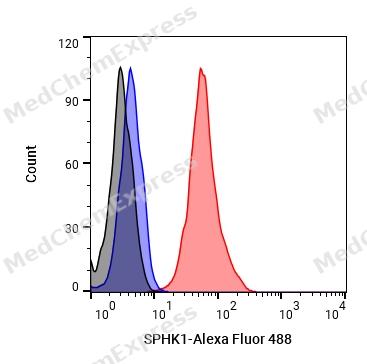 Flow cytometric analysis of 1X10^6 Raji cells labeling SPHK1 Antibody (HY-P80337, red). Cells were fixed with 4% paraformaldehyde and permeabilised with 90% methanol. Then stained with the primary antibody at 1/50 dilution for an hour at 4℃. Alexa Fluor® 488-conjugated AffiniPure Goat Anti-Rabbit IgG H&L (HY-P8002) was used as the secondary antibody at 1/1,000 dilution for 30 minutes at 4℃. Rabbit IgG Isotype Control (HY-P80879, blue) was used as the isotype control, cells without incubation with primary antibody were used as the unlabeled control (black).


Background
-
Function
Sphingosine kinase 1 (SphK1) is a key rate-limiting enzyme in sphingolipid metabolism that phosphorylates sphingosine to generate sphingosine-1-phosphate (S1P), thereby regulating the sphingolipid rheostat and multiple cellular processes including survival, proliferation, migration, inflammation, and vascular remodeling[1]. S1P produced by SphK1 functions as a bioactive signaling mediator and activates downstream pathways through S1P receptors, contributing to intracellular signaling and cell-environment communication[1][2]. Mechanistically, SphK1 is activated by diverse stimuli, including cytokines, growth factors, and MAPK signaling, and translocates from the cytoplasm to the plasma membrane where its catalytic activity is enhanced[1]. Dysregulated SphK1 expression or activity has been reported in numerous cancers and inflammatory disorders, and elevated SphK1 is frequently associated with tumor progression, drug resistance, and unfavorable clinical outcomes[2][3][4]. In experimental disease models, SphK1-dependent signaling contributes to inflammatory responses, immune-cell regulation, and cancer cell survival, highlighting its importance in both tumor biology and immune-mediated pathology[1][3]. Compared with the related isoform SphK2, SphK1 is primarily linked to cell growth and survival signaling, whereas SphK2 exhibits distinct subcellular localization patterns and is more closely associated with apoptosis regulation and epigenetic functions[1][5]. This functional divergence has stimulated the development of isoform-selective pharmacological tools. For experimental applications, several SphK1 inhibitors, including PF-543, SK1-I, and Safingol, have been widely used to investigate SphK1-dependent signaling and evaluate the therapeutic potential of targeting the SphK1/S1P axis in cancer and inflammatory diseases[1][3].
-
Subcellular Localization
Cytoplasm; Nucleus; Cell membrane; Endosome membrane; Peripheral membrane protein; Membrane, clathrin-coated pit; Synapse
-
Expression
Tissue_specificity:Widely expressed with highest levels in adult liver, kidney, heart and skeletal muscle. Expressed in brain cortex (at protein level) (PubMed:29662056) -
Isoforms & Post-Translational Modification
Q9NYA1 has 3 isomers: Q9NYA1-1: 42518 Da (predicted); Q9NYA1-2: 51054 Da (predicted); Q9NYA1-3: 43944 Da (predicted).
-
Subunit
Binds to calmodulin. Interacts with SPHKAP (PubMed:12080051). Interacts with CIB1, the interaction occurs in a calcium-dependent manner (PubMed:19854831). Interacts with TRAF2 (PubMed:20577214).
-
SwissProt ID
-
Synonyms
SK1, SPHK, SPK, SPHK1, Sphingosine kinase 1, SK 1, SPK 1, Acetyltransferase SPHK1
-
Research Field
Signal Transduction


Documentation
-
Data Sheet (263 KB)
-
SDS (252 KB)
- English - EN (252 KB)
- Français - FR (252 KB)
- Deutsch - DE (252 KB)
- Norwegian - NO (252 KB)
- Español - ES (252 KB)
- Swedish - SV (252 KB)
- Italian - IT (252 KB)
- Korean - KR (252 KB)
- Portuguese - PT (252 KB)
-
User Guide for Antibodies (1077 KB)
References
[3]. Jairajpuri DS, et al. Identification of Sphingosine Kinase-1 Inhibitors from Bioactive Natural Products Targeting Cancer Therapy. ACS Omega. 2020 Jun 8;5(24):14720-14729. [Content Brief]
[4]. Gupta P, et al. Evaluation of binding and inhibition mechanism of dietary phytochemicals with sphingosine kinase 1: Towards targeted anticancer therapy. Sci Rep. 2019 Dec 10;9(1):18727. [Content Brief]
[5]. Hatoum D, et al. Mammalian sphingosine kinase (SphK) isoenzymes and isoform expression: challenges for SphK as an oncotarget. Oncotarget. 2017 May 30;8(22):36898-36929. [Content Brief]

 Powered by Bioz
