



STAT5 Antibody(YA054) (PBS only)
(Synonyms: MGF; STAT5)Based on 1 publication(s) in Google Scholar
STAT5 Antibody(YA054) (PBS only) is a Rabbit-derived and non-conjugated IgG monoclonal antibody, targeting to STAT5.
-
Host:
Rabbit
-
Isotype:
IgG
-
Application:
WB, IHC-P, ICC/IF, IP, FC
-
Reactivity :
Human, Mouse, Rat
-
Formulation:
Supplied in PBS, pH 7.4.
-
Conjugation:
Non-conjugated


To place orders, for customer services and technical support, please contact: MedChemExpress USA
Tel: 609-228-6898 E-mail: [email protected] [email protected]



Publications Citing Use of MedChemExpress (MCE) STAT5 Antibody(YA054) (PBS only)
More

Applications
| Application |
WB

WB: Western Blot
|
IHC-P
IHC-P: Immunohistochemistry-Paraffin
|
ICC/IF
ICC/IF: Immunocytochemistry/
Immunofluorescence |
FC
FC: Flow Cytometry
|
IP
IP: Immunoprecipitation
|
|---|---|---|---|---|---|
| Dilution Ratio | 1:500-1:1000 | 1:200-1:2000 | 1:100-1:200 | 1:50-1:100 | 1:50-1:100 |


Product Details
STAT5 Antibody(YA054) (PBS only) is a Rabbit-derived and non-conjugated IgG monoclonal antibody, targeting to STAT5.
-
Host Rabbit

-
Clonality Monoclonal,Recombinant

-
Species ReactivityHuman, Mouse, Rat
-
Observed Molecular WeightObserved band size: 91 kDa
Note: Due to possible protein modifications or aggregation, the molecular weight should be confirmed by actual measurement, and the predicted value is for reference only.

-
Calculated Molecular Weight Predicted band size: 91 kDa

Synthetic peptide corresponding to Mouse STAT5A aa600-786.
Endogenous
affinity purified
Non-conjugated
Unmodified
IgG


Product Properties
-
Appearance
Solution
-
Formulation
Supplied in PBS, pH 7.4.
-
Concentration
Batch-dependent, Please check the COA for the concentration of each lot. Check Lot Concentration
-
Storage & Stability
Stored at -20°C for 1 year. Avoid repeated freeze / thaw cycles.
-
Shipping
Shipping with blue ice.


Publications (1)
-
Journal Impact Factor
-
Most Recent
-
Pharmaceuticals (Basel)
Kaempferol-7-O-Glucoside Ameliorates Atopic Dermatitis via the TSLP-Mediated JAK2/STAT5 Signaling Axis. [Abstract]2026 Apr 4;19(4):580. PMID: 42075836


Verification Images
-
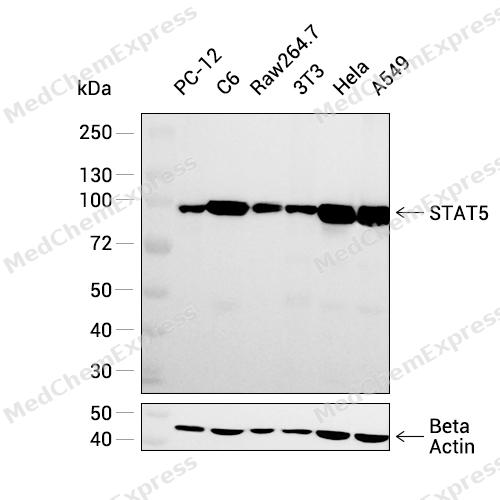 Western blot analysis was performed on extracts from PC-12 (lane 1, 20 μg), C6 (lane 2, 20 μg), RAW264.7 (lane 3, 20 μg), 3T3 (lane 4, 20 μg), HeLa (lane 5, 20 μg), and A549 (lane 6, 20 μg) using STAT5 Rabbit mAb.Proteins were transferred to a PVDF membrane and blocked with 5% non - fat milk in TBST at 4°C overnight.The primary antibody (1:1000 dilution) and the loading control antibody (beta-Actin, HY-P83730, 1:5000 dilution) were incubated in 5% non-fat milk in TBST for 1 hour at 37°C.Goat Anti - Rabbit IgG - HRP Secondary Antibody (1:20000 dilution) was then applied for 40 minutes at 37°C.
 -
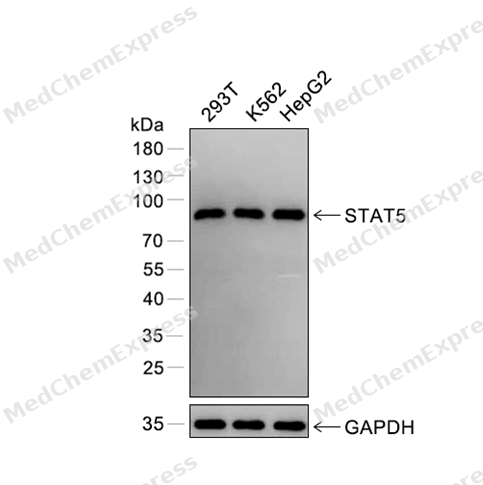 Western blot analysis of extracts from 293T (lane 1) and K562 (lane 2) and HepG2 (lane 3) using STAT5 antibody. Proteins were transferred to a PVDF membrane and blocked with 5% nonfat powdered milk in PBST for 2 hour at room temperature. The primary antibody (1/1000) and loading control antibody (GAPDH, 1/3000) was diluted with 5% nonfat powdered milk in PBST at 4°C overnight. Goat Anti-Rabbit IgG-HRP Secondary Antibody (1/8,000) was incubated for 45min at room temperature.


Background
-
Function
STAT5 comprises STAT5A and STAT5B, transcription factors that regulate hematopoietic cell proliferation, differentiation, and apoptosis[1]. Mechanistically, STAT5 tyrosine phosphorylation in peripheral T cells is driven by cytokine receptor signaling rather than the T-cell receptor complex[2]. This cytokine-linked pathway supports immune regulation, lymphocyte development, and cell survival programs[3]. In disease contexts, STAT5B deficiency is associated with growth failure, immunodeficiency, and severe pulmonary disease[4]. Compared with STAT5A, STAT5B shows dominant activity in effector and regulatory T-cell responses, with paralog dose explaining much functional specificity[5]. In BCR/ABL leukemia models, STAT5B, but not STAT5A, serves as the major STAT5 isoform driving leukemogenesis[6]. For experimental applications, AC-4-130 directly binds STAT5 and disrupts activation, dimerization, nuclear translocation, and STAT5-dependent transcription in AML models[7]. Pimozide also decreases survival of chronic myelogenous leukemia cells resistant to kinase inhibitors[8].
-
Subcellular Localization
Cytoplasm; Nucleus
-
Expression
Tissue_specificity:In adolescent females, it is present in almost all tissues except the brain and muscles. In lactating women, it is abundant in mammary gland tissue and other secretory organs (such as salivary glands and seminal vesicles) . -
Subunit
Forms a homodimer or a heterodimer with a related family member. Interacts with NCOA1 and SOCS7 (By similarity). Binds NR3C1 (PubMed:9528750). Interacts with ERBB4 (PubMed:10508857, PubMed:16837552). Interacts with EBF4 (By similarity). Interacts with CD69 (PubMed:20696842)
-
SwissProt ID
-
Synonyms
MGF; STAT5
-
Research Field
Signal Transduction
Documentation
-
Data Sheet (262 KB)
-
SDS (251 KB)
- English - EN (251 KB)
- Français - FR (251 KB)
- Deutsch - DE (251 KB)
- Norwegian - NO (251 KB)
- Español - ES (251 KB)
- Swedish - SV (251 KB)
- Italian - IT (251 KB)
- Korean - KR (251 KB)
- Portuguese - PT (251 KB)
-
User Guide for Antibodies (1077 KB)
References
[1]. Nosaka T, et al. STAT5 as a molecular regulator of proliferation, differentiation and apoptosis in hematopoietic cells. EMBO J. 1999 Sep 1;18(17):4754-65. [Content Brief]
[2]. Moriggl R, et al. Stat5 activation is uniquely associated with cytokine signaling in peripheral T cells. Immunity. 1999 Aug;11(2):225-30. [Content Brief]
[3]. Smith MR, et al. STAT5b: A master regulator of key biological pathways. Front Immunol. 2023 Jan 23;13:1025373. [Content Brief]
[4]. Nadeau K, et al. STAT5b deficiency: an unsuspected cause of growth failure, immunodeficiency, and severe pulmonary disease. J Pediatr. 2011 May;158(5):701-8. [Content Brief]
[5]. Villarino A, et al. Signal transducer and activator of transcription 5 (STAT5) paralog dose governs T cell effector and regulatory functions. Elife. 2016 Mar 21;5:e08384. [Content Brief]
[6]. Kollmann S, et al. Twins with different personalities: STAT5B-but not STAT5A-has a key role in BCR/ABL-induced leukemia. Leukemia. 2019 Jul;33(7):1583-1597. [Content Brief]
[7]. Wingelhofer B, et al. Pharmacologic inhibition of STAT5 in acute myeloid leukemia. Leukemia. 2018 May;32(5):1135-1146. [Content Brief]
[8]. Nelson EA, et al. The STAT5 inhibitor pimozide decreases survival of chronic myelogenous leukemia cells resistant to kinase inhibitors. Blood. 2011 Mar 24;117(12):3421-9. [Content Brief]

 Powered by Bioz
