



Nuclear Matrix Protein p84 Antibody (YA1437)
(Synonyms: Death domain containing protein p84N5; HPR1; hTREX84; Nuclear matrix protein p84; p84N5; THO complex 1; Tho1; Thoc1)
Based on 1 Customer Validation
Nuclear Matrix Protein p84 Antibody (YA1437) is a Rabbit-derived and non-conjugated IgG monoclonal antibody, targeting to Nuclear Matrix Protein p84.
-
Host:
Rabbit
-
Isotype:
IgG
-
Application:
WB, ICC/IF
-
Reactivity :
Human
-
Formulation:
Supplied in 50mM Tris-Glycine(pH 7.4), 0.15M NaCl, 40% Glycerol, 0.01% Sodium azide and 0.05% BSA
-
Conjugation:
Non-conjugated


To place orders, for customer services and technical support, please contact: MedChemExpress USA
Tel: 609-228-6898 E-mail: [email protected] [email protected]





Applications
| Application |
WB

WB: Western Blot
|
ICC/IF
ICC/IF: Immunocytochemistry/
Immunofluorescence |
|---|---|---|
| Dilution Ratio | 1:500-1:1000 | 1:50-1:200 |


Product Details
Nuclear Matrix Protein p84 Antibody (YA1437) is a Rabbit-derived and non-conjugated IgG monoclonal antibody, targeting to Nuclear Matrix Protein p84.
-
Host Rabbit

-
Clonality Recombinant,Monoclonal

-
Species ReactivityHuman
-
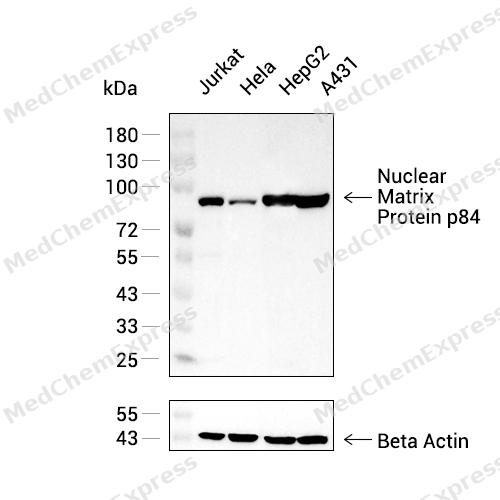
Observed Molecular WeightObserved band size: 84 kDa
Note: Due to possible protein modifications or aggregation, the molecular weight should be confirmed by actual measurement, and the predicted value is for reference only.

-
Calculated Molecular Weight Predicted band size: 76 kDa

A synthetic peptide of human Nuclear Matrix Protein p84 aa:38-49.
Endogenous
Affinity Purified
Non-conjugated
Unmodified
IgG


Product Properties
-
Appearance
Solution
-
Formulation
Supplied in 50mM Tris-Glycine(pH 7.4), 0.15M NaCl, 40% Glycerol, 0.01% Sodium azide and 0.05% BSA
-
Concentration
Batch-dependent, Please check the COA for the concentration of each lot. Check Lot Concentration
-
Storage & Stability
Stored at -20°C for 1 year. Avoid repeated freeze / thaw cycles.
-
Shipping
Shipping with blue ice.


Verification Images
-
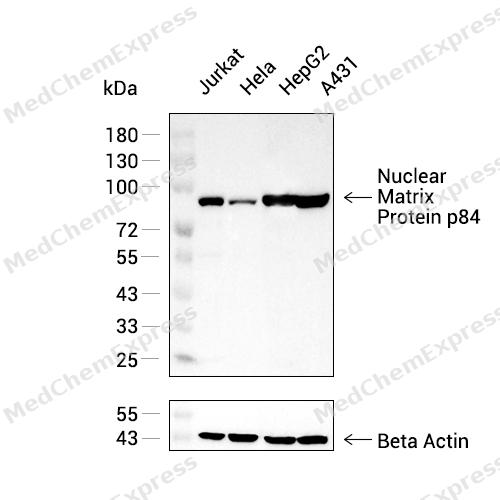 Western blot analysis was performed on extracts from Jurkat (lane 1, 20 μg), Hela (lane 2, 20 μg),HepG2 (lane 3, 20 μg), and A431 (lane 4, 20 μg) using Nuclear Matrix Protein p84 Rabbit mAb.Proteins were transferred to a PVDF membrane and blocked with 5% non - fat milk in TBST at 4°C overnight.The primary antibody (1:1000 dilution) and the loading control antibody (beta-Actin, HY-P83730, 1:5000 dilution) were incubated in 5% non-fat milk in TBST for 1 hour at 37°C.Goat Anti - Mouse/Rabbit IgG - HRP Secondary Antibody (1:20000 dilution) was then applied for 40 minutes at 37°C.
 -
 Immunocytochemistry analysis of Hela cells labeling Nuclear Matrix Protein p84 with Nuclear Matrix Protein p84 Antibody (HY-P81692) at 1/100 dilution. Cells were fixed in 4% paraformaldehyde for 15 minutes at room temperature, permeabilized with 0.1% Triton X-100 in PBS for 15 minutes at room temperature, then blocked with quick block buffer for 10 minutes at room temperature. Cells were then incubated with Nuclear Matrix Protein p84 Antibody (HY-P81692) at 1/100 dilution in quick block buffer overnight at 4 ℃. AF488-conjugated Goat Anti-Rabbit IgG H&L (HY-P8002, Green) was used as the secondary antibody at 1/1,000 dilution. PBS instead of the primary antibody was used as the secondary antibody only control. The Nuclear counterstain was DAPI (Blue).
 -
 Immunocytochemistry analysis of Hela cells labeling Nuclear Matrix Protein p84 with Nuclear Matrix Protein p84 Antibody (HY-P81692) at 1/200 dilution. Cells were fixed in 4% paraformaldehyde for 15 minutes at room temperature, permeabilized with 0.1% Triton X-100 in PBS for 15 minutes at room temperature, then blocked with quick block buffer for 10 minutes at room temperature. Cells were then incubated with Nuclear Matrix Protein p84 Antibody (HY-P81692) at 1/200 dilution in quick block buffer overnight at 4 ℃. AF488-conjugated Goat Anti-Rabbit IgG H&L (HY-P8002, Green) was used as the secondary antibody at 1/1,000 dilution. PBS instead of the primary antibody was used as the secondary antibody only control. The Nuclear counterstain was DAPI (Blue).


Background
-
Function
Nuclear Matrix Protein p84 component of the THO subcomplex of the TREX complex which is thought to couple mRNA transcription, processing and nuclear export, and which specifically associates with spliced mRNA and not with unspliced pre-mRNA. Required for efficient export of polyadenylated RNA. The THOC1-THOC2-THOC3 core complex alone is sufficient to bind export factor NXF1-NXT1 and promote ATPase activity of DDX39B/UAP56. TREX is recruited to spliced mRNAs by a transcription-independent mechanism, binds to mRNA upstream of the exon-junction complex (EJC) and is recruited in a splicing- and cap-dependent manner to a region near the 5' end of the mRNA where it functions in mRNA export to the cytoplasm via the TAP/NXF1 pathway. Regulates transcriptional elongation of a subset of genes. Involved in genome stability by preventing co-transcriptional R-loop formation. May play a role in hair cell formation, hence may be involved in hearing; Participates in an apoptotic pathway which is characterized by activation of caspase-6, increases in the expression of BAK1 and BCL2L1 and activation of NF-kappa-B. This pathway does not require p53/TP53, nor does the presence of p53/TP53 affect the efficiency of cell killing. Activates a G2/M cell cycle checkpoint prior to the onset of apoptosis. Apoptosis is inhibited by association with RB1; (Microbial infection) The TREX complex is essential for the export of Kaposi's sarcoma-associated herpesvirus (KSHV) intronless mRNAs and infectious virus production[1][2][3][4][5][6].
-
Subcellular Localization
Nucleus speckle; Nucleus, nucleoplasm; Nucleus matrix; Cytoplasm; Cytoplasm
-
Expression
Tissue_specificity:It is ubiquitous. It is expressed in a variety of cancer cell lines. Its expression level is extremely low in normal breast epithelial cells, but high in breast tumors. Its expression is closely related to the invasive phenotype of breast tumors, and is also correlated with tumor size and metastatic status.
Induction:Up-regulated during cell proliferation -
Isoforms & Post-Translational Modification
Q96FV9 has 2 isomers: Q96FV9-1: 75666 Da (predicted); Q96FV9-2: 43359 Da (predicted).
Expression is altered specifically during apoptosis and is accompanied by the appearance of novel forms with smaller apparent molecular mass;Polyubiquitinated, leading to proteasomal degradation; probably involves NEDD4 -
Subunit
Component of the THO subcomplex, which is composed of THOC1, THOC2, THOC3, THOC5, THOC6 and THOC7 (PubMed:33191911, PubMed:37020021). The THO subcomplex interacts with DDX39B to form the THO-DDX39B complex which multimerizes into a 28-subunit tetrameric assembly (PubMed:33191911, PubMed:37020021). Component of the transcription/export (TREX) complex at least composed of ALYREF/THOC4, DDX39B, SARNP/CIP29, CHTOP and the THO subcomplex; in the complex interacts with THOC2, THOC5 and THOC7 (PubMed:33191911, PubMed:37020021). TREX seems to have a dynamic structure involving ATP-dependent remodeling (PubMed:23222130, PubMed:37020021). Binds to the hypophosphorylated form of RB1. Interacts with RNA polymerase II. Interacts with LUZP4
-
SwissProt ID
-
Synonyms
Death domain containing protein p84N5; HPR1; hTREX84; Nuclear matrix protein p84; p84N5; THO complex 1; Tho1; Thoc1
-
Research Field
Tags & Cell Markers


Documentation
-
Data Sheet (261 KB)
-
SDS (252 KB)
- English - EN (252 KB)
- Français - FR (252 KB)
- Deutsch - DE (252 KB)
- Norwegian - NO (252 KB)
- Español - ES (252 KB)
- Swedish - SV (252 KB)
- Italian - IT (252 KB)
- Korean - KR (252 KB)
- Portuguese - PT (252 KB)
-
User Guide for Antibodies (1077 KB)
References
[1]. Guo S, et al. Linking transcriptional elongation and messenger RNA export to metastatic breast cancers. Cancer Res. 2005 Apr 15;65(8):3011-6. [Content Brief]
[2]. Masuda S, et al. Recruitment of the human TREX complex to mRNA during splicing. Genes Dev. 2005 Jul 1;19(13):1512-7. [Content Brief]
[3]. Cheng H, et al. Human mRNA export machinery recruited to the 5' end of mRNA. Cell. 2006 Dec 29;127(7):1389-400. [Content Brief]
[4]. Chi B, et al. Aly and THO are required for assembly of the human TREX complex and association of TREX components with the spliced mRNA. Nucleic Acids Res. 2013 Jan;41(2):1294-306. [Content Brief]
[5]. Pühringer T, et al. Structure of the human core transcription-export complex reveals a hub for multivalent interactions. Elife. 2020 Nov 16;9:. [Content Brief]
[6]. Domínguez-Sánchez MS, et al. Genome instability and transcription elongation impairment in human cells depleted of THO/TREX. PLoS Genet. 2011 Dec;7(12):e1002386. [Content Brief]

 Powered by Bioz
