



TIE1 Antibody (YA3973)
(Synonyms: TIE; JTK14)
Based on 1 Customer Validation
TIE1 Antibody (YA3973) is a Mouse-derived and non-conjugated IgG1 monoclonal antibody, targeting to TIE1.
-
Host:
Mouse
-
Isotype:
IgG
-
Application:
IHC-P, ELISA
-
Reactivity :
Human
-
Formulation:
Supplied in PBS with 0.05% sodium azide.
-
Conjugation:
Non-conjugated


To place orders, for customer services and technical support, please contact: MedChemExpress USA
Tel: 609-228-6898 E-mail: [email protected] [email protected]





Applications
| Application |
IHC-P

IHC-P: Immunohistochemistry-Paraffin
|
ELISA
ELISA: Enzyme Linked Immunosorbent Assay
|
|---|---|---|
| Dilution Ratio | 1:200-1:1000 | 1:10000 |


Product Details
TIE1 Antibody (YA3973) is a Mouse-derived and non-conjugated IgG1 monoclonal antibody, targeting to TIE1.
-
Host Mouse

-
Clonality Monoclonal

-
Species ReactivityHuman
-
Observed Molecular WeightObserved band size: 125 kDa
Note: Due to possible protein modifications or aggregation, the molecular weight should be confirmed by actual measurement, and the predicted value is for reference only.

-
Calculated Molecular Weight Predicted band size: 125 kDa

Purified recombinant fragment of human TIE1 (AA: 385-607) expressed in E. Coli.
affinity purified.
Non-conjugated
Unmodified
IgG


Product Properties
-
Appearance
Solution
-
Formulation
Supplied in PBS with 0.05% sodium azide.
-
Concentration
Batch-dependent, Please check the COA for the concentration of each lot. Check Lot Concentration
-
Storage & Stability
Stored at -20°C for 1 year. Avoid repeated freeze / thaw cycles.
-
Shipping
Shipping with blue ice.


Verification Images
-
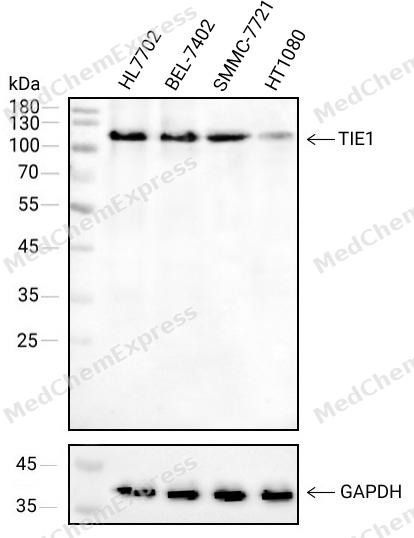 Western blot analysis of extracts from HL7702(lane 1(40μg) ),BEL-7402(lane 2(40μg) ),SMMC-7721(lane 3(40μg) )and HT1080(lane 4(40μg) ) using TIE1 antibody. Proteins were transferred to a NC membrane and blocked with 5% Skim milk in TBST for 2 hour at room temperature. The primary antibody ( 1/1000) and Loading control antibody (GAPDH,1/1000) was used in 5% Skim milk in TBST at 4°C overnight. Goat Anti-Mouse IgG-HRP Secondary Antibody (1/10,000) was used for 1 hour at room temperature.


Background
-
Function
Tie1 is an endothelial receptor tyrosine kinase required for vascular endothelial integrity and survival during blood vessel formation[1]. Mechanistically, Tie1 regulates the angiopoietin-Tie2 signaling pathway, where angiogenic endothelial cells use Tie1 to shape tip-cell behavior by reducing Tie2 surface presentation, while remodeling stalk cells use Tie1 to sustain Tie2 signaling[2]. In inflammatory vascular remodeling, Tie1 controls angiopoietin function and supports Ang1- and Ang2-dependent Tie2 activation, linking Tie1 to vessel leakage and inflammation models[3]. In tumor models, endothelial Tie1 deletion inhibits tumor angiogenesis and growth, and Tie1-mediated angiogenesis and vascular abnormalization promote tumor progression and metastasis[4][5]. Compared with the related Tie2/TEK receptor, Tie1 acts as an orphan, context-dependent regulator rather than a direct angiopoietin receptor, making Tie1-Tie2 coordination central to experimental study design[2][3]. For applications, Tie1-targeting nanobodies and function-blocking antibodies have inhibited endothelial angiogenesis, tumor cell migration, extravasation, and metastasis in preclinical systems[6][7].
-
Subcellular Localization
Cell membrane; Single-pass type I membrane protein
-
Expression
Tissue_specificity:Specifically expressed in developing vascular endothelial cells -
Isoforms & Post-Translational Modification
P35590 has 3 isomers: P35590-1: 125090 Da (predicted); P35590-2: 40616 Da (predicted); P35590-3: 34138 Da (predicted).
Phosphorylated on tyrosine residues in response to ANGPT1, most likely by TEK/TIE2 -
Subunit
Heterodimer with TEK/TIE2 (PubMed:20227369). Interacts with SVEP1 (via C-terminus) (PubMed:37097004)
-
SwissProt ID
-
Synonyms
TIE; JTK14


Documentation
References
[1]. Sato TN, et al. Distinct roles of the receptor tyrosine kinases Tie-1 and Tie-2 in blood vessel formation. Nature. 1995 Jul 6;376(6535):70-4. [Content Brief]
[2]. Savant S, et al. The Orphan Receptor Tie1 Controls Angiogenesis and Vascular Remodeling by Differentially Regulating Tie2 in Tip and Stalk Cells. Cell Rep. 2015 Sep 22;12(11):1761-73. [Content Brief]
[3]. Korhonen EA, et al. Tie1 controls angiopoietin function in vascular remodeling and inflammation. J Clin Invest. 2016 Sep 1;126(9):3495-510. [Content Brief]
[4]. D'Amico G, et al. Tie1 deletion inhibits tumor growth and improves angiopoietin antagonist therapy. J Clin Invest. 2014 Feb;124(2):824-34. [Content Brief]
[5]. La Porta S, et al. Endothelial Tie1-mediated angiogenesis and vascular abnormalization promote tumor progression and metastasis. J Clin Invest. 2018 Feb 1;128(2):834-845. [Content Brief]
[6]. Meltzer M,et al. In vitro inhibition of cancer angiogenesis and migration by a nanobody that targets the orphan receptor Tie1. Cell Mol Life Sci. 2022 May 23;79(6):312. [Content Brief]
[7]. Singhal M, et al. Preclinical validation of a novel metastasis-inhibiting Tie1 function-blocking antibody. EMBO Mol Med. 2020 Jun 8;12(6):e11164. [Content Brief]

 Powered by Bioz
