



TIM3 Antibody (YA1448)
(Synonyms: CD366 antibody; FLJ14428 antibody; HAVcr-2 antibody; Havcr2 antibody; HAVR2_HUMAN antibody; Hepatitis A virus cellular receptor 2 antibody; Kidney injury molecule 3 antibody; KIM 3 antibody; KIM3 antibody; T cell immunoglobulin and mucin domain containing 3 antibody; T cell immunoglobulin mucin 3 antibody; T-cell immunoglobulin and mucin domain-containing protein 3 antibody; T-cell immunoglobulin mucin family member 3 antibody; T-cell immunoglobulin mucin receptor 3 antibody; T-cell membrane protein 3 antibody; Tim 3 antibody; TIM-3 antibody; TIM3 antibody; TIMD-3 antibody; TIMD3 antibody; )Based on 1 publication(s) in Google Scholar
TIM3 Antibody (YA1448) is a Mouse-derived and non-conjugated IgG monoclonal antibody, targeting to TIM3.
-
Host:
Mouse
-
Isotype:
IgG
-
Application:
WB, IHC-P, ICC/IF, FC
-
Reactivity :
Human
-
Formulation:
Supplied in 1*PBS (pH7.4), 0.2% BSA, 50% Glycerol. Preservative: 0.05% Sodium Azide.
-
Conjugation:
Non-conjugated


To place orders, for customer services and technical support, please contact: MedChemExpress USA
Tel: 609-228-6898 E-mail: [email protected] [email protected]



Publications Citing Use of MedChemExpress (MCE) TIM3 Antibody (YA1448)
More

Applications
| Application |
WB

WB: Western Blot
|
ICC/IF
ICC/IF: Immunocytochemistry/
Immunofluorescence |
IHC-P
IHC-P: Immunohistochemistry-Paraffin
|
FC
FC: Flow Cytometry
|
|---|---|---|---|---|
| Dilution Ratio | 1:500-1:2000 | 1:50-1:200 | 1:1000-1:5000 | 1:50-1:100 |


Product Details
TIM3 Antibody (YA1448) is a Mouse-derived and non-conjugated IgG monoclonal antibody, targeting to TIM3.
-
Host Mouse

-
Clonality Monoclonal

-
Species ReactivityHuman
-
Observed Molecular WeightObserved band size: 42 kDa
Note: Due to possible protein modifications or aggregation, the molecular weight should be confirmed by actual measurement, and the predicted value is for reference only.

-
Calculated Molecular Weight Predicted band size: 33 kDa

Recombinant protein with Human Tim3 1-89 / 301.
Endogenous
Affinity Chromatography
Non-conjugated
Unmodified
IgG


Product Properties
-
Appearance
Solution
-
Formulation
Supplied in 1*PBS (pH7.4), 0.2% BSA, 50% Glycerol. Preservative: 0.05% Sodium Azide.
-
Concentration
Batch-dependent, Please check the COA for the concentration of each lot. Check Lot Concentration
-
Storage & Stability
Stored at -20°C for 1 year. Avoid repeated freeze / thaw cycles.
-
Shipping
Shipping with blue ice.


Publications (1)
-
Journal Impact Factor
-
Most Recent
-
J Leukoc Biol
Progenitor-predominant exhaustion in cytokine-induced killers reveals TIM-3 as a superior target for enhancing cytokine-induced killer cytotoxicity. [Abstract]2025 Dec 26;118(1):qiaf180. PMID: 41414757


Verification Images
-
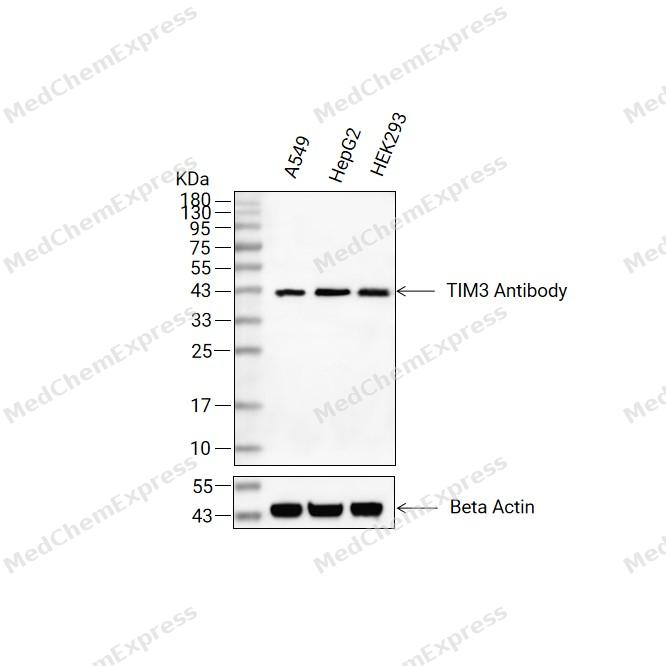 Western blot analysis of extracts from A549(lane 2(20ug) , HepG2(lane 3(20ug) and HEK293(lane 4(20ug) using TIM3 Antibody (HY-P81703) Rabbit mAb. Proteins were transferred to a PVDF membrane and blocked with 5% non-fat milk in TBST for 2 hour at room temperature. The primary antibody (1/1000) and Loading control antibody (Beta Actin, HY-P83730, 1/10000) was used in 5% non-fat milk in TBST at 4°C overnight. Goat Anti-Mouse/Rabbit IgG-HRP Secondary Antibody (1/10000) was used for 1 hour at room temperature.
 -
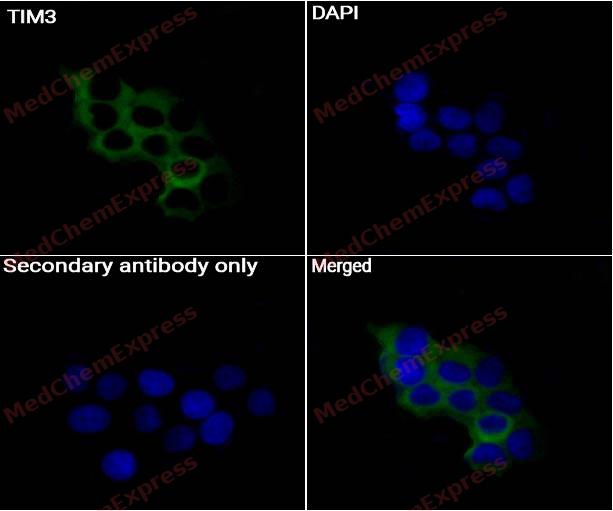 Immunocytochemistry analysis of 293T cells labeling TIM3 Antibody (HY-P81703) at 1/50 dilution. Cells were fixed in 4% paraformaldehyde for 15 minutes at room temperature, permeabilized with 0.1% Triton X-100 for 10 minutes at room temperature, then blocked with BSA for Immunol Staining for 10 min at room temperature. Cells were then incubated with TIM3 Antibody (HY-P81703) at 1/50 dilution in BSA for Immunol Staining at 4 ℃ Overnight. AF488-conjugated AffiniPure Goat Anti-Rabbit IgG H&L(HY-P8002, Green) was used as the secondary antibody at 1/1,000 dilution. PBS instead of the primary antibody was used as the secondary antibody only control. The Nuclear counterstain was DAPI (Blue).
 -
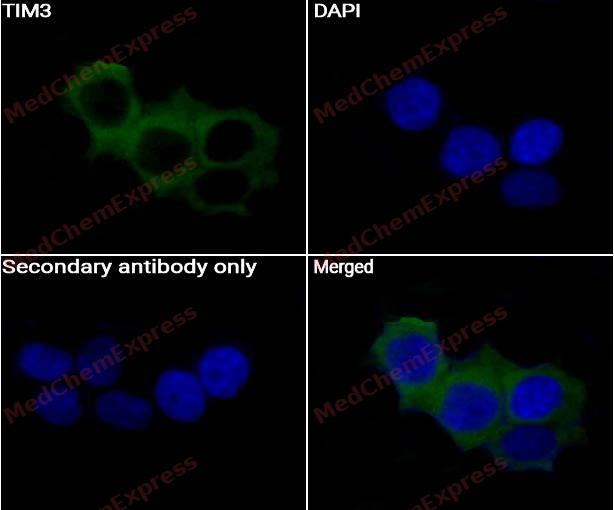 Immunocytochemistry analysis of 293T cells labeling TIM3 Antibody (HY-P81703) at 1/100 dilution. Cells were fixed in 4% paraformaldehyde for 15 minutes at room temperature, permeabilized with 0.1% Triton X-100 for 10 minutes at room temperature, then blocked with BSA for Immunol Staining for 10 min at room temperature. Cells were then incubated with TIM3 Antibody (HY-P81703) at 1/100 dilution in BSA for Immunol Staining at 4 ℃ Overnight. AF488-conjugated AffiniPure Goat Anti-Rabbit IgG H&L(HY-P8002, Green) was used as the secondary antibody at 1/1,000 dilution. PBS instead of the primary antibody was used as the secondary antibody only control. The Nuclear counterstain was DAPI (Blue).


Background
-
Function
CD366 (TIM-3) is a cell-surface receptor involved in regulating innate and adaptive immune responses. CD366 (TIM-3) regulates macrophage activation, inhibits Type 1 helper T cell (Th1)-mediated autoimmune and alloimmune responses, and promotes immune tolerance. In CD8+ cells, CD366 (TIM-3) attenuates T-cell receptor (TCR)-induced signaling, leading to reduced IL-2 secretion by blocking NF-κB and NFAT promoter activity.
-
Subcellular Localization
Cell membrane; Single-pass type I membrane protein; Cell junction; Cell membrane
-
Expression
Tissue_specificity:Expressed in T-helper type 1 (Th1) lymphocytes. Expressed on regulatory T (Treg) cells after TCR stimulation. Expressed in dendritic cells and natural killer (NK) cells. Expressed in epithelial tissues. Expression is increased on CD4+ and CD8+ T-cells in chronic hepatitis C virus (HCV) infection. In progressive HIV-1 infection, expression is up-regulated on HIV-1-specific CD8 T-cells. -
Isoforms & Post-Translational Modification
CD366 (TIM-3) has 2 isomers: Q8TDQ0-1: 33394 Da (predicted); Q8TDQ0-2: 16149 Da (predicted).
O-glycosylated with core 1 or possibly core 8 glycans;Phosphorylated on tyrosine residues; modestly increased after TCR/CD28 stimulation. Can be phosphorylated in the cytoplasmic domain by FYN (By similarity). Phosphorylation at Tyr-265 is increased by stimulation with ligand LGALS9;Palmitoylated by ZDHHC9 at Cys-296; palmitoylation stabilizes HAVCR2 by preventing binding to E3 ubiquitin ligase SYVN1, thereby suppressing its polyubiquitination and degradation;Ubiquitinated by SYVN1, leading to polyubiquitination and proteasomal degradation -
Subunit
Interacts (in basal state T-cells) with VAV1; AKT1/2, LCP2, ZAP70, SYK, PIK3R1, FYN, SH3BP2 and SH2D2A. Interacts (in activated T-cells) with LCK and PLCG.
-
SwissProt ID
-
Synonyms
CD366 antibody; FLJ14428 antibody; HAVcr-2 antibody; Havcr2 antibody; HAVR2_HUMAN antibody; Hepatitis A virus cellular receptor 2 antibody; Kidney injury molecule 3 antibody; KIM 3 antibody; KIM3 antibody; T cell immunoglobulin and mucin domain containing 3 antibody; T cell immunoglobulin mucin 3 antibody; T-cell immunoglobulin and mucin domain-containing protein 3 antibody; T-cell immunoglobulin mucin family member 3 antibody; T-cell immunoglobulin mucin receptor 3 antibody; T-cell membrane protein 3 antibody; Tim 3 antibody; TIM-3 antibody; TIM3 antibody; TIMD-3 antibody; TIMD3 antibody;
-
Research Field
Immunology
Documentation
-
Data Sheet (234 KB)
-
SDS (254 KB)
- English - EN (254 KB)
- Français - FR (254 KB)
- Deutsch - DE (254 KB)
- Norwegian - NO (254 KB)
- Español - ES (254 KB)
- Swedish - SV (254 KB)
- Italian - IT (254 KB)
- Korean - KR (254 KB)
- Portuguese - PT (254 KB)
-
User Guide for Antibodies (1077 KB)

 Powered by Bioz
