



ZAP70 Antibody (YA651)
(Synonyms: ZAP70; SRK; Tyrosine-protein kinase ZAP-70; 70 kDa zeta-chain associated protein; Syk-related tyrosine kinase)
Based on 1 Customer Validation
ZAP70 Antibody (YA651) is a Mouse-derived and non-conjugated IgG2b monoclonal antibody, targeting to ZAP70.
-
Host:
Mouse
-
Isotype:
IgG
-
Application:
WB, IP
-
Reactivity :
Human
-
Formulation:
Supplied in 1*PBS (pH 7.3), 50% glycerol and 0.5% BSA. Preservative: 0.02% sodium azide.
-
Conjugation:
Non-conjugated


To place orders, for customer services and technical support, please contact: MedChemExpress USA
Tel: 609-228-6898 E-mail: [email protected] [email protected]





Applications
| Application |
WB

WB: Western Blot
|
IP
IP: Immunoprecipitation
|
|---|---|---|
| Dilution Ratio | 1:500-1:1000 | 1:20 |


Product Details
ZAP70 Antibody (YA651) is a Mouse-derived and non-conjugated IgG2b monoclonal antibody, targeting to ZAP70.
-
Host Mouse

-
Clonality Monoclonal

-
Species ReactivityHuman
-
Observed Molecular WeightObserved band size: 70 kDa
Note: Due to possible protein modifications or aggregation, the molecular weight should be confirmed by actual measurement, and the predicted value is for reference only.

-
Calculated Molecular Weight Predicted band size: 70 kDa

Synthetic peptide corresponding to Human ZAP-70.The exact sequence is proprietary to MCE.
Endogenous
affinity purified
Non-conjugated
Unmodified
IgG


Product Properties
-
Appearance
Solution
-
Formulation
Supplied in 1*PBS (pH 7.3), 50% glycerol and 0.5% BSA. Preservative: 0.02% sodium azide.
-
Concentration
Batch-dependent, Please check the COA for the concentration of each lot. Check Lot Concentration
-
Storage & Stability
Stored at -20°C for 1 year. Avoid repeated freeze / thaw cycles.
-
Shipping
Shipping with blue ice.


Verification Images
-
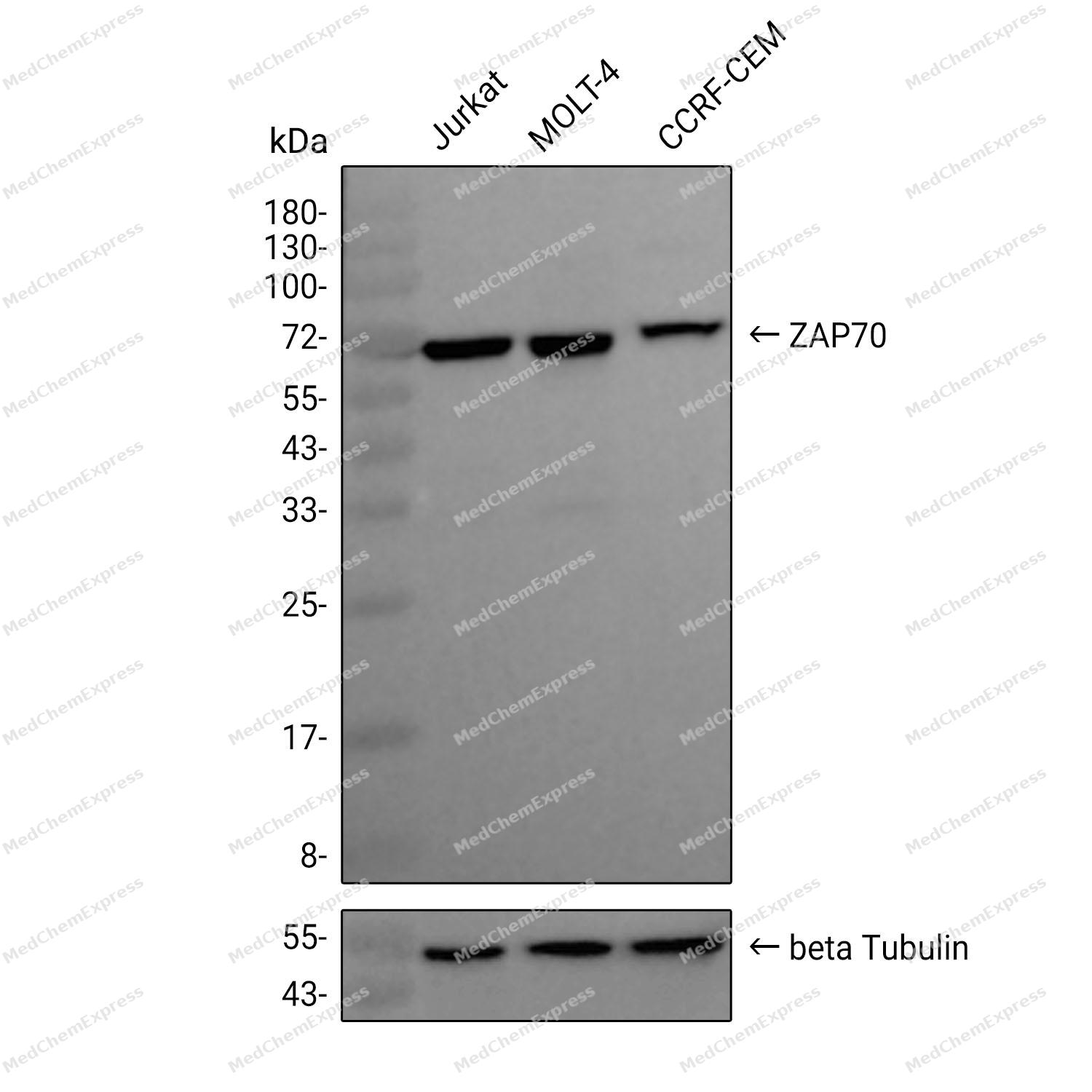 Western blot analysis was performed on extracts from Jurkat (lane 1, 15 μg), MOLT-4 (lane 2, 15 μg), and CCRF-CEM (lane 3, 15 μg) using ZAP70 Mouse mAb.Proteins were transferred to a PVDF membrane and blocked with 5% non-fat milk in TBST at 4°C overnight.The primary antibody (1:1000 dilution) and the loading control antibody (beta-Tubulin, HY-P80955, 1:5000 dilution) was incubated in 5% non-fat milk in TBST for 1 hour at 37°C.Goat Anti-Mouse IgG-HRP Secondary Antibody (1:20000 dilution) was then applied for 40 minutes at 37°C.


Background
-
Function
ZAP70 (zeta-chain-associated protein kinase 70) is a cytoplasmic protein tyrosine kinase that functions as a central signaling mediator downstream of the T-cell receptor (TCR) and is required for the initiation of antigen receptor-driven T-cell responses[1]. Mechanistically, TCR engagement leads to phosphorylation of immunoreceptor tyrosine-based activation motifs (ITAMs), recruitment of ZAP70 through its tandem SH2 domains, and subsequent phosphorylation of adaptor proteins including LAT and SLP-76, thereby propagating signaling pathways that regulate T-cell activation, differentiation, proliferation, and cytokine production[1][5]. Because of this pivotal role in adaptive immunity, ZAP70 is essential for normal thymocyte development as well as peripheral T-cell function[1][5]. In disease settings, loss-of-function mutations in ZAP70 cause a combined immunodeficiency characterized by profound defects in T-cell signaling, markedly reduced CD8+ T-cell populations, recurrent infections, and immune dysregulation[2][3]. Altered ZAP70 signaling has also been linked to autoimmune phenotypes, highlighting the requirement for tightly regulated TCR signaling thresholds during immune homeostasis[2]. Compared with the closely related kinase SYK, ZAP70 exhibits a specialized role in T-cell receptor signaling, whereas SYK displays broader expression and higher intrinsic kinase activity in multiple immune cell types[6]. For experimental research, ZAP70 serves as a widely used molecular node for dissecting TCR signal transduction networks and immune-cell activation mechanisms, and its kinase activity can be selectively inhibited by compounds such as epigallocatechin gallate (EGCG) in cellular studies[4].
-
Subcellular Localization
Cytoplasm; Cell membrane; Peripheral membrane protein
-
Expression
Tissue_specificity:It is expressed in T cells and natural killer cells. It is also present in early thymocytes and pre-B cells/pre-B cells. -
Isoforms & Post-Translational Modification
P43403 has 3 isomers: P43403-1: 69872 Da (predicted); P43403-2: 35647 Da (predicted); P43403-3: 55873 Da (predicted).
Phosphorylated on tyrosine residues upon T-cell antigen receptor (TCR) stimulation. Phosphorylation of Tyr-315 and Tyr-319 are essential for ZAP70 positive function on T-lymphocyte activation whereas Tyr-292 has a negative regulatory role. Within the C-terminal kinase domain, Tyr-492 and Tyr-493 are phosphorylated after TCR induction, Tyr-492 playing a negative regulatory role and Tyr-493 a positive. Tyr-493 is dephosphorylated by PTN22;Ubiquitinated in response to T cell activation. Deubiquitinated by OTUD7B -
Subunit
Interacts with CD247/CD3Z; this interaction docks ZAP70 at the stimulated TCR (PubMed:1423621, PubMed:26783323, PubMed:7659156). Interacts with NFAM1 (PubMed:15143214).
-
SwissProt ID
-
Synonyms
ZAP70; SRK; Tyrosine-protein kinase ZAP-70; 70 kDa zeta-chain associated protein; Syk-related tyrosine kinase
-
Research Field
Immunology


Documentation
-
Data Sheet (263 KB)
-
SDS (252 KB)
- English - EN (252 KB)
- Français - FR (252 KB)
- Deutsch - DE (252 KB)
- Norwegian - NO (252 KB)
- Español - ES (252 KB)
- Swedish - SV (252 KB)
- Italian - IT (252 KB)
- Korean - KR (252 KB)
- Portuguese - PT (252 KB)
-
User Guide for Antibodies (1077 KB)
References
[3]. Ashouri JF, et al. ZAP70, too little, too much can lead to autoimmunity. Immunol Rev. 2022 May;307(1):145-160. [Content Brief]
[4]. Sharifinejad N, et al. Clinical, Immunological, and Genetic Features in 49 Patients With ZAP-70 Deficiency: A Systematic Review. Front Immunol. 2020 May 5;11:831. [Content Brief]
[5]. Wang H, et al. ZAP-70: an essential kinase in T-cell signaling. Cold Spring Harb Perspect Biol. 2010;2(5):a002279. [Content Brief]
[6]. ZAP70 gene information from NCBI.
[7]. Wang H, et al. ZAP-70: an essential kinase in T-cell signaling. Cold Spring Harb Perspect Biol. 2010 May;2(5):a002279. [Content Brief]
[8]. Zhang W, et al. LAT: the ZAP-70 tyrosine kinase substrate that links T cell receptor to cellular activation. Cell. 1998 Jan 9;92(1):83-92. [Content Brief]
[9]. Arpaia E, et al. Defective T cell receptor signaling and CD8+ thymic selection in humans lacking zap-70 kinase. Cell. 1994 Mar 11;76(5):947-58. [Content Brief]
[10]. Wiestner A, et al. ZAP-70 expression identifies a chronic lymphocytic leukemia subtype with unmutated immunoglobulin genes, inferior clinical outcome, and distinct gene expression profile. Blood. 2003 Jun 15;101(12):4944-51. [Content Brief]
[11]. Noraz N, et al. Alternative antigen receptor (TCR) signaling in T cells derived from ZAP-70-deficient patients expressing high levels of Syk. J Biol Chem. 2000 May 26;275(21):15832-8. [Content Brief]
[12]. Visperas PR, et al. Identification of Inhibitors of the Association of ZAP-70 with the T Cell Receptor by High-Throughput Screen. SLAS Discov. 2017 Mar;22(3):324-331. [Content Brief]

 Powered by Bioz
