
Antitumor agent-130
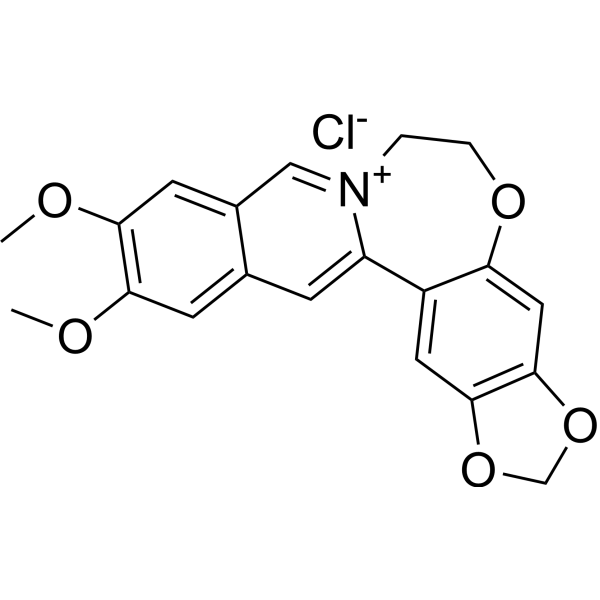
Antitumor agent-130 (Compound 7b) is a p300 histone acetyltransferases (HAT) inhibitor with an IC50 of 1.51 μM. Antitumor agent-130 combinates with doxorubicin (HY-15142A) can significantly inhibit tumor growth and invasion in vitro and in vivo.
Para uso exclusivo en investigación. No vendemos a pacientes.
- No. CAS: 3048422-07-4
- Fòrmula: C20H18ClNO5
- Peso molecular:387.81
-
Almacenamiento:
Please store the product under the recommended conditions in the Certificate of Analysis.
Actividad biológica
Descripciòn
Cellular Effect
|
Cell Line
|
Type | Value | Description | References |
|---|---|---|---|---|
| LNCaP | IC50 |
43.745 μM
Compound: 7b
|
Antiproliferative activity against human LNCaP cells assessed as inhibition of cell growth incubated for 48 hrs by MTT assay
|
[PMID: 38215590] |
| MCF-10A | IC50 |
>50 μM
Compound: 7b
|
Antiproliferative activity against human MCF-10A cells assessed as inhibition of cell growth incubated for 48 hrs by MTT assay
|
[PMID: 38215590] |
| MCF7 | IC50 |
17.34 μM
Compound: 7b
|
Antiproliferative activity against human MCF7 cells assessed as inhibition of cell growth incubated for 48 hrs by MTT assay
|
[PMID: 38215590] |
| MCF7 | IC50 |
17.34 μM
Compound: 7b
|
Antiproliferative activity against human MCF7 cells assessed as inhibition of cell proliferation incubated for 48 hrs by MTT assay
|
[PMID: 38215590] |
| PANC-1 | IC50 |
>50 μM
Compound: 7b
|
Antiproliferative activity against human PANC-1 cells assessed as inhibition of cell growth incubated for 48 hrs by MTT assay
|
[PMID: 38215590] |
Chemical Information
-
No. CAS 3048422-07-4
-
Peso molecular 387.81
-
Fòrmula C20H18ClNO5
-
SMILES
COC1=C(OC)C=C(C=C(C2=CC(OCO3)=C3C=C2OCC4)[N+]4=C5)C5=C1.[Cl-]
-
Envío
Room temperature in continental US; may vary elsewhere.
-
Almacenamiento
Please store the product under the recommended conditions in the Certificate of Analysis.
Protocolo
-
Cell Cytotoxicity Assay
Cytotoxicity assays are usually based on the assessment of cell membrane damage, which can also be indirectly detected by measuring cell viability. Detection methods include MTT assay, CKK-8 assay, LDH assay and ATP assay, etc.
-
Patient-Derived Xenograft (PDX)
Patient-derived xenograft (PDX) models are generated by engrafting primary human tumor tissue directly into immunodeficient mice, allowing in vivo propagation of patient tumor biology without initial in vitro adaptation. These models are used to preserve key histopathological and molecular characteristics of the original tumor and enable assessment of tumor growth dynamics and therapeutic response in a living organism. The biological readout is tumor engraftment and subsequent growth in the murine host, which reflects the ability of human tumor cells to survive, vascularize, and expand in an immunocompromised microenvironment.
-
Patient-Derived Orthotopic Xenograft (PDOX)
Patient-derived orthotopic xenograft (PDOX) modeling implants fresh patient tumor tissue or patient-derived tumor cells into the anatomically corresponding organ or tissue site of immunodeficient mice, usually by surgical orthotopic implantation, to preserve patient tumor histology, local microenvironmental context, invasion, metastatic behavior, and treatment-response features better than subcutaneous implantation. PDOX readouts include tumor engraftment, orthotopic tumor growth, local invasion, metastasis, recurrence after resection, histologic similarity to the donor tumor, biomarker retention, molecular concordance, survival, and response or resistance to therapy. PDOX models are used for preclinical drug testing and individualized therapy evaluation, but engraftment success varies by tumor type and specimen quality.
-
Cell invasion
Cell invasion is the ability of cells to migrate from one area to another via the extracellular matrix. Cell invasion is the response of normal and cancer cells to chemical and mechanical stimuli. Before migrating to a new region, the extracellular matrix is degraded by proteases within the cell. Cell invasion often occurs during wound repair, vascularization and inflammation, abnormal tissue invasion, and tumor cell metastasis.
-
Subcutaneous Cell-Line-Derived Xenograft
Subcutaneous cell-line-derived xenograft (CDX) models are established by implanting cultured human cancer cell lines into immunodeficient mice, where the injected cells form localized tumors that can be monitored in vivo as a measure of tumorigenic potential, growth kinetics, and treatment response. These models are widely used in oncology research because they allow reproducible tumor formation and enable comparative assessment of tumor growth between different cell lines or genetic manipulations in a controlled in vivo microenvironment. Subcutaneous implantation of cancer cells in immunodeficient mice is a standard approach for evaluating tumor growth behavior and therapeutic response across multiple cancer types, including prostate, esophageal, pancreatic, and colon cancer models.
-
Orthotopic Cell-Line Xenograft
Orthotopic cell-line xenograft models involve implantation of human cancer cell lines into the anatomically corresponding organ of immunodeficient mice to reproduce tumor growth within a native microenvironment, enabling more clinically relevant tumor behavior compared with subcutaneous models. These models are widely used because orthotopic placement better recapitulates tumor progression, including invasion and metastatic spread, which are often underrepresented in heterotopic implantation systems. Compared with conventional xenografts, orthotopic implantation is described as more technically complex but provides improved simulation of tumor-microenvironment interactions and metastatic behavior, making it particularly valuable for translational oncology research. Surgical orthotopic implantation approaches have been emphasized as enabling faithful reproduction of clinical cancer features, including metastasis and disease progression patterns that align with the tumor’s organ of origi
Pureza y Documentación
Referencias
Calculators
Concentration (start) × Volume (start) = Concentration (final) × Volume (final)

