



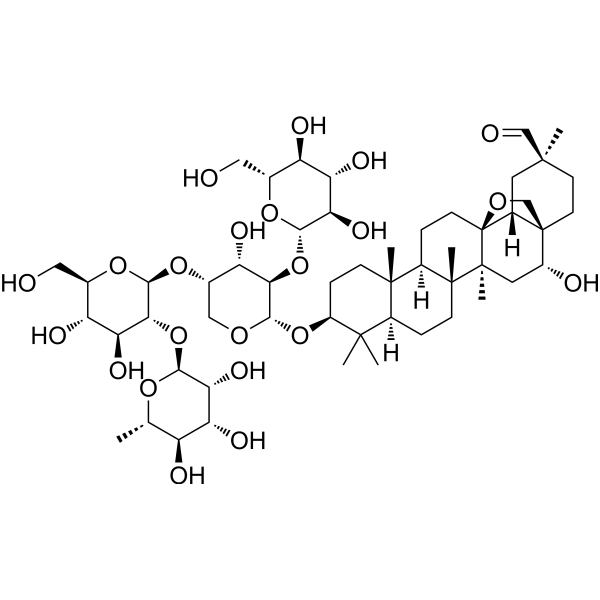
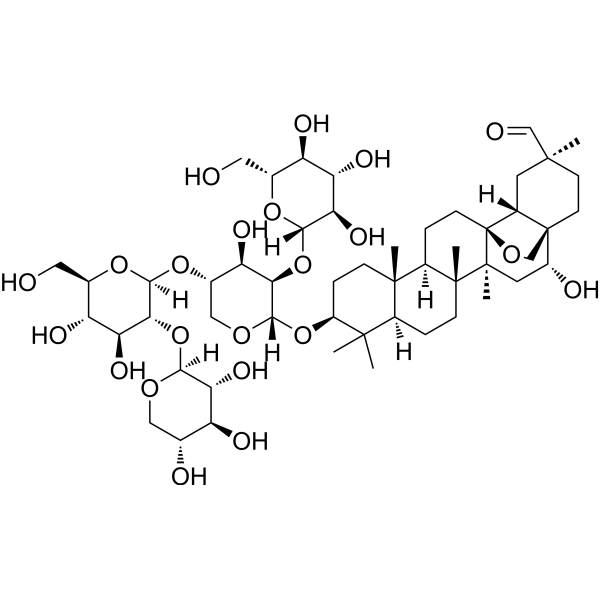
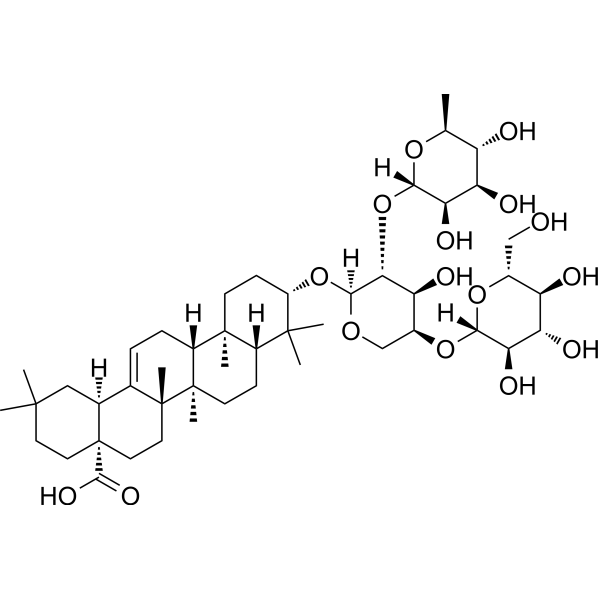
Ardisiacrispin B

Based on 1 Customer Validation
Ardisiacrispin B displays cytotoxic effects in multi-factorial agent resistant cancer cells via ferroptotic and apoptotic cell death.
For research use only. We do not sell to patients.
- Purity : 99.94%
- CAS No.: 112766-96-8
- Formula: C53H86O22
- Molecular Weight:1075.24
-
Storage:
4°C, sealed storage, away from moisture and light
* In solvent : -80°C, 6 months; -20°C, 1 month (sealed storage, away from moisture and light)

To place orders, for customer services and technical support, please contact: MedChemExpress USA
Tel: 609-228-6898 E-mail: [email protected] [email protected]


-
 Biological Activity
-
Chemical Information
-
Solvent & Solubility
- Protocols
- Purity & Documentation
- References
-
 Help & FAQs




Biological Activity
Description
Cellular Effect
|
Cell Line

|
Type | Value | Description | References |
|---|---|---|---|---|
| A549 | IC50 |
3.6 μM
Compound: 10, ardisiacrispin B
|
Cytotoxicity against human A549 cell line by MTT assay
Cytotoxicity against human A549 cell line by MTT assay
|
[PMID: 17243725] |
| Bel-7402 | IC50 |
4.46 mM
Compound: 9
|
Cytotoxicity against human Bel7402 cells after 72 hrs by MTT assay
Cytotoxicity against human Bel7402 cells after 72 hrs by MTT assay
|
[PMID: 22940450] |
| HepG2 | IC50 |
1.53 μM
Compound: 12
|
Cytotoxic activity against human HepG2 cells assessed as inhibition of cell growth incubated for 48 hrs by SRB method
Cytotoxic activity against human HepG2 cells assessed as inhibition of cell growth incubated for 48 hrs by SRB method
|
[PMID: 26077495] |
| HepG2 | IC50 |
20.96 mM
Compound: 9
|
Cytotoxicity against human HepG2 cells after 72 hrs by MTT assay
Cytotoxicity against human HepG2 cells after 72 hrs by MTT assay
|
[PMID: 22940450] |
| HL-60 | IC50 |
22.58 μM
Compound: 12
|
Cytotoxic activity against human HL60 cells assessed as inhibition of cell growth incubated for 48 hrs by SRB method
Cytotoxic activity against human HL60 cells assessed as inhibition of cell growth incubated for 48 hrs by SRB method
|
[PMID: 26077495] |
| HL-60 | IC50 |
3.2 μM
Compound: 10, ardisiacrispin B
|
Cytotoxicity against human HL60 cell line by MTT assay
Cytotoxicity against human HL60 cell line by MTT assay
|
[PMID: 17243725] |
| KB | IC50 |
1.6 μM
Compound: 12
|
Cytotoxic activity against human KB cells assessed as inhibition of cell growth incubated for 48 hrs by SRB method
Cytotoxic activity against human KB cells assessed as inhibition of cell growth incubated for 48 hrs by SRB method
|
[PMID: 26077495] |
| L02 | IC50 |
>100 mM
Compound: 9
|
Cytotoxicity against human HL-7702 cells after 72 hrs by MTT assay
Cytotoxicity against human HL-7702 cells after 72 hrs by MTT assay
|
[PMID: 22940450] |
| LNCaP | IC50 |
9.7 μM
Compound: 12
|
Cytotoxic activity against human LNCAP cells assessed as inhibition of cell growth incubated for 48 hrs by SRB method
Cytotoxic activity against human LNCAP cells assessed as inhibition of cell growth incubated for 48 hrs by SRB method
|
[PMID: 26077495] |
| Lu1 | IC50 |
1.41 μM
Compound: 12
|
Cytotoxic activity against human Lu1 cells assessed as inhibition of cell growth incubated for 48 hrs by SRB method
Cytotoxic activity against human Lu1 cells assessed as inhibition of cell growth incubated for 48 hrs by SRB method
|
[PMID: 26077495] |
| MDA-MB-231 | IC50 |
11.76 μM
Compound: 12
|
Cytotoxic activity against human MDA-MB-231 cells assessed as inhibition of cell growth incubated for 48 hrs by SRB method
Cytotoxic activity against human MDA-MB-231 cells assessed as inhibition of cell growth incubated for 48 hrs by SRB method
|
[PMID: 26077495] |
| MKN-7 | IC50 |
1.27 μM
Compound: 12
|
Cytotoxic activity against human MKN7 cells assessed as inhibition of cell growth incubated for 48 hrs by SRB method
Cytotoxic activity against human MKN7 cells assessed as inhibition of cell growth incubated for 48 hrs by SRB method
|
[PMID: 26077495] |
| SW480 | IC50 |
1.24 μM
Compound: 12
|
Cytotoxic activity against human SW480 cells assessed as inhibition of cell growth incubated for 48 hrs by SRB method
Cytotoxic activity against human SW480 cells assessed as inhibition of cell growth incubated for 48 hrs by SRB method
|
[PMID: 26077495] |


Chemical Information
-
CAS No. 112766-96-8
-
Appearance Solid
-
Molecular Weight 1075.24
-
Formula C53H86O22
-
Color White to off-white
-
SMILES
C[C@]12[C@]3(CC[C@@]4([H])[C@]2(CC[C@]5([H])[C@@]4(CC[C@@H](C5(C)C)O[C@H]6[C@@H]([C@H]([C@H](CO6)O[C@H]7[C@@H]([C@H]([C@@H]([C@H](O7)CO)O)O)O[C@H]8[C@@H]([C@@H]([C@H]([C@@H](O8)C)O)O)O)O)O[C@@H]9O[C@@H]([C@H]([C@@H]([C@H]9O)O)O)CO)C)C)[C@@]%10([H])[C@@]([C@@H](C1)O)(CC[C@@](C)(C%10)C=O)CO3
-
Structure Classification
-
Initial Source
-
Shipping
Room temperature in continental US; may vary elsewhere.
-
Storage
4°C, sealed storage, away from moisture and light
* In solvent : -80°C, 6 months; -20°C, 1 month (sealed storage, away from moisture and light)


Solvent & Solubility
In Vitro:
DMSO : 100 mg/mL (93.00 mM; Need ultrasonic; Hygroscopic DMSO has a significant impact on the solubility of product, please use newly opened DMSO)
Please refer to the solubility information to select the appropriate solvent. Once prepared, please aliquot and store the solution to prevent product inactivation from repeated freeze-thaw cycles.
Storage method and period of stock solution: -80°C, 6 months; -20°C, 1 month (sealed storage, away from moisture and light). When stored at -80°C, please use it within 6 months. When stored at -20°C, please use it within 1 month.
Please refer to the solubility information to select the appropriate solvent. Once prepared, please aliquot and store the solution to prevent product inactivation from repeated freeze-thaw cycles.
Storage method and period of stock solution: -80°C, 6 months; -20°C, 1 month (sealed storage, away from moisture and light). When stored at -80°C, please use it within 6 months. When stored at -20°C, please use it within 1 month.
Concentration (start) × Volume (start) = Concentration (final) × Volume (final)

Protocols
-
Apoptosis
Apoptosis, also called programmed cell death, is generally characterized by distinct morphological characteristics.
-
Cell Cytotoxicity Assay
Cytotoxicity assays are usually based on the assessment of cell membrane damage, which can also be indirectly detected by measuring cell viability. Detection methods include MTT assay, CKK-8 assay, LDH assay and ATP assay, etc.
-
Mammalian live/dead viability and cytotoxicity staining
Live/dead viability and cytotoxicity staining assays are based on the simultaneous detection of intracellular esterase activity in metabolically active (viable) cells and membrane integrity loss in non-viable cells. In commonly used dual-staining approaches, membrane-permeant fluorogenic substrates are converted by intracellular esterases into fluorescent products in live cells, while impermeant DNA-binding dyes selectively enter cells with compromised plasma membranes and label nucleic acids in dead or dying cells, enabling discrimination between viable and non-viable populations by fluorescence microscopy or flow cytometry.
-
Apoptosis Solutions
Apoptosis is a regulated, generally non-lytic cell-death pathway that removes unwanted, damaged, infected, or abnormal cells through coordinated morphological changes, caspase activation, DNA fragmentation, and membrane remodeling. The intrinsic apoptosis pathway is controlled mainly by mitochondrial outer membrane permeabilization, BCL-2 family proteins, cytochrome c release, apoptosome formation, caspase-9 activation, and downstream executioner caspase-3/7 activation. The extrinsic apoptosis pathway is initiated by death receptors such as Fas, TNFR, and TRAIL receptors, which recruit adaptor proteins and activate caspase-8 before engaging executioner caspases or mitochondrial amplification through BID cleavage. Apoptosis is linked to many phenotypes, including cancer cell killing, tissue homeostasis, immune regulation, neurodegeneration, infection response, and treatment-induced cytotoxicity; unresolved questions include how apoptosis interacts with necroptosis, pyroptosis, ferroptos
-
Ferroptosis Solutions
Ferroptosis is an iron-dependent, non-apoptotic form of regulated cell death characterized by lethal lipid peroxidation and sensitivity to suppression by iron chelators or lipophilic radical-trapping antioxidants. The core pathway links cystine uptake through system Xc−, glutathione availability, GPX4-dependent detoxification of phospholipid hydroperoxides, iron-dependent oxidative reactions, and polyunsaturated-phospholipid metabolism into a cell-death program that is biochemically and morphologically distinct from apoptosis, necrosis, and autophagy. The ferroptosis pathway is experimentally linked to phenotype through chemical and genetic perturbation. Erastin induces ferroptosis by inhibiting cystine uptake through system Xc− and weakening antioxidant defenses, while GPX4 inhibition or depletion causes lipid peroxide accumulation and ferroptotic cancer-cell death. ACSL4 and oxidizable arachidonoyl- or adrenoyl-containing phosphatidylethanolamines shape ferroptosis sensitivity by con
-
Cell Viability Determination by MTT Colorimetric Assay
The following protocol uses the MTT colorimetric assay as a classic literature-established method for assessing cell viability/metabolic activity in cultured mammalian cells. MTT[3-(4,5-dimethylthiazol-2-yl)-2,5-diphenyltetrazolium bromide] is reduced by metabolically active cells to a colored formazan product; the amount of formazan is quantified spectrophotometrically and provides an indirect measure of metabolically active viable cells. Importantly, MTT reduction reflects cellular oxidoreductase/metabolic activity rather than an absolute direct count of living cells, so changes in cellular metabolism can alter the signal independently of cell number.


Purity & Documentation
-
Data Sheet (274 KB)
-
SDS (252 KB)
- English - EN (252 KB)
- Français - FR (252 KB)
- Deutsch - DE (252 KB)
- Norwegian - NO (252 KB)
- Español - ES (252 KB)
- Swedish - SV (252 KB)
- Italian - IT (252 KB)
- Korean - KR (252 KB)
- Portuguese - PT (252 KB)
-
Handling Instructions (2659 KB)
References


Complete Stock Solution Preparation Table
Please refer to the solubility information to select the appropriate solvent. Once prepared, please aliquot and store the solution to prevent product inactivation from repeated freeze-thaw cycles.
Storage method and period of stock solution: -80°C, 6 months; -20°C, 1 month (sealed storage, away from moisture and light). When stored at -80°C, please use it within 6 months. When stored at -20°C, please use it within 1 month.
| Optional Solvent | Concentration Solvent Mass | 1 mg | 5 mg | 10 mg | 25 mg |
|---|---|---|---|---|---|
| DMSO | 1 mM | 0.9300 mL | 4.6501 mL | 9.3002 mL | 23.2506 mL |
| 5 mM | 0.1860 mL | 0.9300 mL | 1.8600 mL | 4.6501 mL | |
| 10 mM | 0.0930 mL | 0.4650 mL | 0.9300 mL | 2.3251 mL | |
| 15 mM | 0.0620 mL | 0.3100 mL | 0.6200 mL | 1.5500 mL | |
| 20 mM | 0.0465 mL | 0.2325 mL | 0.4650 mL | 1.1625 mL | |
| 25 mM | 0.0372 mL | 0.1860 mL | 0.3720 mL | 0.9300 mL | |
| 30 mM | 0.0310 mL | 0.1550 mL | 0.3100 mL | 0.7750 mL | |
| 40 mM | 0.0233 mL | 0.1163 mL | 0.2325 mL | 0.5813 mL | |
| 50 mM | 0.0186 mL | 0.0930 mL | 0.1860 mL | 0.4650 mL | |
| 60 mM | 0.0155 mL | 0.0775 mL | 0.1550 mL | 0.3875 mL | |
| 80 mM | 0.0116 mL | 0.0581 mL | 0.1163 mL | 0.2906 mL |


Ardisiacrispin B Related Classifications
HY-N8198 Related Classifications
 Powered by Bioz