



Propentofylline

Based on 1 Customer Validation
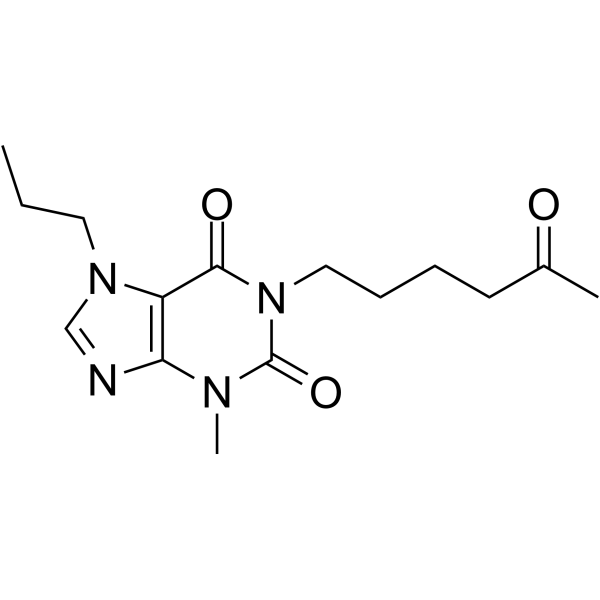
Propentofylline (HWA 285) is an orally active and brain-penetrant phosphodiesterase inhibitor. Propentofylline blocks adenosine reuptake and prevents cyclic nucleotide degradation. Propentofylline can be used for the research of primary degenerative (Alzheimer's) dementia, vascular dementia, cerebral ischemia, acute stroke, and learning and memory disorders.
For research use only. We do not sell to patients.
- Purity : 99.88%
- CAS No.: 55242-55-2
- Formula: C15H22N4O3
- Molecular Weight:306.36
-
Storage:Powder -20°C, 3 years , 4°C, 2 years ; In solvent -80°C, 6 months , -20°C, 1 month

To place orders, for customer services and technical support, please contact: MedChemExpress USA
Tel: 609-228-6898 E-mail: [email protected] [email protected]


-
 Biological Activity
-
Chemical Information
-
Solvent & Solubility
- Protocols
- Purity & Documentation
- References
-
 Help & FAQs



All Adenosine Receptor Isoforms
More

Biological Activity
Description
In Vitro
Propentofylline (50 μM) significantly reduces Concanavalin A (HY-P2149)-stimulated reactive oxygen intermediate release from rat peritoneal macrophages and rat microglial cells[1].
Propentofylline dose-dependently inhibits proliferation of cultured neonatal rat brain microglial cells[1].
Propentofylline (0.1-3 mM) increases nerve growth factor synthesis and secretion by cultured mouse astroglial cells by more than 10-fold relative to controls[1].
Propentofylline significantly reduces the release of proinflammatory cytokines from activated human blood mononuclear cells and activated microglial cells[1].
Propentofylline completely inhibits adenosine transport via the es nucleoside transport system in cultured mouse leukemic L1210/B23.1 cells with an IC50 of 9 μM[2].
Propentofylline completely inhibits adenosine transport via the ei nucleoside transport system in cultured mouse leukemic L1210/C2 cells and rat carcinosarcoma Walker 256 cells with an IC50 of 170 μM[2].
Propentofylline completely inhibits adenosine transport via the N1 (cif) nucleoside transport system in cultured mouse leukemic L1210/MA27.1 cells with an IC50 of 6 mM[2].
Propentofylline (10 μM - 1 mM) inhibits [3H] Nitrobenzylthioinosine (HY-W010936) binding to nucleoside transporters in heart and brain tissue[2].
MedChemExpress (MCE) has not independently confirmed the accuracy of these methods. They are for reference only.
In Vivo
Propentofylline (40 mg/kg/day; p.o.; 4 weeks) does not alter adenosine receptor or es nucleoside transporter binding densities in the brains of normal gerbils[2].
Propentofylline (25 mg/kg; p.o.; daily; 15 days) significantly improves impaired active avoidance learning in aged male SHR rats, without altering blood pressure[3].
Propentofylline (25 mg/kg; p.o.; daily; 14 days) does not alter intact active avoidance learning in aged male WKY rats, and does not affect blood pressure[3].
Propentofylline (3.8-30 mg/kg; i.p.; single dose) significantly improves Cycloheximide (HY-12320)-induced amnesia in male ICR mice, with a dose-related effect[3].
Propentofylline (15-30 mg/kg; i.p.; single dose) significantly prevents Cycloheximide-induced amnesia in male ICR mice[3].
Propentofylline (30 mg/kg; i.p.; single dose) does not alter step-down latency in naive male ICR mice[3].
MedChemExpress (MCE) has not independently confirmed the accuracy of these methods. They are for reference only.
-
Animal Model:Mongolian gerbils[2]
-
Dosage:10 mg/kg
-
Administration:i.p.; daily; 14 days
-
Result:Enhanced survival of CA1 pyramidal neurons in the hippocampus following ischemic injury.
Reduced necrosis of ischemic hippocampal pyramidal cells and inhibited post-ischemic increase of glial fibrillary acidic protein associated with reactive gliosis.
Reduced ischemia-induced neuronal damage and Ca2+ accumulation in the brain.
-
Animal Model:Mongolian gerbils[2]
-
Dosage:40 mg/kg/day
-
Administration:p.o.; 4 weeks
-
Result:No changes in binding densities of adenosine A1 receptors (measured via [3H] cyclohexyladenosine), A2a receptors (measured via [3H] CGS 21680), or es nucleoside transporters (measured via [3H] nitrobenzylthioinosine) in brain tissue.
-
Animal Model:SHR (12-month-old male, spontaneously hypertensive)[3]
-
Dosage:25 mg/kg
-
Administration:p.o.; daily; 15 days
-
Result:Showed significantly higher numbers of correct avoidance responses than controls at the 10th, 12th, 13th, 14th, and 15th training sessions.
Demonstrated no significant difference in blood pressure compared to control rats after the study.
-
Animal Model:Wistar-Kyoto (WKY) (12-month-old male)[3]
-
Dosage:25 mg/kg
-
Administration:p.o.; daily; 14 days
-
Result:Did not affect the number of correct avoidance responses, which increased similarly in treated and control groups from the 6th to 14th sessions.
Demonstrated no significant difference in blood pressure compared to control rats after the study.
-
Animal Model:ICR (6-week-old male, 30-40 g, cycloheximide-induced amnesia)[3]
-
Dosage:3.8 mg/kg; 7.5 mg/kg; 15 mg/kg; 30 mg/kg
-
Administration:i.p.; single dose
-
Result:Produced a 10.0% retention rate at 3.8 mg/kg, which did not significantly improve retention compared to the Cycloheximide plus saline group (10.5% retention rate).
Produced a 31.0% retention rate at 7.5 mg/kg, which significantly improved retention compared to the Cycloheximide plus saline group.
Produced a 33.3% retention rate at 15 mg/kg, which significantly improved retention compared to the Cycloheximide plus saline group.
Produced a 40.0% retention rate at 30 mg/kg, which significantly improved retention compared to the Cycloheximide plus saline group.
-
Animal Model:ICR (6-week-old male, 30-40 g, cycloheximide-induced amnesia)[3]
-
Dosage:15 mg/kg; 30 mg/kg
-
Administration:i.p.; single dose
-
Result:Produced a 35.1% retention rate at 15 mg/kg, which significantly improved retention compared to the saline plus Cycloheximide group (12.5% retention rate).
Produced a 37.1% retention rate at 30 mg/kg, which significantly improved retention compared to the saline plus Cycloheximide group.
-
Animal Model:ICR (6-week-old male, 30-40 g)[3]
-
Dosage:30 mg/kg
-
Administration:i.p.; single dose
-
Result:Demonstrated a mean step-down latency of 7.6 sec, which did not significantly differ from the untreated control latency of 11.8 sec.


Chemical Information
-
CAS No. 55242-55-2
-
Appearance Solid
-
Molecular Weight 306.36
-
Formula C15H22N4O3
-
Color White to off-white
-
SMILES
O=C1C2=C(N(C)C(N1CCCCC(C)=O)=O)N=CN2CCC
-
Synonyms
HWA 285
-
Shipping
Room temperature in continental US; may vary elsewhere.
-
Storage
Powder -20°C 3 years 4°C 2 years In solvent -80°C 6 months -20°C 1 month


Solvent & Solubility
In Vitro:
DMSO : 100 mg/mL (326.41 mM; Need ultrasonic; Hygroscopic DMSO has a significant impact on the solubility of product, please use newly opened DMSO)
H2O : 12.5 mg/mL (40.80 mM; Need ultrasonic)
Please refer to the solubility information to select the appropriate solvent. Once prepared, please aliquot and store the solution to prevent product inactivation from repeated freeze-thaw cycles.
Storage method and period of stock solution: -80°C, 6 months; -20°C, 1 month. When stored at -80°C, please use it within 6 months. When stored at -20°C, please use it within 1 month.
* Note: If you choose water as the stock solution, please dilute it to the working solution, then filter and sterilize it with a 0.22 μm filter before use.
Please refer to the solubility information to select the appropriate solvent. Once prepared, please aliquot and store the solution to prevent product inactivation from repeated freeze-thaw cycles.
Storage method and period of stock solution: -80°C, 6 months; -20°C, 1 month. When stored at -80°C, please use it within 6 months. When stored at -20°C, please use it within 1 month.
* Note: If you choose water as the stock solution, please dilute it to the working solution, then filter and sterilize it with a 0.22 μm filter before use.
Concentration (start) × Volume (start) = Concentration (final) × Volume (final)


Purity & Documentation
-
Data Sheet (281 KB)
-
SDS (393 KB)
- English - EN (393 KB)
- Français - FR (393 KB)
- Deutsch - DE (393 KB)
- Norwegian - NO (393 KB)
- Español - ES (393 KB)
- Swedish - SV (393 KB)
- Italian - IT (393 KB)
- Korean - KR (393 KB)
- Portuguese - PT (393 KB)
-
Handling Instructions (2659 KB)
References
[1]. Noble S, et al. Propentofylline. CNS Drugs. 1997 Sep;8(3):257-264.
[2]. Parkinson FE, et al. Propentofylline: a nucleoside transport inhibitor with neuroprotective effects in cerebral ischemia. Gen Pharmacol. 1994 Oct;25(6):1053-8. [Content Brief]
[3]. Goto M, et al. Effects of propentofylline on disorder of learning and memory in rodents. Jpn J Pharmacol. 1987 Nov;45(3):373-8. [Content Brief]
[4]. Rother M, et al. Propentofylline in the treatment of Alzheimer's disease and vascular dementia: a review of phase III trials. Dement Geriatr Cogn Disord. 1998;9 Suppl 1:36-43. [Content Brief]


Complete Stock Solution Preparation Table
Please refer to the solubility information to select the appropriate solvent. Once prepared, please aliquot and store the solution to prevent product inactivation from repeated freeze-thaw cycles.
Storage method and period of stock solution: -80°C, 6 months; -20°C, 1 month. When stored at -80°C, please use it within 6 months. When stored at -20°C, please use it within 1 month.
| Optional Solvent | Concentration Solvent Mass | 1 mg | 5 mg | 10 mg | 25 mg |
|---|---|---|---|---|---|
| H2O / DMSO | 1 mM | 3.2641 mL | 16.3207 mL | 32.6413 mL | 81.6033 mL |
| 5 mM | 0.6528 mL | 3.2641 mL | 6.5283 mL | 16.3207 mL | |
| 10 mM | 0.3264 mL | 1.6321 mL | 3.2641 mL | 8.1603 mL | |
| 15 mM | 0.2176 mL | 1.0880 mL | 2.1761 mL | 5.4402 mL | |
| 20 mM | 0.1632 mL | 0.8160 mL | 1.6321 mL | 4.0802 mL | |
| 25 mM | 0.1306 mL | 0.6528 mL | 1.3057 mL | 3.2641 mL | |
| 30 mM | 0.1088 mL | 0.5440 mL | 1.0880 mL | 2.7201 mL | |
| 40 mM | 0.0816 mL | 0.4080 mL | 0.8160 mL | 2.0401 mL | |
| DMSO | 50 mM | 0.0653 mL | 0.3264 mL | 0.6528 mL | 1.6321 mL |
| 60 mM | 0.0544 mL | 0.2720 mL | 0.5440 mL | 1.3601 mL | |
| 80 mM | 0.0408 mL | 0.2040 mL | 0.4080 mL | 1.0200 mL | |
| 100 mM | 0.0326 mL | 0.1632 mL | 0.3264 mL | 0.8160 mL |
* Note: If you choose water as the stock solution, please dilute it to the working solution, then filter and sterilize it with a 0.22 μm filter before use.


Propentofylline Related Classifications
HY-107203 Related Classifications
 Powered by Bioz
Keywords
- Propentofylline
- 55242-55-2
- HWA 285
- HWA285
- HWA-285
- Phosphodiesterase (PDE)
- Adenosine Receptor
- adenosine transporter
- mouse leukemic L1210/B23.1 cells
- cyclic nucleotide phosphodiesterase
- adenosine receptor
- human blood mononuclear cells
- mouse astroglial cells
- rat peritoneal macrophages
- rat hippocampal neurons
- rat carcinosarcoma Walker 256 cells
- microglial cells
- Inhibitor
- inhibitor
- inhibit