



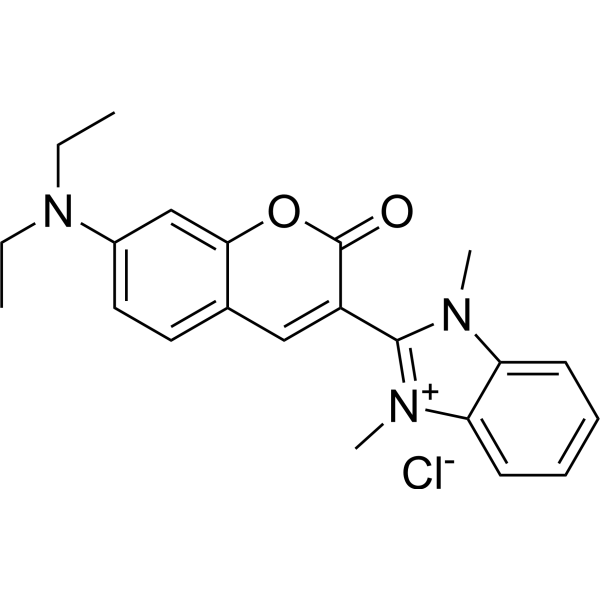
Basic yellow 40
Basic yellow 40 (Coumarin 40) is a heterocyclic cationic dye. Basic yellow 40 is mainly used for dyeing acrylic textiles and for fingerprint development. Basic yellow 40 exhibits a UV-Vis absorption maximum at 431 nm.
For research use only. We do not sell to patients.
- CAS No.: 29556-33-0
- Formula: C22H24ClN3O2
- Molecular Weight:397.90
-
Storage:
Please store the product under the recommended conditions in the Certificate of Analysis.

To place orders, for customer services and technical support, please contact: MedChemExpress USA
Tel: 609-228-6898 E-mail: [email protected] [email protected]


-
 Biological Activity
-
Chemical Information
- Purity & Documentation
- References
-
 Help & FAQs




Biological Activity
Description
In Vitro
2. Working solution preparation
2.1 Diluent: water; Basic yellow 40 (BY40; also known as Maxilon Flavine 10GFF; CAS 12221-32-5; molecular formula C20H20ClN3O2; molecular weight 369.84 g/mol) is a water-soluble bright yellow powder.
2.2 Working concentration: prepare BY40 solutions at initial concentrations of 1 to 600 mg L−1, pH = 9, for adsorption tests. For surfactant tests, prepare a 10 mg L−1 BY40 solution.
2.3 Note: adjust the working solution concentration as needed; prepare fresh before use.
3. Staining procedure
3.1 Sample type: use polymeric adsorbent microspheres Mic1, Mic1/AMS, Mic2, or Mic2/AMS; weigh 0.05 g of adsorbent into an Erlenmeyer flask[2].
3.2 Incubation conditions: add 20 mL of BY40 solution at the selected working concentration to the Erlenmeyer flask, place the flask in a mechanical shaker set at an amplitude of 8 and 150 cycles per minute, and shake at room temperature for 24 h. For surfactant tests, use 10 mg L−1 BY40 with 0.1-0.5 g L−1 CTAB or SDS, with a contact time of 15 min, then separate the solution by filtration.
4. Controls
4.1 Blank: determine the BY40 concentration against a blank at 431 nm.
4.2 Surfactant-free control: compare adsorption in the presence of CTAB or SDS with BY40 adsorption without these additives.
5. Detection and analysis
5.1 Instrument type: use a single-beam UV-visible spectrophotometer.
5.2 Wavelength setting: measure absorbance at the maximum wavelength of 431 nm.
5.3 Calibration: determine the BY40 concentration from a calibration curve established in the 0.1-20 mg L−1 range with a coefficient of determination of 0.998, using a 1 cm quartz cuvette, a slit width of 1 mm, and an integration time of 1 s.
5.4 Result analysis: calculate the adsorption capacity q_e using q_e = (C0 − Ce) V/m, where C0 and Ce are the initial and equilibrium concentrations of BY40 (mg L−1), respectively, V is the volume of BY40 solution (L), and m is the mass of adsorbent (g). For surfactant tests, calculate q_t using q_t = (C0 − Ct) V/m, where Ct is the BY40 concentration after a specific adsorption time t. Equilibrium data can be fitted to isotherm models such as Freundlich, Langmuir, Temkin, and Dubinin-Radushkevich. The adsorption of BY40 on the studied adsorbents follows the Freundlich isotherm model, and a 1/n value below 1 indicates favorable adsorption.
MedChemExpress (MCE) has not independently confirmed the accuracy of these methods. They are for reference only.


Chemical Information
-
CAS No. 29556-33-0
-
Molecular Weight 397.90
-
Formula C22H24ClN3O2
-
SMILES
C[N+]1=C(C2=CC3=CC=C(N(CC)CC)C=C3OC2=O)N(C)C4=CC=CC=C14.[Cl-]
-
Synonyms
Coumarin 40
-
Shipping
Room temperature in continental US; may vary elsewhere.
-
Storage
Please store the product under the recommended conditions in the Certificate of Analysis.


Purity & Documentation
References

Calculators
Concentration (start) × Volume (start) = Concentration (final) × Volume (final)


Basic yellow 40 Related Classifications
HY-D1129 Related Classifications
 Powered by Bioz
Keywords
- Basic yellow 40
- 29556-33-0
- Coumarin 40
- Basic yellow40
- Basic yellow-40
- Coumarin40
- Coumarin-40
- Fluorescent Dye
- Freundlich isotherm
- acrylic textiles
- adsorption
- cationic dye
- electrostatic attraction
- fingerprint visualization
- heterocyclic
- polymeric adsorbent microspheres
- van der Waals interactions
- π-π stacking
- Inhibitor
- inhibitor
- inhibit