



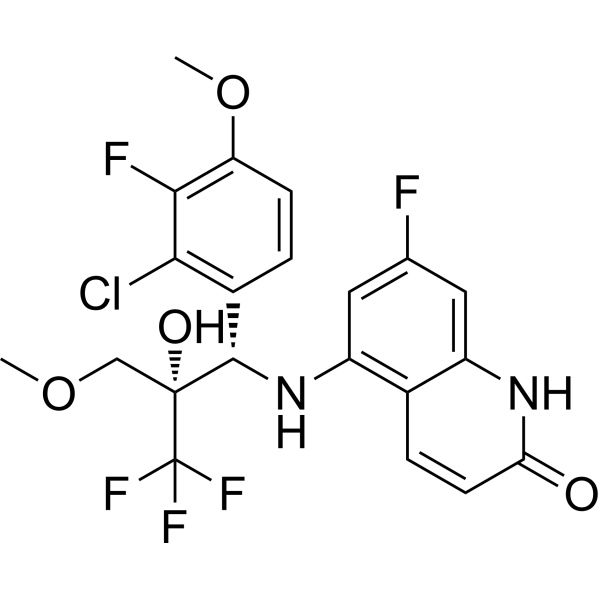
BAY 1003803

Based on 1 Customer Validation
BAY 1003803 is a glucocorticoid receptor agonist for the topical research of psoriasis or severe atopic dermatitis.
For research use only. We do not sell to patients.
- Purity : 99.85%
- CAS No.: 1152781-51-5
- Formula: C21H18ClF5N2O4
- Molecular Weight:492.82
-
Storage:Powder -20°C, 3 years , 4°C, 2 years ; In solvent -80°C, 6 months , -20°C, 1 month

To place orders, for customer services and technical support, please contact: MedChemExpress USA
Tel: 609-228-6898 E-mail: [email protected] [email protected]


-
 Biological Activity
-
Chemical Information
-
Solvent & Solubility
- Protocols
- Purity & Documentation
- References
-
 Help & FAQs




Biological Activity
Description
Cellular Effect
|
Cell Line

|
Type | Value | Description | References |
|---|---|---|---|---|
| PBMC | IC50 |
0.42 nM
Compound: BAY 1003803
|
Inhibition of PHA-induced IL4 release in human PBMC cells
Inhibition of PHA-induced IL4 release in human PBMC cells
|
[PMID: 32631518] |
| PBMC | IC50 |
0.7 nM
Compound: BAY 1003803
|
Inhibition of PHA-induced IFNgamma release in human PBMC cells
Inhibition of PHA-induced IFNgamma release in human PBMC cells
|
[PMID: 32631518] |
| PBMC | IC50 |
0.75 nM
Compound: BAY 1003803
|
Inhibition of LPS-induced IL12p40 release in human PBMC cells
Inhibition of LPS-induced IL12p40 release in human PBMC cells
|
[PMID: 32631518] |
| PBMC | IC50 |
0.88 nM
Compound: BAY 1003803
|
Inhibition of PHA-induced IL2 release in human PBMC cells
Inhibition of PHA-induced IL2 release in human PBMC cells
|
[PMID: 32631518] |
| PBMC | IC50 |
0.92 nM
Compound: BAY 1003803
|
Inhibition of LPS-induced TNFalpha release in human PBMC cells
Inhibition of LPS-induced TNFalpha release in human PBMC cells
|
[PMID: 32631518] |


Chemical Information
-
CAS No. 1152781-51-5
-
Appearance Solid
-
Molecular Weight 492.82
-
Formula C21H18ClF5N2O4
-
Color White to off-white
-
SMILES
FC1=CC(N[C@@H](C2=C(C(F)=C(C=C2)OC)Cl)[C@](C(F)(F)F)(O)COC)=C3C(NC(C=C3)=O)=C1
-
Shipping
Room temperature in continental US; may vary elsewhere.
-
Storage
Powder -20°C 3 years 4°C 2 years In solvent -80°C 6 months -20°C 1 month


Solvent & Solubility
In Vitro:
DMSO : 100 mg/mL (202.91 mM; Need ultrasonic; Hygroscopic DMSO has a significant impact on the solubility of product, please use newly opened DMSO)
Please refer to the solubility information to select the appropriate solvent. Once prepared, please aliquot and store the solution to prevent product inactivation from repeated freeze-thaw cycles.
Storage method and period of stock solution: -80°C, 6 months; -20°C, 1 month. When stored at -80°C, please use it within 6 months. When stored at -20°C, please use it within 1 month.
Please refer to the solubility information to select the appropriate solvent. Once prepared, please aliquot and store the solution to prevent product inactivation from repeated freeze-thaw cycles.
Storage method and period of stock solution: -80°C, 6 months; -20°C, 1 month. When stored at -80°C, please use it within 6 months. When stored at -20°C, please use it within 1 month.
Concentration (start) × Volume (start) = Concentration (final) × Volume (final)
In Vivo:
Select the appropriate dissolution method based on your experimental animal and administration route.
- For the following dissolution methods, please ensure to first prepare a clear stock solution using an In Vitro approach and then sequentially add co-solvents:
- To ensure reliable experimental results, the clarified stock solution can be appropriately stored based on storage conditions. As for the working solution for In Vivo experiments, it is recommended to prepare freshly and use it on the same day.
- The percentages shown for the solvents indicate their volumetric ratio in the final prepared solution. If precipitation or phase separation occurs during preparation, heat and/or sonication can be used to aid dissolution.
Add each solvent one by one: 10% DMSO 40% PEG300 5% Tween-80 45% Saline
Solubility: ≥ 2.5 mg/mL (5.07 mM); Clear solution
This protocol yields a clear solution of ≥ 2.5 mg/mL (saturation unknown).
Taking 1 mL working solution as an example, add 100 μL DMSO stock solution (25.0 mg/mL) to 400 μL PEG300, and mix evenly; then add 50 μL Tween-80 and mix evenly; then add 450 μL Saline to adjust the volume to 1 mL.
Preparation of Saline: Dissolve 0.9 g sodium chloride in ddH₂O and dilute to 100 mL to obtain a clear Saline solution.
In Vivo Dissolution Calculator
Please enter the basic information of animal experiments:
-
-
-
-
Recommended: Prepare an additional quantity of animals to account for potential losses during experiments.
Please enter your animal formula composition:
-
%DMSO +
Recommended: Keep the proportion of DMSO in working solution below 2% if your animal is weak.
-
%+
-
+%Tween-80 + +
-
%Saline +
The co-solvents required include: DMSO, . All of co-solvents are available by MedChemExpress (MCE). , Tween 80. All of co-solvents are available by MedChemExpress (MCE).
Working solution concentration: 0.22 mg/mL
Method for preparing stock solution: mg drug dissolved in μL DMSO. Stock solution concentration: mg/mL.
1. Take μL DMSO stock solution;
2. Add μL .
μL , mix evenly;
3. Then add μL Tween 80, mix evenly;
4. Then add μL
Please ensure that the stock solution in the first step is dissolved to a clear state, and add co-solvents in sequence. You can use ultrasonic heating (ultrasonic cleaner, recommended frequency 20-40 kHz), vortexing, etc. to assist dissolution.

Protocols
-
Imiquimod-Induced Psoriasiform Dermatitis
Imiquimod (IMQ)-induced psoriasiform dermatitis is a widely used murine model in which topical application of IMQ, a Toll-like receptor 7 (TLR7) agonist, triggers innate immune activation in the skin and induces a psoriasis-like inflammatory cascade characterized by epidermal hyperplasia, immune cell infiltration, and cytokine production dominated by the IL-23/IL-17 axis. This inflammatory response is mediated through activation of dendritic cells and downstream induction of IL-23, IL-17A, IL-22, and related pro-inflammatory mediators, recapitulating key features of human plaque psoriasis and enabling mechanistic and therapeutic studies. The model is commonly induced using Aldara (5% IMQ cream) applied topically to murine skin, resulting in rapid onset of erythema, scaling, and thickening that can be quantified as disease severity indices and validated histologically.
-
Research Protocol for Endocrine Diseases
Endocrine diseases often arise from disrupted hormone production, hormone signaling, or target-tissue responsiveness; for diabetes-focused endocrine disease models, insulin signaling regulates glucose uptake, hepatic glucose output, lipid metabolism, and β-cell compensation. Type 2 diabetes develops through interacting defects in insulin resistance, β-cell dysfunction, adipose inflammation, hepatic glucose overproduction, altered incretin signaling, and ectopic lipid metabolism. A major unresolved question is whether endocrine dysfunction is driven primarily by target-tissue insulin resistance, intrinsic β-cell failure, immune/inflammatory stress, or combined multi-organ failure that differs by disease stage.
-
TPA/Croton Oil Ear Edema and Dermatitis
The TPA (12-O-tetradecanoylphorbol-13-acetate) and croton oil-induced mouse ear edema model is a well-established acute cutaneous inflammation system used to evaluate topical anti-inflammatory activity by measuring edema formation, neutrophil infiltration, vascular permeability, and cytokine-mediated skin responses in vivo. The inflammatory response is triggered by topical application of phorbol esters (TPA) or croton oil constituents, leading to rapid activation of protein kinase C signaling, leukocyte recruitment, and increased vascular permeability, which can be quantified by ear thickness, weight, dye extravasation, and biochemical markers such as myeloperoxidase (MPO) activity and pro-inflammatory mediators in ear tissue homogenates. This model is widely used for screening anti-inflammatory agents, where reductions in edema and inflammatory biomarkers reflect suppression of acute dermal inflammation and immune cell infiltration. Histological evaluation typically confirms epidermal


Purity & Documentation
-
Data Sheet (275 KB)
-
SDS (418 KB)
- English - EN (418 KB)
- Français - FR (418 KB)
- Deutsch - DE (418 KB)
- Norwegian - NO (418 KB)
- Español - ES (418 KB)
- Swedish - SV (418 KB)
- Italian - IT (418 KB)
- Korean - KR (418 KB)
- Portuguese - PT (418 KB)
-
Handling Instructions (2659 KB)
References


Complete Stock Solution Preparation Table
Please refer to the solubility information to select the appropriate solvent. Once prepared, please aliquot and store the solution to prevent product inactivation from repeated freeze-thaw cycles.
Storage method and period of stock solution: -80°C, 6 months; -20°C, 1 month. When stored at -80°C, please use it within 6 months. When stored at -20°C, please use it within 1 month.
| Optional Solvent | Concentration Solvent Mass | 1 mg | 5 mg | 10 mg | 25 mg |
|---|---|---|---|---|---|
| DMSO | 1 mM | 2.0291 mL | 10.1457 mL | 20.2914 mL | 50.7285 mL |
| 5 mM | 0.4058 mL | 2.0291 mL | 4.0583 mL | 10.1457 mL | |
| 10 mM | 0.2029 mL | 1.0146 mL | 2.0291 mL | 5.0728 mL | |
| 15 mM | 0.1353 mL | 0.6764 mL | 1.3528 mL | 3.3819 mL | |
| 20 mM | 0.1015 mL | 0.5073 mL | 1.0146 mL | 2.5364 mL | |
| 25 mM | 0.0812 mL | 0.4058 mL | 0.8117 mL | 2.0291 mL | |
| 30 mM | 0.0676 mL | 0.3382 mL | 0.6764 mL | 1.6909 mL | |
| 40 mM | 0.0507 mL | 0.2536 mL | 0.5073 mL | 1.2682 mL | |
| 50 mM | 0.0406 mL | 0.2029 mL | 0.4058 mL | 1.0146 mL | |
| 60 mM | 0.0338 mL | 0.1691 mL | 0.3382 mL | 0.8455 mL | |
| 80 mM | 0.0254 mL | 0.1268 mL | 0.2536 mL | 0.6341 mL | |
| 100 mM | 0.0203 mL | 0.1015 mL | 0.2029 mL | 0.5073 mL |


BAY 1003803 Related Classifications
HY-145351 Related Classifications
 Powered by Bioz